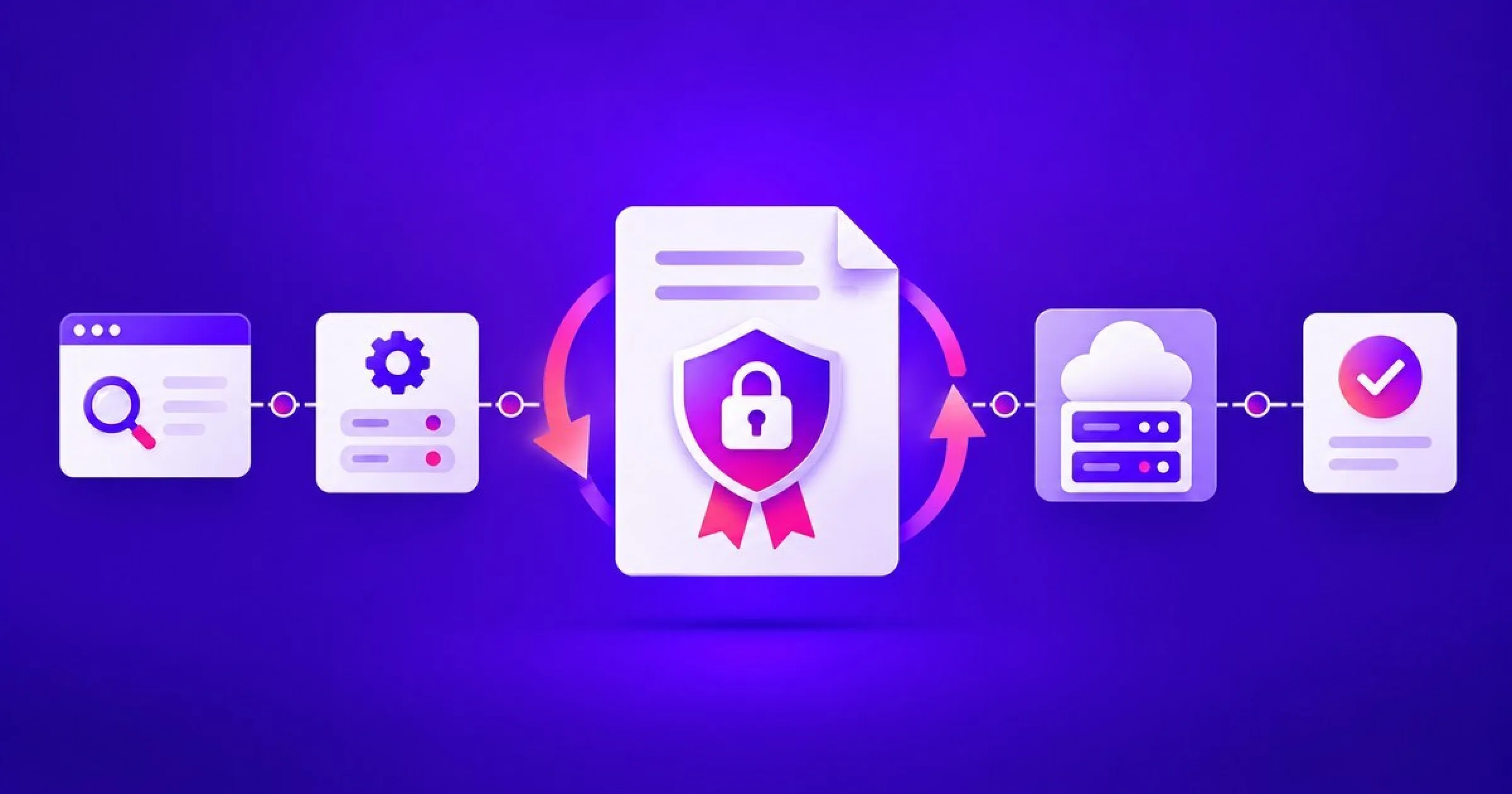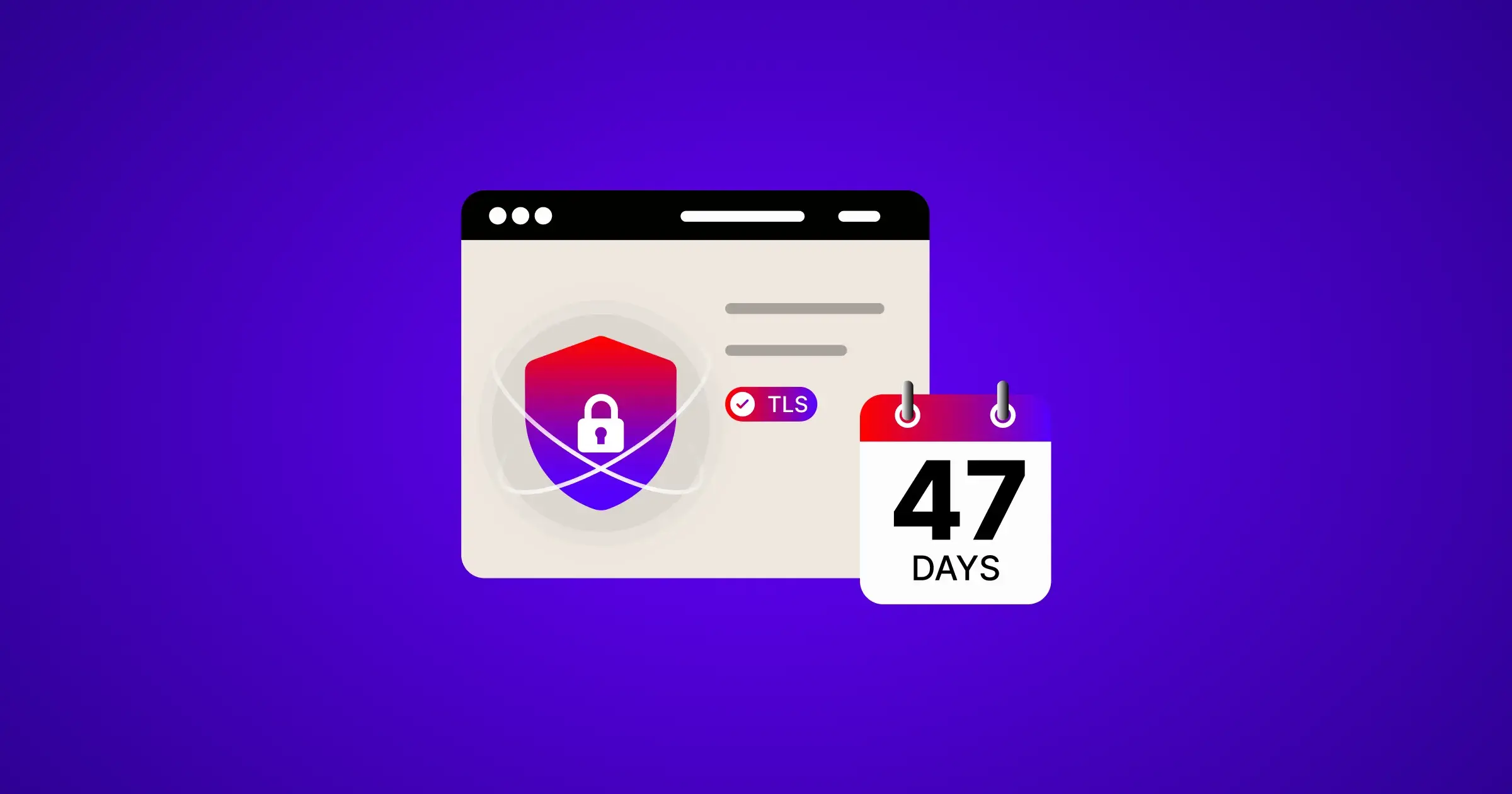


Automated certificate lifecycle management (CLM) uses software to find, issue, install, and renew the digital certificates that keep your websites and internal services trusted. Public TLS certificates will be limited to 47 days by March 2029.
AppViewX, which makes CLM software, wrote this guide. It explains each stage of the certificate lifecycle, what automation takes over at each step, and how companies move from manual tracking to automated management.
Key takeaways
- Automated certificate lifecycle management works by having software discover certificates, issue them against company policy, deploy and verify them, then renew or revoke them as needed.
- Each lifecycle stage has manual steps that software can handle, from discovery through revocation.
- A few open standards let a CLM platform request and renew certificates for most kinds of systems.
- Companies usually begin with an inventory and a small renewal pilot, then expand to installation and security rules.
Why certificate automation matters
Shorter certificate lifespans
The CA/Browser Forum sets the rules that public certificate authorities (CAs) follow, and it is cutting certificate lifespans in stages. Since March 15, 2026, public TLS certificates can last at most 200 days, falling to 100 days in March 2027 and 47 days in March 2029, when each certificate will need replacing roughly eight times a year.
Growing certificate volumes
Cloud workloads, containers, and APIs often carry their own certificates, and the count rises with each new service. Kubernetes adds to that count, and 82% of container users now run it in production, according to the Cloud Native Computing Foundation (CNCF).
Manual errors and staff time
A manual renewal means finding the certificate, creating a request, waiting on the CA, and installing the result by hand. Each step is a chance for a mistyped hostname or a renewed certificate that never gets installed. In a Forrester Total Economic Impact (TEI) study commissioned by AppViewX, automation cut the staff effort per renewal from about 30 minutes to about 15 seconds.
Compliance and audit pressure
Since March 31, 2025, PCI DSS has required companies that handle card data to keep an inventory of the keys and certificates that protect cardholder data in transit. An automated platform produces that record on demand.
Post-quantum readiness
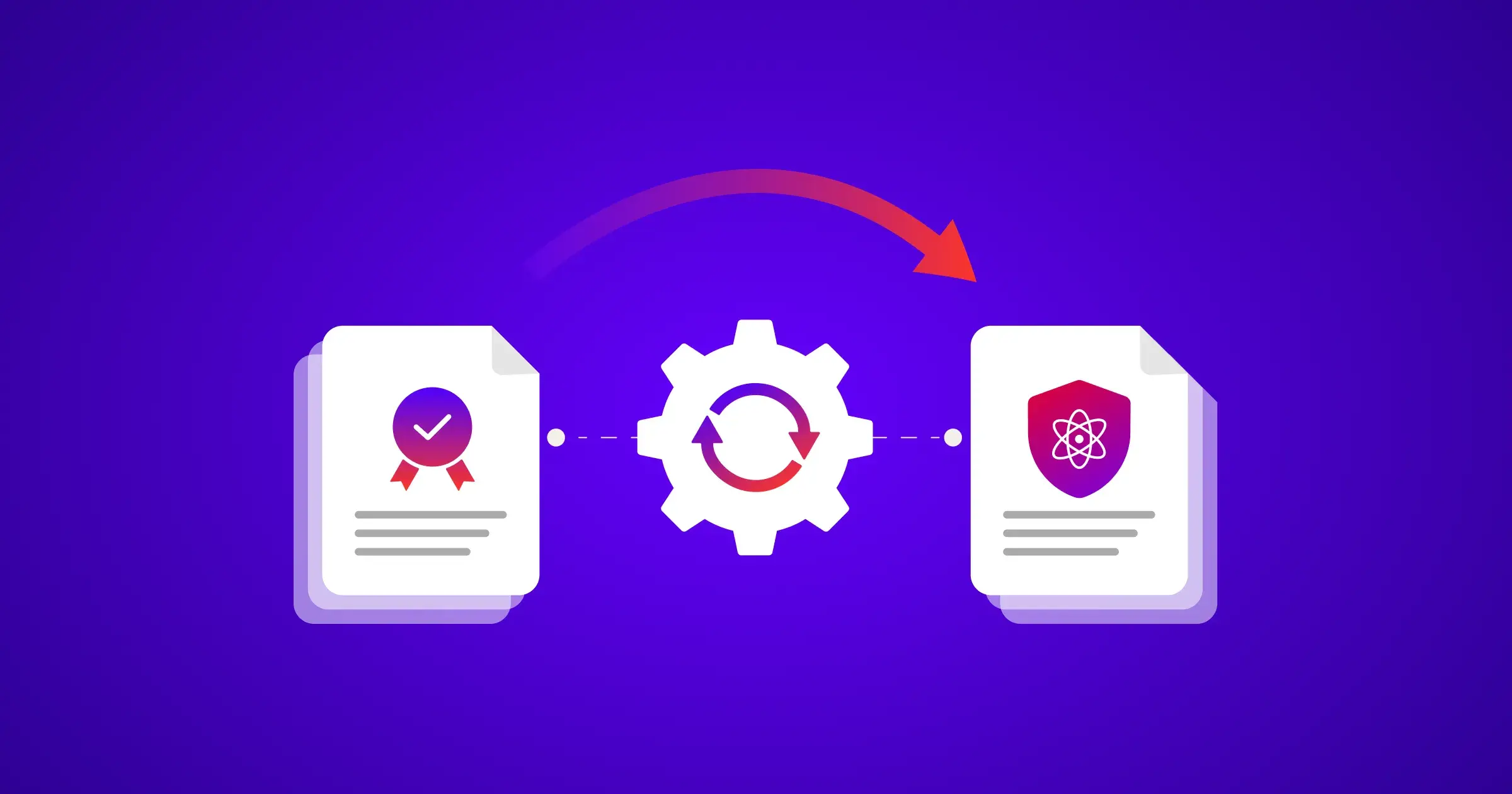
In October 2026, NIST finalized its plan to deprecate quantum-vulnerable algorithms such as RSA after 2030 and disallow them after 2035. Moving thousands of certificates to new algorithms becomes practical once issuance and deployment already run automatically. Teams in that position can switch algorithms through their existing workflows as their CAs adopt the new standards.
The certificate lifecycle stages
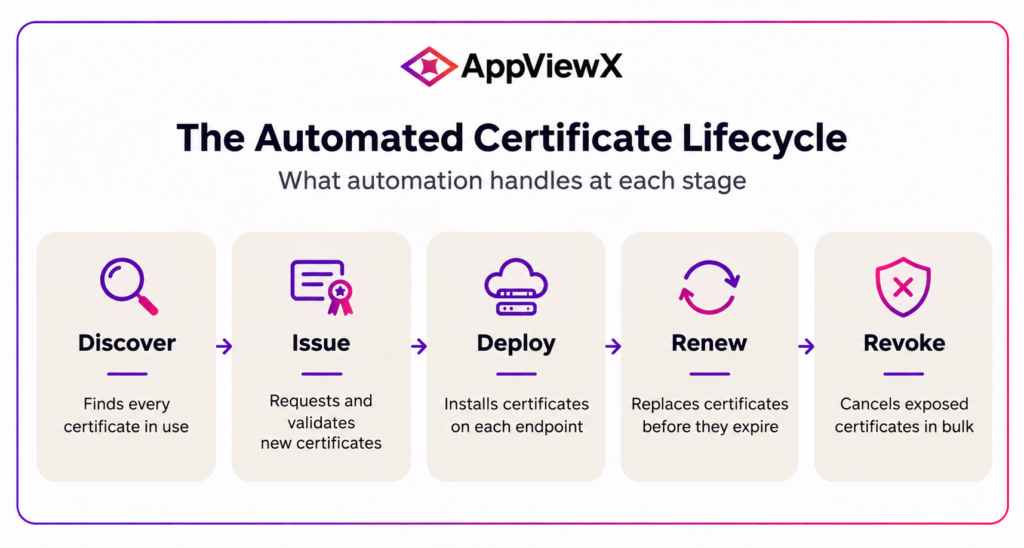
A certificate can move through up to five stages, from the day it is found or requested to the day it expires or is retired.
1.Discovery
Teams start by locating the certificates in use, including ones nobody remembers issuing. Discovery tools scan networks and cloud accounts on a schedule and flag anything new. Scans also catch certificates bought outside approved channels, such as one a developer paid for with a company card. Agentless discovery scans without installing anything on each server.
2.Issuance
Issuance means requesting a certificate from a CA and proving you control the domain or system it covers. Automation creates the key pair, submits the request, and completes domain control validation. It also checks each request against company policy before anything is issued. For internal systems, the request can go to a private CA, run in-house or as a hosted service.
3.Deployment
Deployment installs the new certificate on the server, load balancer, or application that uses it. Each platform has different steps, and this stage often takes the most manual effort. Automated platforms push certificates to endpoints and bind them to load balancers. After installation, the platform confirms that the service is presenting the new certificate. A single certificate often covers a shared load balancer or API gateway, and keeping it current protects each service behind it.
4.Renewal
Renewal replaces a certificate before it expires, with automation tracking each expiry date so the new certificate is live in time. Most teams start renewal once a certificate has used about two-thirds of its lifetime, leaving time to retry if a CA responds slowly. AppViewX covers this stage in more depth in its guide to SSL certificate renewal.
5.Revocation
A certificate is revoked before its expiry date when its private key is exposed, or the system it protected is retired. Automated platforms can revoke and replace affected certificates in bulk, a capability that matters when one incident touches hundreds of certificates at once.
Table 1. Manual vs automated certificate management
| Stage | Manual approach | Automated with AppViewX |
| Discovery | Lists pulled from each CA and server | Smart Discovery scans on a schedule |
| Issuance | Ticket raised, request created by hand | Request generated, checked against policy, and validated by the CA |
| Deployment | Admin logs in to each endpoint | Closed-loop automation installs and verifies |
| Renewal | Calendar reminders and spreadsheets | Renewal workflows run before expiry |
| Revocation | Certificates located and replaced one by one | Affected certificates replaced through the same workflow |
Source: AppViewX analysis.
Run AppViewX’s free SSL/TLS certificate scan to
find out which public certificates you have today.
Certificate automation protocols
Automation works across so many systems because CAs and certificate tools share a few open standards. Each one fits a different kind of system:
- ACME (Automatic Certificate Management Environment) handles web servers and cloud applications. The ACME standard lets software request and renew certificates automatically.
- EST (Enrollment over Secure Transport) handles internal systems and newer devices. Devices use the EST standard to enroll for certificates over an encrypted connection.
- SCEP (Simple Certificate Enrollment Protocol) handles network gear and company-managed phones and laptops. The older SCEP standard is still built into many of those devices.
A CLM platform that supports all three can automate certificates for web servers, internal systems, and managed devices.
What to expect from automated CLM
Forrester’s TEI study found a 302% return on investment over three years for a composite AppViewX customer organization. In AppViewX’s experience, much of that value comes from faster certificate requests, as developers use self-service and receive certificates within minutes.
Most automation projects also run into the same four obstacles. Planning for them early keeps the rollout on schedule:
- Legacy systems: Older appliances may lack an API or ACME support and need custom connectors or scripted installs.
- Unclear ownership: Certificates with no named owner stall when a renewal needs someone’s approval.
- Change windows: Many production systems accept changes only at set times, and renewals have to be scheduled around them.
- Several CAs: Each CA has its own request format, and the platform has to handle all of them consistently.
How to automate certificate management
Most companies phase automation in over a few months. Before choosing a platform, check it against the must-have CLM requirements for your environment.
Build an inventory
Start with a full discovery scan and assign an owner to each certificate it turns up. Record the issuing CA, expiry date, and installed location for every certificate, since those details decide which ones to automate first.
Start with low-risk renewals
Pick a group of low-risk certificates, such as those on internal test systems, and automate their renewal first. Running the process there builds confidence before it reaches customer-facing services. Track how many renewals complete without intervention, and use that rate to decide when to expand.
Connect your CAs
Link the platform to every public and private CA you use. Requests and renewals then flow through those connections, and a second CA gives you a fallback if the first has an outage. A CA-agnostic platform also lets you switch providers if prices or policies change, a capability often called CA-agility.
Automate deployment
Once renewals run on their own, extend automation to installing certificates wherever they run, Kubernetes clusters included. Start with systems that have standard installers, such as common web servers and cloud services, then add custom scripts for older equipment. Schedule each install inside that system’s change window, and keep a rollback step ready in case a service fails to load the new certificate.
Enforce policy
Set rules for key strength, approved CAs, and validity that apply to every request. A policy engine applies those rules automatically and flags anything that breaks them before it reaches production.
Automated CLM with AppViewX
AppViewX CLM covers each stage described above. Smart Discovery keeps the certificate inventory current, and closed-loop automation handles renewal and installation end to end.
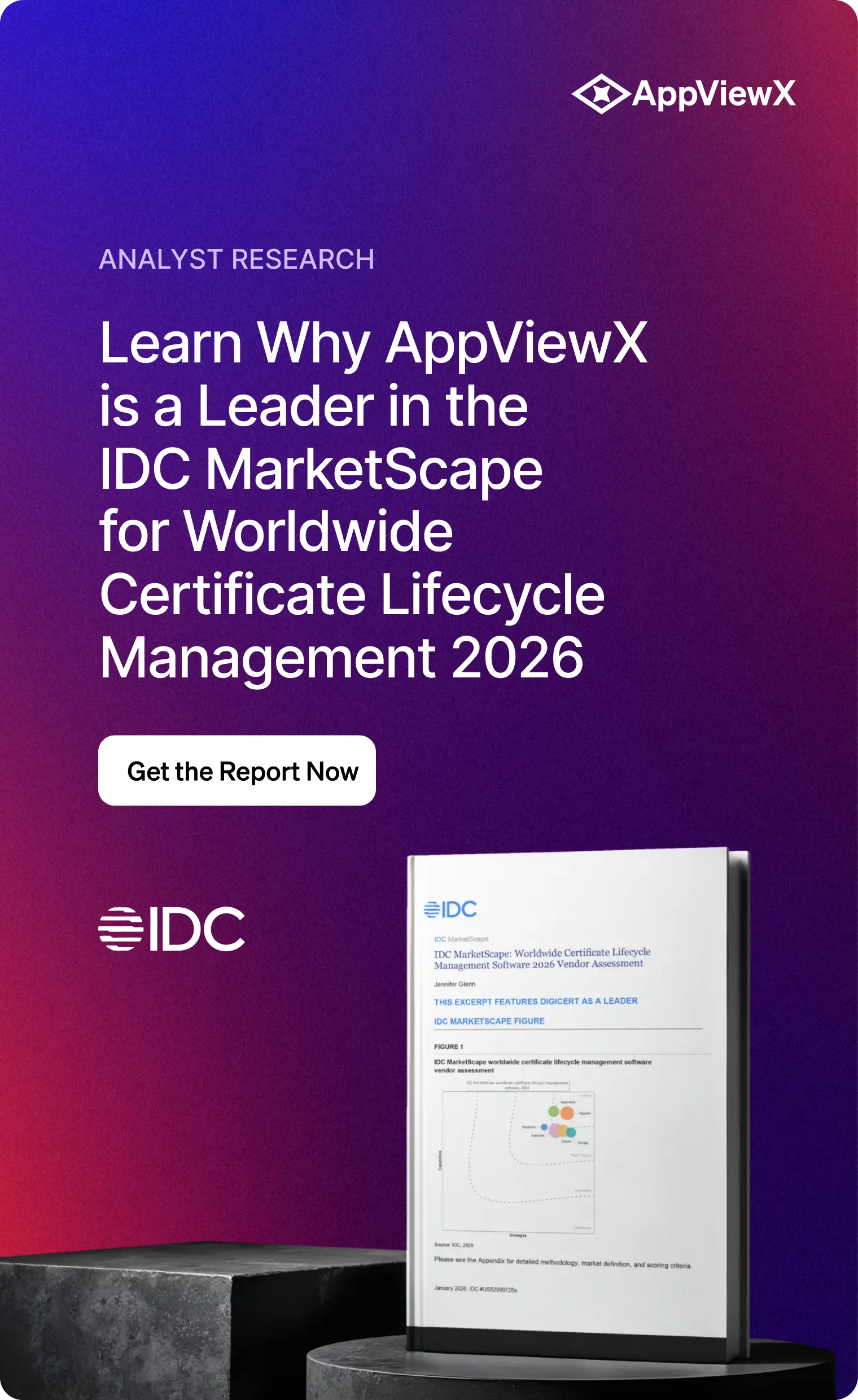
The platform also lets teams reissue certificates with new algorithms through its post-quantum cryptography readiness tools. AppViewX was named a Leader in the 2026 IDC MarketScape for worldwide CLM software.

Disclaimer: Facts checked 12th November 2026. Industry deadlines and product features change often and should be confirmed before acting on them.
Frequently asked questions
1.What is domain control validation?
Domain control validation (DCV) is how a CA confirms you control the domain on a certificate request, usually by checking a DNS record or a file placed on your web server. ACME clients complete these challenge types automatically.
2.Can automation cover Kubernetes certificates?
AppViewX’s Kubernetes container security tracks certificates inside clusters alongside the rest of your inventory. Many clusters already run cert-manager, an open-source tool, and CNCF user research suggests 86% of new production clusters deploy it as standard practice.
3.Does ACME only work with Let’s Encrypt?
ACME works with many CAs beyond Let’s Encrypt. Common ACME clients such as Certbot can act as a client for any CA that supports the protocol, including commercial and private CAs.
Sources
- CA/Browser Forum, Ballot SC-081v3 (April 11, 2025): https://cabforum.org/2025/04/11/ballot-sc081v3-introduce-schedule-of-reducing-validity-and-data-reuse-periods/
- AppViewX, Why credit unions need better certificate management: https://www.appviewx.com/blogs/why-credit-union-needs-better-certificate-management/
- CNCF, Annual Cloud Native Survey report: https://www.cncf.io/reports/the-cncf-annual-cloud-native-survey/
- AppViewX, Total Economic Impact study news release (March 12, 2026): https://www.appviewx.com/news/with-march-15-ca-browser-forum-deadline-looming-total-economic-impact-study-quantifies-benefits-of-automating-certificate-lifecycle-management/
- AppViewX, Decoding the PCI DSS v4.0 cryptographic requirements: https://www.appviewx.com/blogs/decoding-the-pci-dss-v4-0-cryptographic-requirements/
- Cloud Security Alliance, NIST IR 8547 Final: Post-Quantum Deadlines Become Vendor Requirements (October 30, 2026): https://labs.cloudsecurityalliance.org/research/csa-research-note-nist-ir8547-pqc-transition-20261030-csa-st/
- AppViewX, Agent vs agentless deployment for CLM: https://www.appviewx.com/blogs/agent-vs-agentless-which-deployment-to-choose-for-certificate-lifecycle-management/
- AppViewX, Simplifying automation of certificate binding to load balancing applications: https://www.appviewx.com/blogs/simplifying-automation-of-certificate-binding-to-load-balancing-applications/
- AppViewX, How to automate SSL certificate renewal: https://www.appviewx.com/blogs/how-to-automate-ssl-certificate-renewal/
- AppViewX, Free SSL/TLS certificate scan: https://www.appviewx.com/free-ssl-tls-certificate-scan/
- IETF, RFC 8555: Automatic Certificate Management Environment (ACME): https://datatracker.ietf.org/doc/html/rfc8555
- IETF, RFC 7030: Enrollment over Secure Transport: https://datatracker.ietf.org/doc/html/rfc7030
- IETF, RFC 8894: Simple Certificate Enrolment Protocol: https://datatracker.ietf.org/doc/html/rfc8894
- Forrester, The Total Economic Impact of the AppViewX Platform (commissioned by AppViewX, February 2026): https://tei.forrester.com/go/appviewx/certificatelifecyclemanagement
- AppViewX, Certificate lifecycle management requirements: https://www.appviewx.com/blogs/certificate-lifecycle-management-requirements/
- AppViewX, CA-agnostic vs CA-native CLM: https://www.appviewx.com/blogs/ca-agnostic-vs-ca-native-clm/
- AppViewX, Policy engine: https://www.appviewx.com/blogs/appviewx-policy-engine/
- AppViewX, Certificate lifecycle management software: https://www.appviewx.com/products/certificate-lifecycle-management-software/
- AppViewX, Smart Discovery: https://www.appviewx.com/solutions/clm-smart-discovery/
- AppViewX, Closed-loop automation: https://www.appviewx.com/solutions/clm-closed-loop-automation/
- AppViewX, Crypto-agility and post-quantum cryptography readiness: https://www.appviewx.com/solutions/crypto-agility-and-post-quantum-cryptography-readiness/
- AppViewX, IDC MarketScape for CLM: https://www.appviewx.com/idc-marketscape-on-certificate-lifecycle-management/
- Let’s Encrypt, Challenge types: https://letsencrypt.org/docs/challenge-types/
- AppViewX, Kubernetes container security: https://www.appviewx.com/solutions/kubernetes-container-security/
- CNCF, cert-manager graduation announcement (November 12, 2024): https://www.cncf.io/announcements/2024/11/12/cloud-native-computing-foundation-announces-cert-manager-graduation/
- Certbot, GitHub repository: https://github.com/certbot/certbot
Tags
About the Author