

From March 15, 2027, certificate authorities (CAs) in Chrome’s root program may issue public TLS certificates for server authentication only. Because public certificates are capped at 200 days, the last one able to authenticate a client will expire by September 30, 2027.
Enterprise PKI is the CA hierarchy an organization runs for its own trust, in-house or as a managed service. VPN and Wi-Fi logins that rely on publicly trusted client certificates will need a new issuer, such as a private CA or another hierarchy outside Chrome’s root program.
NIST’s final transition plan, published October 27, 2026, deprecates RSA and elliptic-curve cryptography after 2030 and disallows both under NIST standards and guidelines after 2035. The plan expects classical and post-quantum PKIs to run side by side during migration.
Key takeaways
- An enterprise PKI lets an organization issue and revoke certificates for its own users and machines, run on internal servers or by a provider. Its role grows in 2027, when public TLS certificates stop covering client authentication, moving VPN and Wi-Fi logins to privately issued certificates.
- A two-tier hierarchy with an offline root suits a first deployment, as long as every CA key sits in a validated HSM.
- Governance gives every certificate an accountable owner and puts a second approver on any CA change. Payment card and EU financial rules also require a maintained certificate inventory.
- Federal contracts and national roadmaps can move post-quantum deadlines for private organizations ahead of 2035.
How trust flows in a private CA hierarchy
IT teams install an enterprise PKI’s root in their own trust stores through group policy, mobile device management (MDM), or application bundles. Devices and applications outside that distribution never receive the root and don’t trust what it signs.
A person or machine submits a public key and identity details through an enrollment protocol. The registration authority (RA) checks the request against policy. An issuing CA then signs a certificate from a template that fixes the key type, validity, and permitted uses. Relying systems build the chain back to the root and check revocation status before trusting it.
A first hierarchy is easier to plan after watching one run end to end.
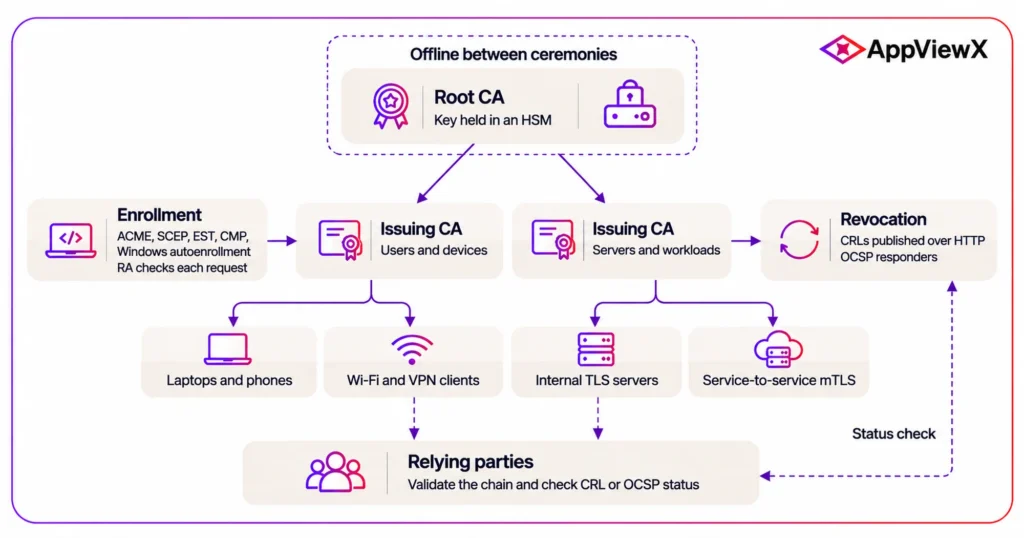
Figure 1. A two-tier enterprise PKI, from enrollment to status checks.

Core components: CAs, HSMs, policy, and services
Request for Comments (RFC) 5280, an Internet Engineering Task Force (IETF) standard, defines the X.509 certificate format that CAs and relying systems share.
Root and issuing CAs
The root CA is the trust anchor at the top of the hierarchy. Issuing CAs, also called subordinate or intermediate CAs, sign the certificates that users, devices, and services present. Chrome’s root program limits a public root to 15 years from key generation, and the same ceiling suits a private root.
Hardware security modules
A hardware security module (HSM) is a tamper-resistant device that stores CA private keys and signs with them inside the hardware. NIST scheduled every Federal Information Processing Standard (FIPS) 140-2 validation to move to its Historical list in September 2026. Modules on that list can serve existing systems only. Ask vendors when their modules will support the Module-Lattice-Based Digital Signature Algorithm (ML-DSA), the FIPS 204 post-quantum signature standard, before choosing an HSM model.
Certificate policy and practice statement
The certificate policy (CP) defines what certificates exist, who may hold them, how identity is checked, and how keys are protected. The certification practice statement (CPS) explains how each CA meets that policy. Both documents follow the RFC 3647 outline.
Enrollment and revocation services
Enrollment protocols carry requests to the issuing CAs: Automatic Certificate Management Environment (ACME) for web and application servers, Simple Certificate Enrollment Protocol (SCEP) and Enrollment over Secure Transport (EST) for MDM-managed devices, Certificate Management Protocol (CMP) for network equipment, and Windows autoenrollment for domain-joined machines. A certificate revocation list (CRL) is a signed list of revoked certificates published over HTTP. The Online Certificate Status Protocol (OCSP) answers status queries one certificate at a time.
How to design the CA hierarchy
Public CAs operate under the CA/Browser Forum’s Baseline Requirements, and a private PKI can borrow those audited controls.
Table 1. Enterprise PKI design decisions
| Decision | Start with | Go further when |
| Hierarchy depth | Two tiers, a root and online issuing CAs | Business units, regions, or assurance levels need separate policy CAs |
| Root operation | Offline, signing only CA certificates and CRLs in scripted, logged ceremonies that an authorized operator runs by hand | Auditors want a witness or video record, or a site loss must not force a root rebuild (offsite backup HSM) |
| Key protection | Every CA key in an HSM validated to FIPS 140-3 Level 3 | Regulators examine key custody (dedicated or customer-held HSMs) |
| Issuing CA scope | One issuing CA per purpose, such as client authentication, servers and workloads, or code signing | Revoking one CA must not reach other regions or tenants |
| Revocation | CRLs on highly available HTTP endpoints, republished within 24 hours of a revocation | VPN, Wi-Fi, or logon checks status in real time and needs OCSP served from several regions |
Teams that run Active Directory Certificate Services (AD CS) or another CA in-house buy and operate the HSMs, servers, revocation endpoints, and recovery site themselves. PKI-as-a-Service (PKIaaS) hands that infrastructure to a provider. If your team opts for a service, AVX PKI (now generally available) provisions CAs through a virtual key ceremony and issues hybrid composite certificates.
AVX PKI issues post-quantum certificates only from its built-in CA. Clients that fail closed on OCSP checks need response caching or an on-premise deployment.
Enterprise PKI vs public PKI and certificate management
Under Apple’s Certificate Transparency (CT) policy, Apple platforms trust a public TLS certificate only when it carries signed timestamps from approved public logs. Domain owners can search those logs for certificates issued in their name. For private CAs, certificate lifecycle management (CLM) software keeps an inventory of each certificate and its owner.
Table 2. Enterprise PKI, public PKI, and CLM compared
| Enterprise PKI | Public PKI | CLM | |
| What it is | Private CAs for the organization’s own users and machines | CAs whose roots browser and operating system vendors ship | Software that finds, tracks, renews, and installs certificates |
| Who sets the rules | The organization, through its CP and CPS | Browser root programs and the CA/Browser Forum | The organization, through policies applied across every CA |
| Issues certificates | Yes, for identities the organization controls | Yes, for domains that pass public validation | No, it requests them from CAs |
When an organization needs its own CA
A private CA fits certificates for anything the organization manages directly, such as MDM-enrolled laptops and phones, employees signing in with smart cards, internal servers that never face the internet, Internet of Things (IoT) and operational technology (OT) devices, and internally signed code.
Public websites and APIs belong with a public CA and automated renewal. A single-cloud estate can usually run on its provider’s managed private CA.
What PKI governance covers
A policy authority drawn from security, IT, and compliance approves the CP and every exception. Changes by CA administrators need a second person’s approval. Key custodians each hold one share of the credentials that activate a CA key. Each certificate has an owner accountable for its renewal and revocation.
Audit evidence comes from issuance and revocation logs stored outside the CA, a CPS that matches the live configuration, approved templates, and a record of each key ceremony.
The Payment Card Industry Data Security Standard (PCI DSS) v4.0.1 has required an inventory of the trusted keys and certificates that protect card data in transit (Requirement 4.2.1.1) and a yearly cipher suite and protocol review (Requirement 12.3.3) since March 31, 2025. The EU’s Digital Operational Resilience Act (DORA) technical standards require financial entities to keep a current register of certificates and certificate-storing devices for systems supporting critical or important functions, and to renew certificates before they expire.
Joint guidance from Australian and US cybersecurity agencies and their partners names AD CS compromise and the Golden Certificate technique in its list of 17 common Active Directory attacks. Protect issuing CA servers and their HSM credentials as carefully as domain controllers.
AVX CLM discovery inventories public and private certificates from any CA, including where each one is deployed and which CA issued it. On the issuing side, AVX PKI turns an uploaded CPS into reusable CA policies. For a single CA with a few hundred certificates, the CA’s own reports and a scheduled network scan can cover the same ground.
Post-quantum deadlines by jurisdiction
Governments have layered migration dates on top of NIST’s algorithm timetable, with 26 experts in a 2025 Global Risk Institute survey putting the average chance of a cryptographically relevant quantum computer within 10 years at 28% to 49%. Contracts and regulators pass these dates to private organizations. Migration plans should follow the earliest date that applies.
Table 3. Post-quantum migration dates by jurisdiction
| Jurisdiction | Milestones | Source |
| United States, federal | High value assets (HVAs) and high impact systems adopt post-quantum key establishment by December 31, 2030, and post-quantum signatures by December 31, 2031. The order also directs the Federal Acquisition Regulatory Council (FAR Council) to propose, within 180 days, a rule requiring covered contractors to meet NIST’s post-quantum standards by the same 2030 date. | Executive Order 14412 |
| European Union | Member states start by the end of 2026, migrate high-risk use cases by the end of 2030, and complete medium-risk use cases by 2035. | EU roadmap and AppViewX’s summary |
| United Kingdom | Discovery and an initial plan by 2028, highest-priority migrations by 2031, and full migration by 2035. | NCSC timelines |
How CA terms meet the 2035 cutoff
Classical CAs created now need terms of nine years or less to expire before the 2035 cutoff. A 5-year issuing CA meets that limit, expiring in late 2031. Roots planned for 15 or 20 years need a retirement date in the CP or a post-quantum successor in place before 2036.
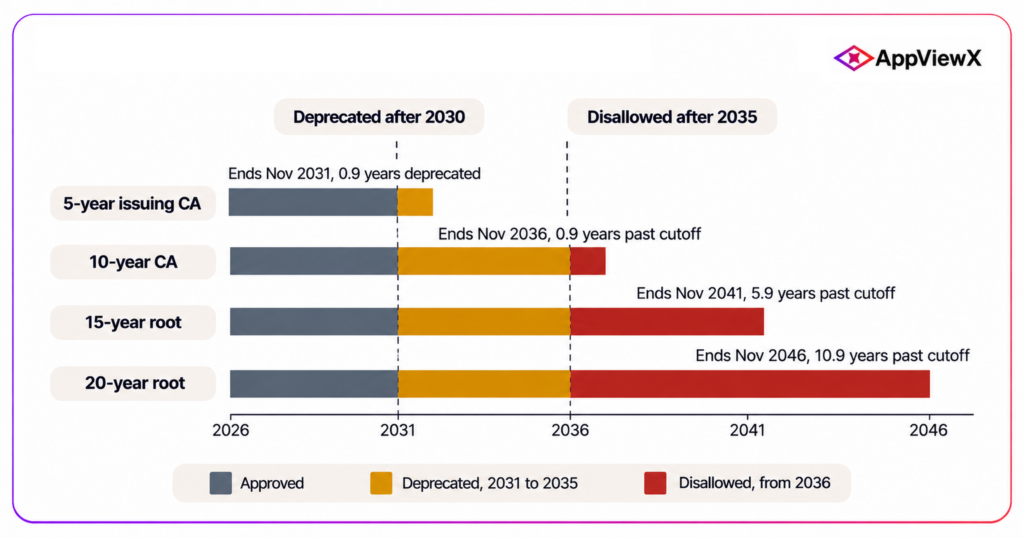
Figure 2. Validity of classical CA certificates created November 10, 2026, by term length.
AppViewX’s post-quantum readiness guide for PKI teams phases the work as cryptographic visibility, hybrid cryptography, and migration. A test hierarchy for internal services that already renew automatically fits the hybrid phase.
Getting started with AppViewX
Your team can modernize a private PKI one step at a time:
- Inventory every CA your systems trust, including AD CS servers, cloud-managed CAs, and roots baked into device images. AVX CLM discovery covers private CAs, and a free SSL/TLS scan from AppViewX reports the public certificates tied to your domain within one business day.
- Refresh the CP and CPS, and map each control to the requirements you answer to, such as PCI DSS or DORA.
- Shortlist private CA platforms with the PKI management platforms comparison.
- Reissue client-authentication certificates from a private issuing CA, starting with the systems that renew soonest.
- Plan any AD CS exit around the guided migration wizard, available now in the Summer 2026 release of AVX PKI.
PacificSource, a not-for-profit health insurer, once issued certificates by hand from an internal private CA and a public CA, with no standard process. AVX CLM now manages certificates from both CAs, more than 1,500 in all, and has cut the IT team’s lifecycle work by 97%. One deployment of 35 certificates across dozens of servers dropped from a full day to 15 minutes. An AppViewX architect can show how AVX CLM would handle your private CA certificates the same way.

Disclaimer: Sources and dates checked November 12, 2026. Standards, deadlines, and product details change. Confirm current versions with each source before acting.
Frequently asked questions
1. Is Microsoft AD CS an enterprise PKI?
Yes. AD CS is the Windows Server role for running private CAs, and Microsoft’s documentation describes enterprise and standalone CA types. Enterprise CAs integrate with Active Directory for templates and autoenrollment. Standalone CAs run without Active Directory membership and suit an offline root.
2. What happens if a root CA private key is compromised?
All certificates under that root become untrustworthy, because an attacker can sign certificates that relying parties accept. Recovery means generating a new root, distributing it to every trust store, reissuing all subordinate CA and end-entity certificates, and removing the old root from every device.
3. Does Chrome’s 2027 change affect certificates from an enterprise PKI?
No. Chrome’s root program policy governs CAs whose roots Chrome trusts for TLS, and it states that it does not apply to enterprise CAs. Your own issuing CAs can keep signing client-authentication certificates after March 15, 2027, as long as the systems that rely on them trust your root.
Sources
- Google, Chrome Root Program Policy, Version 1.8, February 5, 2026, https://googlechrome.github.io/chromerootprogram/crp/policy/
- CA/Browser Forum, Ballot SC081v3, April 11, 2025, https://cabforum.org/2025/04/11/ballot-sc081v3-introduce-schedule-of-reducing-validity-and-data-reuse-periods/
- NIST, IR 8547: Transition to Post-Quantum Cryptography Standards, October 27, 2026, https://csrc.nist.gov/pubs/ir/8547/final
- NIST CMVP, FIPS 140-3 Transition Effort, April 13, 2026, https://csrc.nist.gov/Projects/fips-140-3-transition-effort
- CA/Browser Forum, TLS Baseline Requirements, Version 2.3.1, October 4, 2026, https://github.com/cabforum/servercert/blob/main/docs/BR.md
- AppViewX, Enterprise PKI Modernization, June 19, 2026, https://www.appviewx.com/solutions/enterprise-pki-modernization/
- AppViewX, PKI User Guide: Introduction, release 2026.2.0, https://docs.appviewx.com/2026.2.0/oxy_ex/intro_latest.html
- Apple, Apple’s Certificate Transparency policy, accessed November 10, 2026, https://support.apple.com/103214
- PCI SSC, Payment Card Industry Data Security Standard: Requirements and Testing Procedures, v4.0.1, June 2024, https://www.pcisecuritystandards.org/document_library/
- European Commission, Delegated Regulation (EU) 2024/1774, June 25, 2024, https://eur-lex.europa.eu/eli/reg_del/2024/1774/oj
- CISA, ASD’s ACSC, and partners, Detecting and Mitigating Active Directory Compromises, September 26, 2024, https://www.cisa.gov/resources-tools/resources/detecting-and-mitigating-active-directory-compromises
- AppViewX, CLM Smart Discovery, March 23, 2026, https://www.appviewx.com/solutions/clm-smart-discovery/
- AppViewX, PKI product page, October 29, 2026, https://www.appviewx.com/products/pki-software/
- Global Risk Institute, Quantum Threat Timeline Report 2025, March 2026, https://globalriskinstitute.org/publication/quantum-threat-timeline-report-2025b/
- The White House, Executive Order 14412, June 22, 2026, https://www.whitehouse.gov/wp-content/uploads/2026/06/eo-14412.pdf
- European Commission, Coordinated Implementation Roadmap for the Transition to Post-Quantum Cryptography, June 23, 2025, https://digital-strategy.ec.europa.eu/en/library/coordinated-implementation-roadmap-transition-post-quantum-cryptography
- AppViewX, The EU Just Released a New Post-Quantum Cryptography (PQC) Roadmap, https://www.appviewx.com/blogs/the-eu-just-released-a-new-post-quantum-cryptography-pqc-roadmap-heres-what-you-need-to-know/
- NCSC, Timelines for migration to post-quantum cryptography, March 20, 2025, https://www.ncsc.gov.uk/guidance/pqc-migration-timelines
- AppViewX, Post-Quantum Cryptography Readiness Guide for PKI, https://www.appviewx.com/blogs/pqc-readiness-for-pki/
- AppViewX, SSL/TLS Certificate Discovery Scan, https://www.appviewx.com/free-ssl-tls-certificate-scan/
- AppViewX, Top PKI Management Platforms Compared, https://www.appviewx.com/blogs/top-pki-management-platforms-compared/
- AppViewX, Summer 2026 Product Release: PKI, https://www.appviewx.com/blogs/introducing-appviewx-pki/
- AppViewX, How PacificSource Transformed Certificate Management with AppViewX, September 5, 2025, https://www.appviewx.com/case-study/how-pacificsource-transformed-certificate-management-with-appviewx/
- Microsoft, What is the Certification Authority Role Service?, accessed November 12, 2026, https://learn.microsoft.com/windows-server/identity/ad-cs/certification-authority-role
Tags
About the Author