


Managing expiring certificates at scale means running expiry as a schedule. Every certificate gets an owner, a renewal point set as a fixed share of its lifetime, and an automated path that issues, deploys, and verifies the replacement. Alerts fire only when a renewal misses its window, which keeps the signal readable as certificate lifetimes shrink.
Shorter public TLS lifetimes raise renewal volume at each step through 2029. The sections below cover renewal timing, alerting, ownership, certificates outside public TLS, domain validation, and a starting plan. Dates and rules were checked against primary sources, including CA/Browser Forum ballots, standards documents, and vendor documentation. To recover one certificate that has already lapsed, see this guide on how to fix an expired SSL certificate.
Key takeaways
- Teams keep expiring certificates under control by giving each one an owner team, a renewal date computed from its lifetime, and automation that deploys and confirms the replacement. Alerts then go to owners for late or failed renewals, and alert volume stays flat as public TLS lifetimes fall to 47 days.
- Public TLS validity caps reach 100 days in March 2027 and 47 days in March 2029, with domain validation reuse cut to 10 days in the 47-day phase.
- At a renewal point of two-thirds of lifetime, an illustrative estate of 10,000 public certificates goes from 75 renewals a day under the 200-day cap to about 319 at 47 days. A fixed 30-day alert in the 47-day phase trips on every healthy certificate ahead of its scheduled renewal.
- Start with public TLS and domain validation, move client authentication to private PKI next, and then add Kubernetes, code signing, and intermediate CA certificates.
Expiry dates now run on a published calendar
Browser root programs and certificate authorities (CAs) have published the dates that govern public TLS expiry through 2029. CA/Browser Forum Ballot SC-081v3, adopted in April 2025 with yes votes from Apple, Google, Microsoft, and Mozilla, cuts maximum validity from 398 days to 200 on March 15, 2026, 100 on March 15, 2027, and 47 on March 15, 2029. Domain validation reuse falls on the same dates and ends after 10 days.
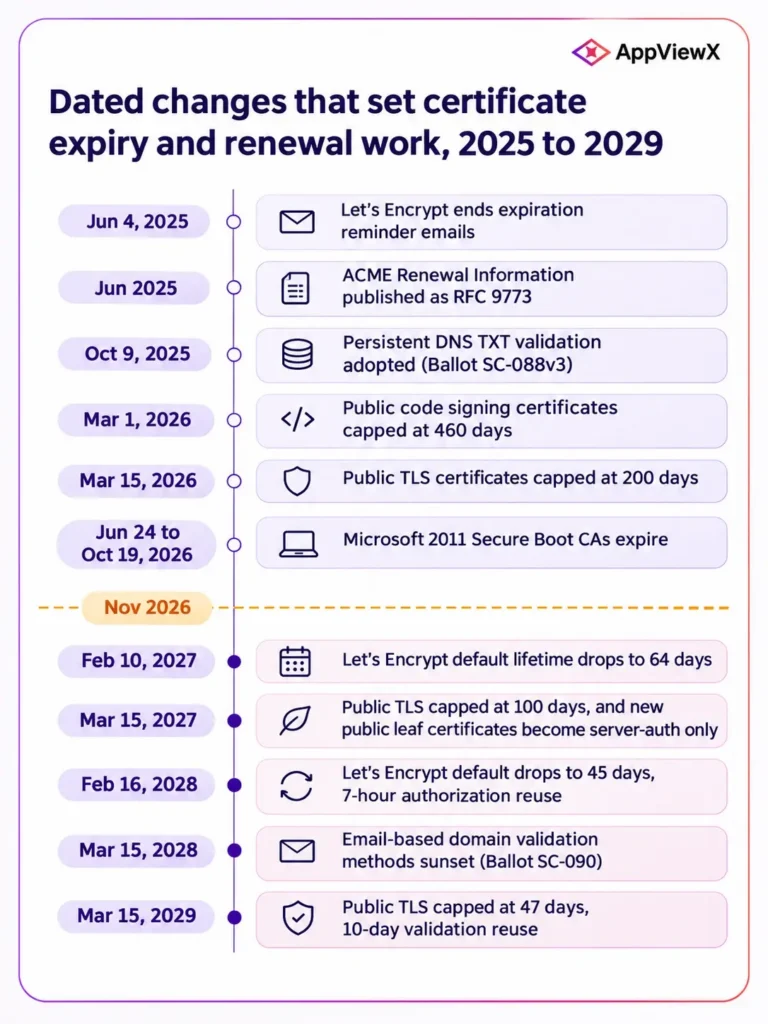
Figure 1. Key expiry dates, 2025 to 2029, from CA/Browser Forum, Let’s Encrypt, IETF, Chrome, and Microsoft sources.
Let’s Encrypt ended its expiration emails on June 4, 2025, citing wider use of reliable renewal automation among subscribers. Teams that relied on those emails need expiry monitoring of their own.
Tie each renewal point to the certificate’s lifetime
A renewal point set as a percentage of lifetime holds through every cap change. Let’s Encrypt will cut its default lifetime from 90 days to 64 on February 10, 2027, and to 45 on February 16, 2028. Its announcement warns that a hardcoded 60-day renewal interval fails at 45 days.
The same announcement recommends Automatic Certificate Management Environment (ACME) Renewal Information (ARI), published by the IETF as RFC 9773 in June 2025. ARI lets the CA suggest a renewal window for each certificate and spreads renewal load across that window. Renewing about two-thirds of the way through a certificate’s life is the accepted fallback for clients without ARI.
Table 1. Expiry math for a hypothetical estate of 10,000 public TLS certificates
| Phase start | Max validity | Validation reuse | Renew on day | Days left at renewal | Renewals per day | Fixed 30-day alert on a healthy certificate |
| Before March 15, 2026 | 398 days | 398 days | 265 | 133 | 38 | Never fires |
| March 15, 2026 | 200 days | 200 days | 133 | 67 | 75 | Never fires |
| March 15, 2027 | 100 days | 100 days | 67 | 33 | 150 | Never fires |
| March 15, 2029 | 47 days | 10 days | 31 | 16 | 319 | Fires on day 17, before renewal is due |
Hypothetical estate, renewing at two-thirds of maximum validity (10,000 divided by the unrounded renewal interval). Periods from Ballot SC-081v3.
Estimates that assume renewal at expiry come out lower. For 47-day certificate lifecycles, that pace means about 21 operations a day per 1,000 certificates. Renewing at two-thirds of lifetime moves each renewal earlier and raises the figure to about 32.
Why a fixed 30-day alert breaks at 47 days
A 30-day “expiring soon” threshold never fires on a healthy 100-day certificate renewed at day 67. That certificate still has 33 days left. In the 47-day phase, the scheduled renewal falls around day 31. The same threshold then fires on day 17 for every certificate in the estate, 2 weeks ahead of schedule.
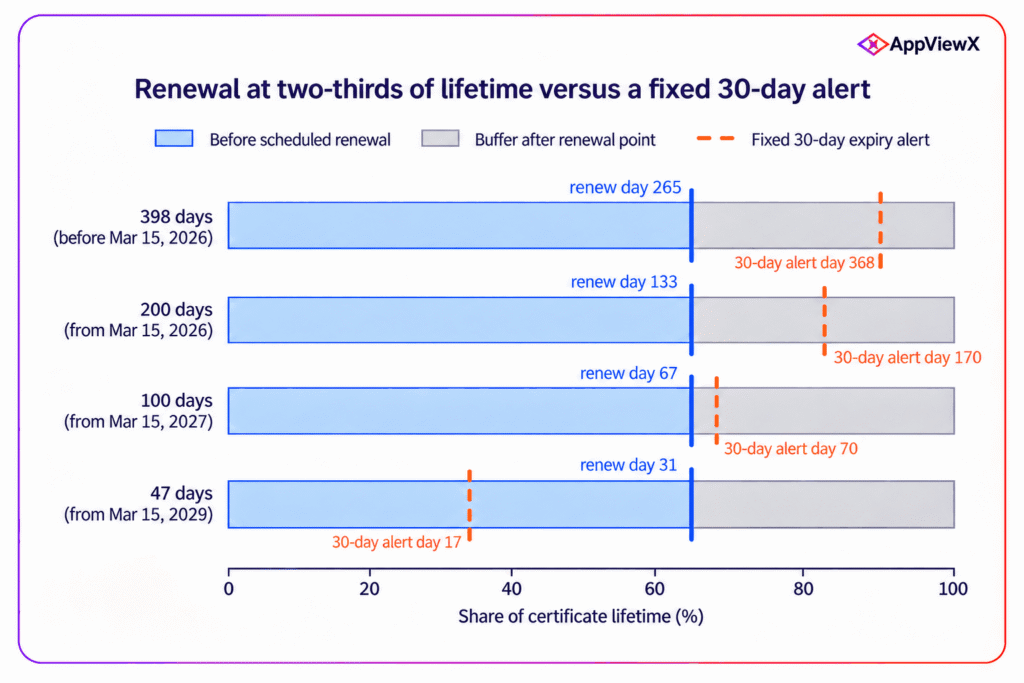
Figure 2. The renewal point holds at two-thirds of lifetime as the 30-day alert moves earlier with each cap. Based on Ballot SC-081v3 validity caps.
How to define a late renewal
Alert when a renewal runs late. A certificate counts as late once it passes its renewal point plus a grace period and the replacement has yet to reach every endpoint. Let’s Encrypt’s lifetime announcement also recommends monitoring that flags certificates not renewed on schedule. Three measures track program health:
- Renewal success rate
- Time from renewal point to confirmed deployment
- Certificates past their renewal point
Expiring certificates outside public TLS need the same tracking
Code signing, client authentication, private PKI, Kubernetes, intermediate CA, and firmware certificates follow lifetimes of their own. Each belongs in the inventory used for public TLS.
Table 2. Lifetimes and renewal routes beyond public TLS server certificates
| Certificate type | Lifetime set by | Current lifetime | Effect at expiry | Renewal route |
| Public code signing | CA/Browser Forum Ballot CSC-31 | 460 days maximum for certificates issued since March 1, 2026 | New signing stops, while timestamped signatures keep verifying | Scheduled re-enrollment with keys in hardware security modules (HSMs) |
| Private TLS and mutual TLS (mTLS) | Internal PKI policy | Set by the PKI team | Service-to-service authentication fails | ACME, EST, or SCEP against a private CA |
| Public TLS client authentication | CA/Browser Forum caps and CA profiles | Follows the public TLS caps | Renewal from a public CA drops client authentication | Re-issue from a private CA |
| Kubernetes control plane | kubeadm defaults | 1 year for client certificates, 10 years for the cluster CA | Cluster components fail to authenticate | Control plane upgrades or kubeadm certs renew |
| Intermediate CAs | CA operator | Multiple years | Every leaf chaining through it fails validation | Re-issue leaves under the successor intermediate |
| Firmware trust anchors | Platform vendor | 2011 Secure Boot CAs expired June to October 2026 | Devices boot but stop receiving boot-level security updates | Operating system and device maker firmware updates |
Based on CA/Browser Forum, Let’s Encrypt, Kubernetes, and Microsoft documentation.
Code signing certificates
A code signature carrying an RFC 3161 timestamp proves it was made while the code signing certificate was valid, so timestamped releases keep verifying after the certificate expires. Signatures without a timestamp lose that anchor, which makes timestamping a policy requirement for every pipeline. Ballot CSC-31 cut public code signing validity from 39 months to 460 days for certificates issued from March 1, 2026.
Kubernetes control plane certificates
The kubeadm tool issues client certificates that expire after one year and renews them during control plane upgrades. Clusters that go more than a year between upgrades need a separate renewal path.
Firmware and intermediate CA certificates
Microsoft’s 2011 Secure Boot certificates expired between June 24 and October 19, 2026. Devices kept booting, but any device still missing the 2023 replacements gets no new Secure Boot protections. An intermediate CA that expires breaks validation for every leaf that chains through it. Re-issue those leaves under its successor before that date.
Client authentication certificates
Let’s Encrypt removed the client authentication extended key usage (EKU) from its default profile on February 11, 2026. Under the Chrome Root Program Policy, certificates that Chrome-trusted CAs issue from March 15, 2027 may assert server authentication only. Plan each client certificate’s move to a private CA before its next renewal from a public CA.
Assign an owner to every certificate
The National Institute of Standards and Technology (NIST) practice guide SP 1800-16 notes that large and medium enterprises can hold thousands or tens of thousands of TLS server certificates. A central team typically issues them, while line-of-business groups and system administrators install and run them. Give every certificate one accountable owner team across that split.
Build the inventory from network scans, CA account imports, cloud certificate services, load balancers, and Kubernetes secrets. Certificate discovery produces the list. Each record then needs these fields so a renewal can run without a meeting:
- Owner team and escalation contact
- Renewal method, such as ACME, EST, a CA API, or manual
- Every binding, including host, port, load balancer profile, and Kubernetes secret
- Issuing CA, extended key usage (EKU), key algorithm, and key size
- Expiry date and scheduled renewal point
Spot checks confirm each renewal reached its endpoints. Compare the serial number an endpoint serves with the newest serial issued for that certificate, and investigate any mismatch.
Domain validation has to run unattended
In the 47-day phase, domain validation can be reused for 10 days. Nearly every renewal then needs fresh proof of domain control. Let’s Encrypt reaches that point earlier, with 7-hour authorization reuse from February 16, 2028.
Ballot SC-090 sunsets the phone-based domain validation methods on March 15, 2027, and the email-based domain contact methods on March 15, 2028. The ballot points to ACME-based DNS and HTTP challenges as the more automated replacements, and Let’s Encrypt supports HTTP-01, TLS-ALPN-01, and DNS-01. Wildcard certificates and hosts that aren’t publicly reachable depend on two DNS routes:
- DNS-01 with scoped API credentials: Where the renewal system writes and removes a TXT record for each validation
- Persistent DNS TXT validation: Added by Ballot SC-088v3 in October 2025, where one static record tied to a CA account covers repeated issuance with no DNS change per renewal
The persistent method suits zones where DNS write access for renewal tooling is hard to approve. Dynamic DNS-01 fits zones already managed through an API. Either way, log each validation next to the issuance it supports.
Where to start with the expiry queue
Sequence the work by deadline. NIST’s practice guide offers 30-day policy and 90-day inventory milestones as examples, and the steps below follow a similar pace:
- List near-term expiries by exporting every certificate that expires in the next 60 days with its owner team and renewal method.
- Write the renewal policy around the two-thirds point or the CA’s ARI window, with a grace period and late-renewal alerts for owner teams.
- Automate public TLS first, covering internet-facing certificates and DNS validation before the 100-day phase.
- Move client authentication to private PKI before each certificate’s next public renewal.
- Fold in the remaining certificate types, adding Kubernetes, code signing, and intermediate CA certificates to the inventory and alert rules.
How to test expiry automation before you buy
A proof of concept should show how the tool handles a failed renewal. Run each test in staging.
- Issue a short-validity certificate and check that renewal fires at the configured point unattended.
- Change the ARI window on a test ACME server and verify the tool follows the new window.
- Break a deployment target on purpose and check that the alert names the certificate, endpoint, and owner team.
- Re-issue several hundred certificates from a second CA in one run and time it, because the TLS Baseline Requirements require revocation within 24 hours after triggers such as key compromise.
- Compare the tool’s list of overdue renewals with manual checks.
Smaller estates on a single ACME CA can often manage with an ARI-capable client and an expiry monitor. Past that, the must-haves are discovery across every CA and cloud, renewal through confirmed deployment, automated domain validation, ARI support, and bulk re-issuance that finishes within a day. Self-service portals and custom dashboards are useful additions.
How AppViewX handles certificate expiry across CAs
Certificates, keys, code signing, and SSH certificates often sit in separate tools, each with its own expiry view. AppViewX brings them into one platform across public and private CAs, with no CA lock-in.
- Smart Discovery scans CAs, clouds, Kubernetes, and legacy applications, and AppViewX reports it finds 3x more certificates
- Closed-Loop Automation renews each certificate, binds it to its endpoints, and moves certificate groups between CAs in bulk
- The CLM product sets renewal windows by policy and supports ACME ARI and automated domain validation, with coverage for Kubernetes and private PKI

Disclaimer: Sources and dates checked November 11, 2026. Standards and product details change. Confirm current versions with each source before acting. Renewal figures are calculations for a hypothetical estate.
Sources
- CA/Browser Forum, Ballot SC081v3: Introduce Schedule of Reducing Validity and Data Reuse Periods, April 11, 2025, https://cabforum.org/2025/04/11/ballot-sc081v3-introduce-schedule-of-reducing-validity-and-data-reuse-periods/
- CA/Browser Forum, Ballot SC-088v3: DNS TXT Record with Persistent Value DCV Method, October 9, 2025, https://cabforum.org/2025/10/09/ballot-sc-088v3-dns-txt-record-with-persistent-value-dcv-method/
- CA/Browser Forum, Ballot SC-090: Gradually sunset all remaining email-based, phone-based, and ‘crossover’ validation methods, November 20, 2025, https://cabforum.org/2025/11/20/ballot-sc-090-gradually-sunset-all-remaining-email-based-phone-based-and-crossover-validation-methods-from-sections-3.2.2.4-and-3.2.2.5/
- CA/Browser Forum, Ballot CSC-31: Maximum Validity Reduction, November 17, 2025, https://cabforum.org/2025/11/17/ballot-csc-31-maximum-validity-reduction/
- CA/Browser Forum, Baseline Requirements for the Issuance and Management of Publicly-Trusted TLS Server Certificates, Section 4.9.1.1, accessed November 11, 2026, https://cabforum.org/working-groups/server/baseline-requirements/requirements/
- Let’s Encrypt, Decreasing Certificate Lifetimes to 45 Days, December 2, 2025, https://letsencrypt.org/2025/12/02/from-90-to-45/
- Let’s Encrypt, Ending Support for Expiration Notification Emails, January 22, 2025, https://letsencrypt.org/2025/01/22/ending-expiration-emails/
- Let’s Encrypt, Upcoming Features, updated July 22, 2026, https://letsencrypt.org/upcoming-features/
- Let’s Encrypt, Challenge Types, updated February 12, 2026, https://letsencrypt.org/docs/challenge-types/
- IETF, RFC 9773: ACME Renewal Information (ARI) Extension, June 2025, https://rfc-editor.org/rfc/rfc9773.html
- IETF, RFC 3161: Internet X.509 Public Key Infrastructure Time-Stamp Protocol (TSP), August 2001, https://datatracker.ietf.org/doc/html/rfc3161
- Google, Chrome Root Program Policy, Version 1.8, February 5, 2026, https://googlechrome.github.io/chromerootprogram/crp/policy/
- NIST NCCoE, SP 1800-16 Volume A: Securing Web Transactions: TLS Server Certificate Management, June 2020, https://www.nccoe.nist.gov/publication/1800-16/VolA/index.html
- Kubernetes, Certificate Management with kubeadm, accessed November 11, 2026, https://kubernetes.io/docs/tasks/administer-cluster/kubeadm/kubeadm-certs/
- Microsoft, Windows Secure Boot certificate expiration and CA updates, accessed November 11, 2026, https://support.microsoft.com/help/5062710
- AppViewX, CLM Smart Discovery, March 23, 2026, https://www.appviewx.com/solutions/clm-smart-discovery/
- AppViewX, CLM Closed-Loop Automation, March 25, 2026, https://www.appviewx.com/solutions/clm-closed-loop-automation/
- AppViewX, Automate Certificate Lifecycle Management (CLM), October 29, 2026, https://www.appviewx.com/products/certificate-lifecycle-management-software/
- AppViewX, Certificate Lifecycle Management for Kubernetes, March 25, 2026, https://www.appviewx.com/products/avx-one-clm-for-kubernetes/
- AppViewX, PKI product page, accessed November 11, 2026, https://www.appviewx.com/products/pki-software/
- AppViewX, IDC MarketScape on Certificate Lifecycle Management, accessed November 11, 2026, https://www.appviewx.com/idc-marketscape-on-certificate-lifecycle-management/
- AppViewX, PacificSource Cuts 97% of IT Time on Certificate Lifecycle Management, September 5, 2025, https://www.appviewx.com/case-study/how-pacificsource-transformed-certificate-management-with-appviewx/
Tags
About the Author