

Key takeaways
- Every CLM vendor’s deck now says CA-agnostic. The label holds up only when six capabilities pass technical scrutiny: automation parity across enrollment protocols, full lifecycle API depth, policy enforcement at issuance, CA migration tooling, multi-CA reporting fidelity, and vendor-neutral pricing.
- Discovery works uniformly across CAs in most platforms because it does not require CA-specific APIs. The bias shows up at issuance, renewal, revocation, and reissuance, the operations vendors have to build per CA. That is where the test lives.
- CA migration tooling is the sharpest evidence of vendor neutrality. If the platform moves you between CAs without breaking automation, the architecture is real. If migration means re-platforming, the label is marketing.
- Pricing reveals what the architecture hides. A platform’s commercial model is the final test of whether CA-agnostic claims hold up. Three quotes at the same total volume across different CA mixes will tell you if pricing is CA-blind.
Most CLM platforms that call themselves CA-agnostic don’t actually work the same way across every CA in your estate, public or private, even though they should. The label has been stretched far enough to cover platforms that automate deeply against one preferred CA and bolt thin integrations onto the rest. The six capabilities below are what you need to verify before you trust the label:
Capability 1: Native automation parity across every CA
Native automation parity means the platform runs every lifecycle operation, including issuance, renewal, revocation, reissuance, and endpoint binding, with the same depth across every CA in its supported list. The upstream CA should not matter, whether it is a public commercial CA, a private internal PKI, a Microsoft ADCS, or an ACME-issued cloud certificate.
The bias usually hides in the gap between enrollment protocols. A platform may offer clean ACME automation for public CAs and clean REST automation for one private CA, then drop to manual workflows or one-off scripts for the rest. That gap is where outages and audit findings come from. Real parity means ACME, EST, SCEP, and REST integrations all running closed-loop automation from discovery to last-mile endpoint binding, with no protocol-specific gaps in between.
What to verify: ask the vendor to map every supported CA against every lifecycle operation and every enrollment protocol they support. Real parity reads the same across every row. Asymmetric language (“full automation” for some CAs, “supports integration” for others) is the tell.
Capability 2: API depth across issuance, renewal, revocation, and reissuance
The lifecycle has four primary operations: issuance, renewal, revocation, and reissuance. A real CA-agnostic platform exposes all four through stable, documented APIs across every supported CA, with consistent request/response semantics, status webhooks, and error handling. Most platforms cover issuance and renewal well. Revocation and reissuance are where vendors thin out.
That gap shows up exactly when you can least afford it:
- Key compromise
- CA distrust events
- Audit findings that require mass revocation
- Mass cert rotation under the 47-day mandate
If revocation and reissuance require a support ticket or a console workflow for some CAs and a clean API call for others, the platform is not architecturally neutral. It is automated, where the vendor invested, and procedural everywhere else.
What to verify: ask the vendor for OpenAPI specs covering all four operations across every supported CA, including private PKI and Microsoft ADCS. Documentation consistency is integration consistency. Specs that go deep for some CAs and reference “see admin console” for others fail this test.
Capability 3: Policy enforcement at issuance, not just discovery
Discovery-time policy enforcement tells you which certificates violate policy after they have already been issued. Issuance-time enforcement prevents non-compliant certificates from being issued in the first place. That is the difference between cleanup work and prevention.
A CA-agnostic platform enforces policy at the issuance API call, regardless of which CA the certificate routes to. Every CSR passes through the same policy gate before it leaves the platform:
- Key size and key generation rules
- Validity period
- Signature algorithm
- EKU restrictions
- SAN allowlist
- Approval workflows
A bolt-on platform enforces policy on the issuance flows it owns at depth and audits the rest after the fact. The audit-after-the-fact model creates real compliance exposure under NIST IR 8547 and the CNSA 2.0 transition timeline, both of which expect policy controls applied at issuance.
What to verify: ask the vendor to walk through the same policy applied to two different CAs in their supported list. If the enforcement points, policy types, or approval workflows change between CAs, the policy layer is not architecture-deep. It is a layer on top of one CA and a wrapper around the others.
Capability 4: CA migration tooling that actually works
The CA migration test is the sharpest single evidence of vendor neutrality. If the platform moves you between CAs without breaking automation, the architecture is real. If migration means rebuilding workflows, running parallel systems, or engaging professional services, the CA-agnostic label is marketing.
CAs raise prices, get acquired, fail audits, and change business models. In 2024, Google announced that Chrome would stop trusting new TLS certificates from a major public CA after a multi-year pattern of compliance failures. The question is not whether a CA change happens, but whether the platform absorbs it as a workflow or forces a re-platform.
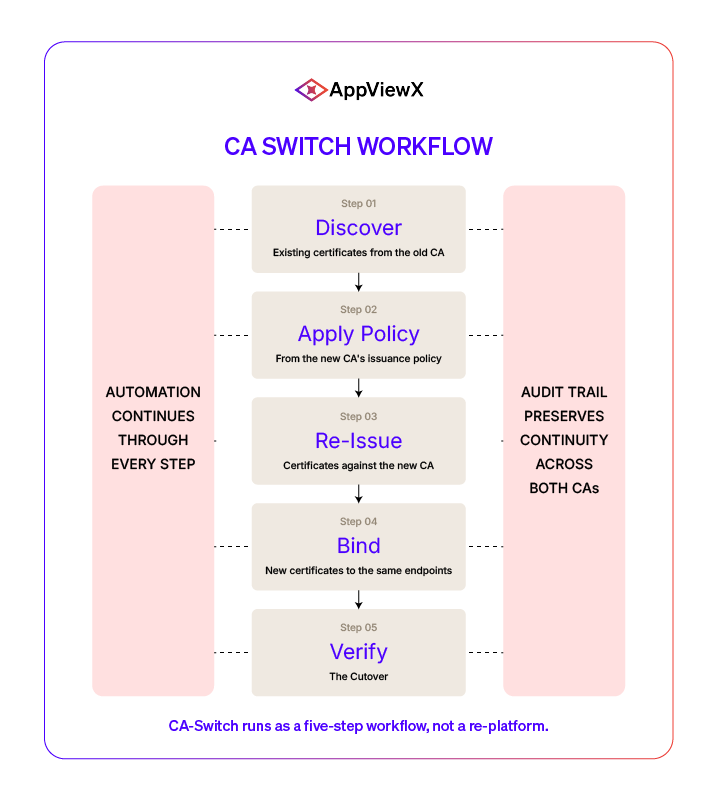
A real CA-switch workflow runs in five operational steps:
- Discover existing certificates from the old CA
- Apply the new CA’s issuance policy
- Re-issue against the new CA
- Bind the new certificates to the same endpoints
- Verify the cutover
Automation continues through the switch, and audit trails preserve continuity across CAs.
What to verify: ask the vendor to describe their CA-switch workflow step by step. A professional services engagement to plan the migration is a re-platform answer dressed as a workflow.
Capability 5: Multi-CA reporting and audit in a single pane
Three things have to hold across every CA in your estate:
- Certificate inventory reads the same regardless of the issuing CA
- Compliance reporting spans every CA without field gaps
- Audit trails log the same fields with the same fidelity
This sounds basic, and most platforms fail it. A platform reports richly on its preferred CA with full coverage:
- Issuance dates
- Revocation status
- EKU configuration
- Policy state
- Full audit history
Then it reports thinly on integrated CAs with basic metadata only. For audit frameworks that span the full estate, including NYDFS 500, HIPAA, FedRAMP, NERC CIP, and PCI DSS, the partiality is real exposure. The auditor’s question is, “Show me your certificate estate.” A CA-agnostic platform answers with one view. A bolt-on platform answers with one rich view and several thin ones.
What to verify: ask the vendor for sample inventory reports spanning at least three CAs, one public, one private PKI, and one Microsoft ADCS. Compare the field coverage. The reports should be structurally identical. Field gaps signal integration depth gaps.
Capability 6: Pricing that doesn’t tax you for using the wrong CA
This is the capability most buyers miss. CA-agnostic architecture means nothing if the pricing model penalizes you for using CAs the vendor does not own. The bias appears in three patterns:
- Per-certificate fees that vary by CA
- A preferred CA bundled into the platform license, with integrations to other CAs metered separately
- API throttling or feature gating tied to which CA the certificate comes from
CA-blind pricing charges for what the platform manages, including certificates under lifecycle, endpoints under automation, and workflows under orchestration. The underlying CA does not enter the math. Anything else is an economic incentive to centralize on the vendor’s preferred CA, regardless of what the architecture claims.
What to verify: ask the vendor for pricing across three scenarios at the same total volume of 10,000 certificates: one CA, three CAs, and five CAs, including private PKI and ADCS. If the price moves meaningfully across the three, the pricing is CA-biased.
How to tell a real CA-agnostic CLM from a marketing CA-agnostic claim
The six capabilities above are the technical filter. Three patterns tell you almost as much in a 30-minute vendor call.
- The breadth-vs-depth tell. A real CA-agnostic vendor talks about specific CA integrations in depth, including the protocols supported, the policy hooks available, and the audit fields captured. A bolt-on vendor lists supported CAs without explaining what “supported” means at each layer.
- The case study tell. A real CA-agnostic vendor publishes case studies of CA migrations, multi-CA enterprises, and M&A consolidation across heterogeneous CA estates. A bolt-on vendor publishes case studies of single-CA deployments at scale.
- The roadmap tell. A real CA-agnostic vendor’s roadmap is organized by CLM capabilities and applies across every CA. A bolt-on vendor’s roadmap is organized by which CA features they are catching up to.
The table below maps each capability to a verification test and the red flag answer that should slow you down.
| Capability | What to verify | Red flag answer |
| Automation parity | Map every CA against every lifecycle operation and enrollment protocol | Asymmetric language across CAs |
| API depth | OpenAPI specs for all four operations across every CA | “See admin console” for some CAs |
| Policy at issuance | Walk through enforcement for two different CAs | Symmetric for one CA, audit-after-the-fact for others |
| CA migration | Five-step operational walkthrough of a CA-switch | Migration requires professional services |
| Multi-CA reporting | Sample reports spanning three CAs, including private PKI and ADCS | Field coverage differs across CAs |
| Pricing | Quotes for one, three, and five CAs at the same total volume | Price moves meaningfully by the CA mix |
RFP questions to send to every CLM vendor
Send these to vendors in writing and score the answers. Gartner’s 2025 Buyers’ Guide for PKI and Certificate Life Cycle Management frames the broader evaluation methodology these questions plug into.
| # | Category | Question |
| 1 | Architecture | Which CAs do you support, and what specific automation does each integration provide for issuance, renewal, revocation, and reissuance? |
| 2 | Architecture | How does policy enforcement work at issuance, and can you walk through specific examples for two different CAs? |
| 3 | Architecture | What is the architectural difference, if any, between your integration for one supported CA and another? |
| 4 | Operations | What does your CA-switch workflow look like in operational detail, from existing-cert discovery through new-cert issuance to automation continuity? |
| 5 | Operations | What sample reports can you share that span at least three CAs, including one private PKI and one Microsoft ADCS? |
| 6 | Operations | What audit trail fields do you capture for each lifecycle operation across every supported CA? |
| 7 | Operations | What happens to existing automation workflows during a CA migration? |
| 8 | Roadmap | What CA-agnostic capabilities are on your roadmap for the next 12 months? |
| 9 | Roadmap | How does the platform handle post-quantum certificate issuance, and which CAs are first in your PQC integration timeline? |
| 10 | Commercial | What is the pricing for 10,000 certificates issued from one CA, from three CAs combined, and from five CAs combined? |
| 11 | Commercial | Are there per-CA fees, integration fees, or API throttling tied to CA selection? |
| 12 | Commercial | If we migrate from one CA to another after signing, does the platform license cover the migration tooling, or is professional services required? |
Architecture questions reveal the design. Operations questions reveal production behavior. Commercial questions reveal whether the pricing agrees with the architecture. A platform that scores well on architecture but fails commercially is CA-agnostic in theory and CA-biased in practice.
Question 9 matters more than it looks. CA/Browser Forum Ballot SC-081v3 takes TLS validity to 47 days by 2029, and NIST finalized the first three PQC standards (FIPS 203, 204, 205) in August 2024. Crypto-agility across every CA is no longer optional, and any platform that has not started PQC integration across its full CA list will be playing catch-up under hard deadlines.
How AppViewX delivers genuine CA-agnostic CLM
Apply the 12 questions to AppViewX, and the answers hold up under scrutiny. The platform is built CA-agnostic at the architecture layer, which means every capability below works the same way regardless of which CA sits underneath.
- Automation parity. Closed-loop automation runs the same flow from discovery to last-mile endpoint binding across 35+ supported CAs, with ACME, EST, SCEP, and REST integrations all running at the same depth.
- API depth. Full lifecycle APIs cover issuance, renewal, revocation, and reissuance across every supported CA, with no console-only operations on any of them.
- Policy at issuance. Centralized policy enforcement gates every CSR before it leaves the platform, covering key size, validity, EKU, SAN, signature algorithm, and approval workflows.
- CA migration. CA-Switch is a five-step workflow, not a re-platform. Automation continues through the switch, and audit trails preserve continuity across CAs.
- Multi-CA reporting. Smart Discovery surfaces every certificate across cloud, on-prem, Kubernetes, and certificate transparency logs with the same field coverage on every CA.
- CA-blind pricing. The CA underneath the platform does not enter the math.
The same architecture extends to post-quantum readiness, with the PQC solution applying visibility, policy, and automation uniformly across every CA. This aligns with the NIST 2030 deprecation and 2035 disallowance timeline, and the CNSA 2.0 deadlines for federal-adjacent organizations, and the PQC readiness guide covers the operational specifics.
Score your CLM shortlist against the 12 questions, then bring the scorecard to a conversation with an AppViewX expert.
Tags
About the Author

Ganesh Mallaya
Global Field CTO
Enabling businesses to design, engineer and deploy automation and Digital trust management solutions.