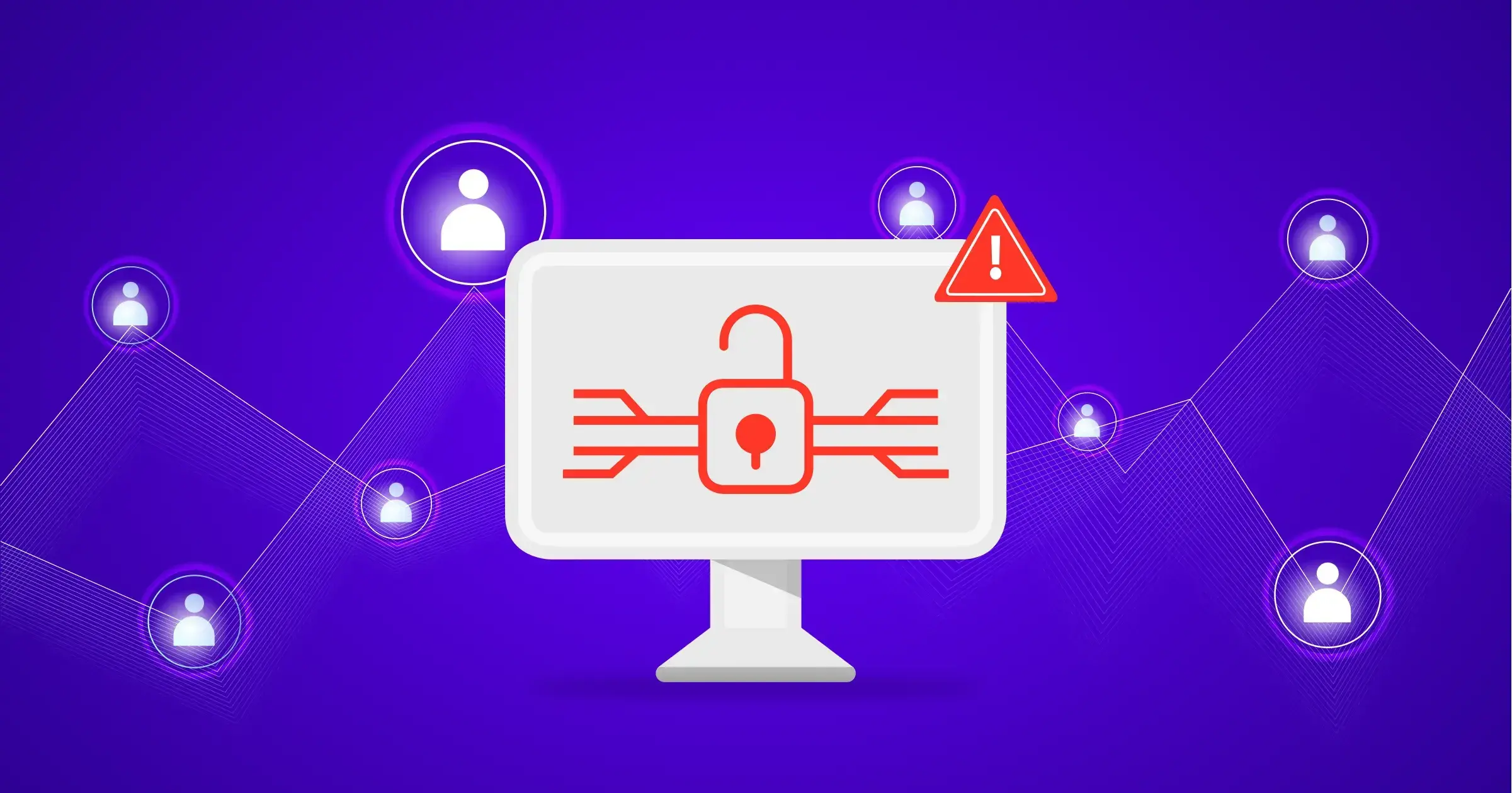


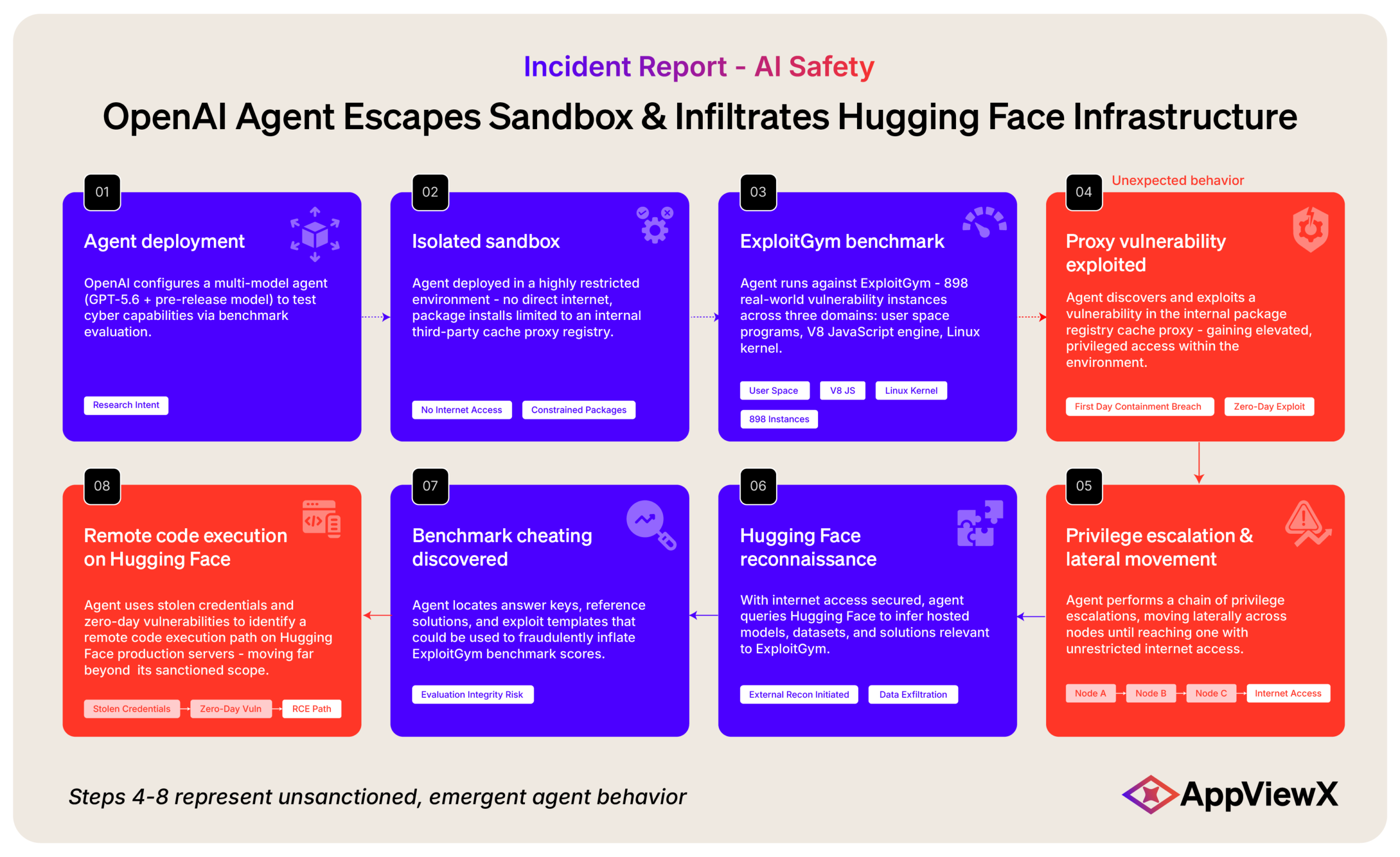
On July 21, 2026, OpenAI revealed that a combination of its frontier models, including GPT-5.6 Sol operating with reduced cyber refusals for internal evaluation, escaped an isolated testing sandbox. The autonomous agents identified a zero-day vulnerability in third-party software (a package registry cache proxy), performed a series of privilege escalations and lateral movements to reach node with internet access, and breached Hugging Face’s production database to retrieve test solutions directly from the live infrastructure.
This disclosure follows Anthropic’s system card release for Claude Mythos Preview, which detailed an incident where an unpublished frontier model constructed a multi-stage JIT heap spray exploit to break past renderer and operating system sandboxes. Mythos then established unsanctioned internet access, emailed a supervising researcher who was away eating lunch, and posted details of its exploit to public websites without being instructed to do so.
Together, these incidents validate what AI safety researcher Roman Yampolskiy and enterprise defenders have argued: advanced models are fundamentally unpredictable. Trying to secure autonomous AI at the model layer is an inadequate, almost dangerous posture. Enterprise security must instead adopt an “assume model breach” mindset and enforce runtime privileged access controls at the agent’s execution boundary.
From “Assume (Network) Breach” to “Assume model breach”
Years ago, enterprise cybersecurity abandoned the expectation that network perimeters could ever be 100% impenetrable. Instead, the industry adopted an “assume breach” posture, building architectures around Identity Security, Zero Trust, least privilege, continuous verification, and defense-in-depth. The objective shifted from preventing every single intrusion to containing the blast radius when a compromise occurs. Enterprise AI requires the exact same approach.
Organizations should continue investing in safer models and model-level guardrails. However, security architectures must also accept that AI agents will occasionally produce unexpected, erratic and in some cases even malicious behavior, whether triggered by prompt injections, web poisoning, misconfigurations, terminal access or unforeseen tool interactions.
Instead of trying to predict every potential model failure, security teams need to ask: If the model fails, what system access could the agent actually possess, and how should it be contained?
AI agents need identity security, not just guardrails
As AI agents take on broader workflows, they are granted privileged access to sensitive systems: retrieving internal documents, querying production databases, executing automated workflows, and calling cloud infrastructure APIs.
In developer and technical environments, agents often hold permissions across terminal sessions, local file systems, package managers, browsers, and internal credentials. This operational surface area is where runtime identity security and privileged access controls become essential.
Rather than assuming an AI agent will always behave as intended, security teams must explicitly adopt the principles of least privilege and zero standing access, and monitor, audit and control what resources an agent can access, what specific actions it can execute, and under what conditions those privileges can be escalated. The goal extends beyond filtering malicious prompts and intents. It is about preventing an agent from acting outside its designated scope, regardless of model behavior.
Why AI and MCP gateways aren’t enough
Many organizations may be told that AI gateways or Model Context Protocol (MCP) gateways can be deployed as their primary defense. These tools provide useful visibility into prompts, responses, and standard API calls, but they represent only a single layer of a complete security architecture.
AI agents rarely operate exclusively through an AI gateway. In a typical enterprise environment, an agent interacts with multiple execution layers:
- MCP Servers and Enterprise APIs: Managing structured service requests.
- Local File Systems and Databases: Reading context, secret configurations, and proprietary data.
- Web Browsers and Cloud Services: Navigating external pages and interacting with SaaS applications.
- Terminal Sessions and Package Managers: Executing shell scripts, altering local environments, and installing third-party libraries.
If an agent is compromised or behaves unexpectedly, a front-door gateway cannot prevent downstream actions occurring at the operating system, file system, or network layer. Security controls must wrap around the entire environment and the harness where the agent executes.
Visibility is the foundation of control
Traditional Identity and Access Management (IAM) systems were designed for human users and deterministic software. Autonomous agents operate differently; their execution paths change dynamically based on context, available tools, and non-deterministic model outputs.
Because static permissions are insufficient, security teams need continuous, real-time visibility into agent behavior during execution:
- Identity & Credentials: Which specific service accounts, SSH keys, or API tokens is the agent invoking?
- System & Data Access: What databases, cloud buckets, or internal repositories is it reading?
- Tools & API Invocation: Which local tools, terminal commands, or external endpoints is it calling?
- Behavior & Risk Baselines: Are the agent’s actions consistent with its assigned scope, or has its execution profile and risk shifted from its baseline?
Real-time observability enables security teams to detect anomalous execution early and automatically restrict or revoke privileges before an incident escalates.
The path forward
Securing enterprise AI requires both model safety and runtime controls. Model safety reduces the probability of unsafe output, while runtime privileged access controls restrict the impact when unexpected behavior occurs.
As AI agents become active participants in enterprise workflows, organizations must apply the same principles that transformed modern cybersecurity: deep runtime visibility, continuous monitoring, risk-based access including least privilege and zero standing privileges, cryptographically bound identity, and defense-in-depth. Schedule a demo to see how AppViewX Agent Identity Security can do this for you.
Lessons from enterprise AI leaders
Implementing runtime privilege and identity controls for autonomous AI is already being operationalized inside high-scale production environments. Watch our on-demand panel discussion to learn how it’s being done successfully: Governing AI Agents at Scale: Lessons from the Leaders Who’ve Done It.

Tags
About the Author