


We compared 10 certificate lifecycle management (CLM) platforms, including AppViewX, Keyfactor, Palo Alto Networks (formerly Venafi), DigiCert, and Sectigo, on how they’ll hold up as certificate lifetimes shrink and post-quantum work begins.
On March 15, 2027, the longest a public TLS certificate can stay valid drops from 200 days to 100, and in 2029 it drops to 47. A team that renews from a spreadsheet and a ticket queue goes from touching each certificate about once a year to roughly eight times.
We looked at 10 CLM platforms with that schedule in mind. AppViewX publishes this guide and ranks its own platform first. To keep that honest, every capability claim comes from public documentation, review scores appear even where they don’t favor us, and AppViewX’s weak spots sit next to everyone else’s. We didn’t run hands-on tests of competing products. If you’re choosing a private CA rather than a management layer, our PKI management platforms comparison is the better read.
Key takeaways
- AppViewX is the best certificate lifecycle management software for most enterprises in 2026. It pairs CA-neutral discovery and automation (19 named CA providers documented, 200+ integrations) with a private PKI that issues post-quantum and hybrid certificates, and it runs as SaaS, on-premises, or hybrid. Keyfactor, Palo Alto Networks, DigiCert and Sectigo round out the top five.
- Public certificates are capped at 200 days today, 100 days from March 2027, and 47 days from March 2029, when each one needs a 7.8 renewals a year.
- March 2027 is the harder deadline in practice, because renewal volume doubles and public certificates lose client authentication on the same day.
The best certificate lifecycle management software: Top 5
| # | Platform | Best for | Third-party CAs documented* | Deployment |
| 1 | AppViewX | CA-neutral automation across hybrid, network-heavy estates | 19 | SaaS, on-premises, hybrid |
| 2 | Keyfactor Command | Teams running EJBCA, and FedRAMP buyers | 8 | On-premises, hosted, SaaS |
| 3 | Palo Alto Networks Next-Gen Trust Security (formerly Venafi) | Palo Alto firewall and SASE customers | 11 | SaaS, self-hosted |
| 4 | DigiCert Trust Lifecycle Manager | Estates standardized on DigiCert certificates | 8 | SaaS, on-premises via DigiCert ONE |
| 5 | Sectigo Certificate Manager | Fast SaaS rollout for Sectigo customers | 5 | SaaS |
*Named third-party CAs with a documented connector, counted October 8, 2026. How we counted.
Notable mentions
These five do a narrower job well, and plenty of teams run one of them alongside a CLM platform.
| # | Platform | Known for | Where it stops |
| 6 | AWS Certificate Manager | Free public certificates for integrated AWS services, plus 45-day certificates from a managed ACME endpoint since July 2026 | Free certificates attach only to integrated AWS services |
| 7 | cert-manager | The CNCF-graduated controller that issues and renews certificates inside Kubernetes | Kubernetes and OpenShift only |
| 8 | IBM Vault PKI (formerly HashiCorp Vault) | Short-lived certificates for apps that already authenticate to Vault | An issuer, not an inventory |
| 9 | GlobalSign | LifeCycleX for on-premises CLM and TLS Connect for teams with up to 100 certificates | Separate products, no ACME in LifeCycleX yet |
| 10 | Microsoft Cloud PKI | Cloud CAs for Intune devices at $2 per user per month, rolling into Microsoft 365 E5 from July 2026 | Intune devices only, at most three CAs per tenant, root and issuing combined |
Why CLM buying looks different in 2026
Most of this traces back to CA/Browser Forum Ballot SC-081v3, which passed on April 11, 2025, without a single certificate issuer voting against it. Its first step took effect this March, so every public certificate issued today is already capped at 200 days.
The renewal math
We modeled the schedule for a team managing 1,000 public TLS certificates, assuming each is renewed on its last valid day, so treat the numbers as a floor. Time per renewal comes from a Forrester Total Economic Impact study commissioned by AppViewX: about 30 minutes by hand and 15 seconds automated.
Table 1. Renewal workload for 1,000 public TLS certificates
| Effective date | Max validity | DCV reuse | Renewals per certificate per year (min.) | Renewals per 1,000 certificates | Manual hours (30 min each) | Automated hours (15 sec each) |
| Before March 15, 2026 | 398 days | 398 days | 0.92 | 917 | 459 | 4 |
| March 15, 2026 (now) | 200 days | 200 days | 1.83 | 1,825 | 913 | 8 |
| March 15, 2027 | 100 days | 100 days | 3.65 | 3,650 | 1,825 | 15 |
| March 15, 2029 | 47 days | 10 days | 7.77 | 7,766 | 3,883 | 32 |
Renewals per year = 365 divided by maximum validity. Hours exclude domain validation, approvals, and testing. Sources: SC-081v3, Forrester Total Economic Impact study of AppViewX (February 2026).
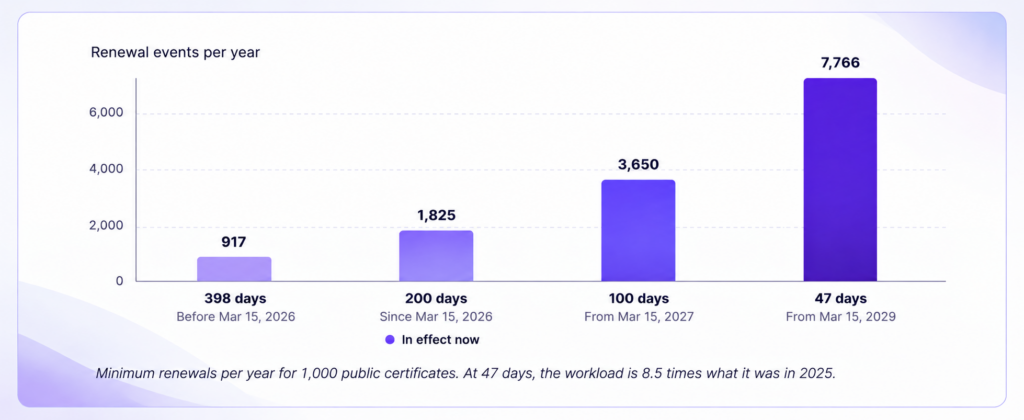
Figure 1. Minimum renewals per year for 1,000 public certificates. At 47 days, the workload is 8.5 times what it was in 2025.
The step people underestimate is 2027. Renewal volume doubles that March, on the same day public certificates lose client authentication. By 2029, manual renewals add up to roughly 1.9 full-time people (at 2,080 hours a year) doing nothing else. Automated, the same 7,766 renewals take about 32 hours. Our 47-day compliance guide covers each phase.
Domain validation is the part nobody budgets for
SC-081v3 also shrinks how long a CA can reuse a domain control validation (DCV): 200 days now, 100 in 2027, and 10 in 2029. Once validations last 10 days and certificates 47, nearly every renewal needs a fresh check. Email validation won’t keep up. DNS validation will, if your CLM platform can reach every DNS provider your domains use. AppViewX’s DCV management renews validations ahead of expiry through DNS or HTTP. Whatever you buy, ask to see DCV working across more than one CA account.
Public certificates lose client authentication
Under Chrome Root Program Policy 1.8, public certificates issued on or after March 15, 2027 can carry only the serverAuth purpose, and Let’s Encrypt dropped client authentication from its default certificates in February 2026. If you use public certificates for mutual TLS, those connections need a private CA by then. If your CLM platform runs or connects to one, that’s a reissuance job. If it doesn’t, it’s a redesign.
Switching CAs stopped being hypothetical
In late 2024, Chrome and Mozilla stopped trusting new Entrust TLS certificates. Entrust stopped issuing public TLS certificates from its own roots in March 2025 and sold the business to Sectigo, which reported moving more than half a million certificates. If that happened to your CA, buying replacements would be the easy part. Finding every endpoint that holds one before the cutoff would be the work.
Post-quantum deadlines arrived
NIST finalized its first post-quantum standards in August 2024, and its draft NIST IR 8547 would disallow today’s RSA and elliptic-curve algorithms after 2035. Executive Order 14412 set December 31, 2030, for post-quantum key establishment and December 31, 2031, for post-quantum signatures on federal high-value and high-impact systems. OMB memo M-26-15 then asked agencies for migration plans by October 22, 2026, built on “a dynamic, continuously updated inventory of all cryptographic assets.”
For CLM buyers, that puts cryptographic discovery, CBOM (cryptographic bill of materials) export and hybrid certificate issuance on the requirements list. Our guide to PQC-ready certificate lifecycle management goes further.
Dates to plan around
Table 2. Certificate and post-quantum milestones, 2026 to 2035
| Date | What changes | Source |
| March 15, 2026 (now) | Maximum validity 200 days, DCV reuse 200 days | SC-081v3 |
| October 22, 2026 | US agency post-quantum migration plans due | OMB M-26-15 |
| March 15, 2027 | Maximum validity 100 days, DCV reuse 100 days, public TLS certificates serverAuth only | SC-081v3, Chrome policy 1.8 |
| March 15, 2029 | Maximum validity 47 days, DCV reuse 10 days | SC-081v3 |
| December 31, 2030 | Post-quantum key establishment for US federal high-value and high-impact systems, EU high-risk use cases migrated | EO 14412, EU roadmap |
| December 31, 2031 | Post-quantum signatures for the same federal systems | EO 14412 |
| 2035 | RSA and elliptic-curve algorithms disallowed | NIST IR 8547 (draft) |
What to look for in CLM software
Surveys suggest most teams have work to do. The average organization now holds more than 114,000 internal certificates, according to Ponemon Institute research for CyberArk (2026). Depending on how each survey defines its terms, 56% to 86% of organizations report certificate-related outages, 17% to 47% report complete visibility, and just 5% describe their certificate management as fully automated (Ponemon, 2026, Wakefield Research for Keyfactor, 2025, Omdia for Sectigo, 2025). At 100-day lifetimes, a CLM platform has to do the renewal work itself. Here’s what we weighed:
- Discovery that doesn’t depend on the issuing CA. Certificates hide on load balancers, in Java keystores and Kubernetes secrets, and in forgotten cloud accounts, so test discovery on a real network segment.
- CA neutrality. You need connectors for every CA you use or might move to, and a way to switch issuers without touching each endpoint.
- Last-mile automation. Most load balancers and firewalls don’t run an ACME client, so the platform has to install the certificate, update every binding, and confirm traffic uses it.
- Automated DCV and a private CA. Look for DNS-based validation across CA accounts and a private CA for internal TLS, devices, and mutual TLS.
- Crypto-agility. Expect a cryptographic inventory, CBOM export, hybrid certificate issuance and policies that trigger reissuance when an algorithm is retired.
- Deployment and pricing. Regulated teams often need on-premises or air-gapped options, and everyone needs pricing they can project to 2029 volumes.
Automated vs. monitored
In December 2025, automatic renewal failed for Bazel’s download sites because a subdomain deleted from DNS was still listed on the certificate. Nothing alerted the team, and the sites were down for about 13 hours. In March 2024, Tailscale’s website went down for about 90 minutes after an IPv6 workaround broke its automated renewal, and its monitoring only checked over IPv6. Both teams had automation. Neither had a separate check on whether it was working.
How we ranked these platforms
We started with Gartner Peer Insights’ CLM market and G2’s CLM category, kept the enterprise platforms that manage certificates across more than one CA, and assessed each on discovery, CA neutrality, automation, private PKI, post-quantum readiness, deployment, and buyer validation.
Ranking is decided like so: the top five sit within 0.3 stars of each other on Gartner Peer Insights, with AppViewX lowest at 4.3, and within 0.2 on G2. Buyers are broadly happy with all five, so we treated ratings as a sanity check.
Counting CA connectors
CA neutrality is easy to claim, so we counted every named third-party CA with a documented connector.
Table 3. Third-party CA connectors in public documentation
| Platform | Count | Named CA providers |
| AppViewX | 19 | Amazon, CSC Global, DigiCert, EJBCA, Entrust, Futurex, GlobalSign, GoDaddy, Google, HashiCorp Vault, HydrantID, IDnomic, InCommon, Let’s Encrypt, Microsoft, Nexus, Sectigo, SwissSign, Trustwave |
| Palo Alto Networks NGTS | 11 | AWS, DigiCert, Entrust, GlobalSign, GoDaddy, Google, HID, Let’s Encrypt, Microsoft, Sectigo, SSL.com |
| Keyfactor Command | 8 | Amazon, DigiCert, Entrust, GlobalSign, GoDaddy, Microsoft, Sectigo, The SSL Store |
| DigiCert Trust Lifecycle Manager | 8 | AWS, EJBCA, Entrust, GlobalSign, Let’s Encrypt, Microsoft, Sectigo, Step CA |
| Sectigo Certificate Manager | 5 | AWS, DigiCert, Entrust, Google, Microsoft |
Excludes each vendor’s own CA, generic connectors, and a legacy Symantec connector in AppViewX’s list. Keyfactor’s count includes AnyCA Gateway plug-ins.
Four of the 10 tools here come from companies that also sell public certificates: DigiCert, Sectigo, AWS, and GlobalSign. Their CLM products connect to other CAs, but limits show up when you split issuance. DigiCert, for example, reserves multi-CA management for its Advanced plan and above.
Feature comparison across seven dimensions
Table 4. Capability matrix (“not documented” means we couldn’t confirm it publicly)
| Capability | AppViewX | Keyfactor Command | Palo Alto NGTS | DigiCert TLM | Sectigo SCM |
| Discovery | Network, CA account, CT log, cloud, device and attack surface scans | CA sync, network scans, key store discovery | Networks, cloud keystores, Kubernetes, firewall and SASE configs | Cloud, CT logs, APIs, network scans on Advanced | Network agent, external scans, Microsoft CA via AD, cloud keystores |
| Endpoint automation | 200+ integrations: load balancers, firewalls, HSMs, cloud, ITSM | Orchestrators for IIS, Apache, F5, Kubernetes and more | F5, Citrix, A10, Kemp, Radware, Avi, FortiGate | F5, A10, NetScaler, HAProxy, Kemp, Avi, server agents | 50+ integrations, Orchestration Gateway |
| Private CA | AVX PKI, SaaS or on-premises | EJBCA | Zero Touch PKI | DigiCert private CA | Sectigo Private CA |
| Post-quantum certificates | ML-DSA, SLH-DSA and hybrid at every level | ML-DSA, SLH-DSA and composites in EJBCA | Not documented | Readiness tools (Premium plan) | Private ML-DSA on request |
| Crypto inventory and CBOM | AVX CLM with Quantum Trust Hub | AgileSec (separate product) | Quantum-Safe Security (separate product) | Quantum Central | Quantum Ready |
| Deployment | SaaS, on-premises, hybrid, private cloud | On-premises, hosted, SaaS | SaaS, self-hosted | SaaS, on-premises via DigiCert ONE | SaaS |
| Pricing | Quote | Quote, EJBCA Community free | Quote, Secure-Flex credits | Essentials $40 per seat (managed certificate), 25 minimum | SCM Pro from $25 a month |
1. AppViewX
Gartner Peer Insights: 4.3 (53 ratings) | G2: 4.5 (44 reviews)
Best for: hybrid enterprises with several CAs, lots of network appliances and a post-quantum plan
AppViewX runs certificate lifecycle management, private PKI, SSH keys, code signing and Kubernetes certificates from one platform. Its edge is reach. Discovery spans six scan types plus uploaded certificates, and automation runs through 200+ integrations, from F5, NetScaler and A10 load balancers to Palo Alto, Check Point and Fortinet firewalls, HSMs and ITSM tools. Its documentation names connectors for 19 CA providers, the most here, and a CA Switch workflow moves endpoints between issuers.
Since July 2026, AppViewX PKI has issued ML-DSA, SLH-DSA and hybrid composite certificates at every level of the hierarchy, and an AD CS migration wizard lets teams move off Microsoft AD CS in phases. The Quantum Trust Hub add-on inventories cryptography in code, configurations and certificates and generates a CBOM. The platform runs as SaaS, on-premises, hybrid, or in a private cloud.
IDC named AppViewX a Leader in its 2026 CLM MarketScape. In the Forrester study, the composite customer saw a 302% return on investment with payback in under six months, and one interviewed customer described the change this way:
“15 major outages the year before, which dropped to three the next year.”
Senior vice president of data protection at a financial services firm, interviewed for Forrester’s Total Economic Impact study of AppViewX
Reviewers credit AppViewX with taking renewal work off their teams and with integrations that reach load balancers, firewalls and HSMs. The pushback is about support, which some find slow and others praise, and about wanting more prebuilt templates for niche vendors. G2 users report a four-month average implementation. Health insurer PacificSource, which manages more than 1,500 certificates, went from three or four certificate outages a month to none and cut the time to generate and push a set of certificates from a full day to 15 minutes.
| Pros | Cons |
| Broadest CA support here, plus automated CA switching
Deep automation for load balancers, firewalls and HSMs Post-quantum certificates and a CBOM in one platform Every deployment model, including on-premises |
Quote-based pricing
More platform than small estates need Gartner Peer Insights rating 0.3 stars below the top-rated tools here No FedRAMP authorization listed |
2. Keyfactor Command
Gartner Peer Insights: 4.5 (46 ratings) | G2: 4.5 (86 reviews)
Best for: teams running EJBCA, and US public sector buyers who need FedRAMP
Keyfactor pairs Command with EJBCA, the CA software it picked up when it acquired PrimeKey in 2021, so it’s the natural choice if you already run EJBCA. Command discovers certificates through CA sync, network scans, and key store discovery and installs them through Keyfactor Orchestrators. Microsoft and EJBCA CAs connect natively, others connect through AnyCA Gateway plug-ins.
EJBCA supports ML-DSA, SLH-DSA, and composite algorithm pairs, and AgileSec handles cryptographic discovery. Keyfactor’s government CLM service received FedRAMP Moderate authorization in May 2026, the only top-five vendor where we could confirm FedRAMP. Reviewers mention an interface that takes time to learn, and G2 users report a six-month average implementation.
| Pros | Cons |
| Free EJBCA Community edition alongside Enterprise
FedRAMP Moderate government service Strong cryptographic discovery through AgileSec |
More components to run with Orchestrators
Eight named third-party CA connectors, compared with 19 for AppViewX |
3. Palo Alto Networks Next-Gen Trust Security (formerly Venafi)
Gartner Peer Insights: 4.6 (223 ratings) | G2: 4.3 (3 reviews, as Venafi TLS Protect)
Best for: Palo Alto Networks firewall and SASE customers
This is the former Venafi. CyberArk bought Venafi in 2024, Palo Alto Networks completed its CyberArk acquisition on February 11, 2026, and the SaaS product is now sold as Next-Gen Trust Security (NGTS), with a Strata Cloud Manager integration. Self-hosted editions keep CyberArk names.
Discovery reaches networks, cloud keystores, Kubernetes, and Palo Alto firewall and SASE configurations, a real advantage for Palo Alto shops. NGTS documents 11 third-party CA connectors plus its managed Zero Touch PKI. Through Strata Cloud Manager, it’s licensed with Secure-Flex credits, and we couldn’t find documented post-quantum algorithm support in Certificate Manager. It is praised by reviewers for its scale, but cost and setup complexity are flagged.
| Pros | Cons |
| 4.6 on Gartner Peer Insights from 223 ratings
Network-native discovery for Palo Alto customers Mature self-hosted edition |
Product names and documentation mid-transition
Credit-based licensing through Strata Cloud Manager No documented post-quantum algorithms in Certificate Manager |
4. DigiCert Trust Lifecycle Manager
Gartner Peer Insights: 4.6 (58 ratings) | G2: 4.3 (81 reviews, DigiCert ONE)
Best for: organizations that buy most public certificates from DigiCert
Trust Lifecycle Manager (TLM) is DigiCert’s CLM product inside DigiCert ONE, and the most straightforward option here if DigiCert already issues most of your certificates. It discovers through cloud scans, CT logs, and imports, adds network scanning on the Advanced plan, and automates through ACME, SCEP, EST, and connectors for the major load balancers.
DigiCert documents eight third-party CA connectors, but managing more than one CA requires the Advanced plan or above. In September 2026, it added Continuous Validation for automated DCV and made Quantum Central, with CBOM export, generally available. IDC also named DigiCert a Leader in its 2026 CLM MarketScape. TLM Essentials is listed at $40 per seat (one managed certificate), with a 25-seat minimum on a 12-month subscription. Reviewers like the central inventory but mention setup effort and thin integration examples.
| Pros | Cons |
| CA and CLM from one vendor
Automated DCV through Continuous Validation Published entry pricing |
Multi-CA management only on Advanced and above
Code signing and IoT sold separately |
5. Sectigo Certificate Manager
Gartner Peer Insights: 4.4 (223 ratings) | G2: 4.5 (198 reviews)
Best for: Sectigo customers who want a fast SaaS rollout
Sectigo Certificate Manager (SCM) is cloud-native SaaS, and Sectigo bought Entrust’s public certificate business in 2025. Discovery covers a network agent, external scans, Active Directory and cloud keystores, and the Orchestration Gateway (August 2026) installs certificates on IIS, Apache, Tomcat, F5, NGINX and Citrix.
Its datasheet names five third-party CAs, and since April 2026, existing Private CA customers can request private ML-DSA certificates. SCM Pro starts at $25 a month for up to three domains. Sectigo’s strongest numbers are on G2, with 198 reviews and a Leader placement in the Fall 2026 CLM grid, though reviewers mention a dated interface and paid add-on integrations.
| Pros | Cons |
| Strong G2 satisfaction
Quick SaaS onboarding Published starter pricing |
SaaS only, with no on-premises edition we could find
Five named third-party CA connectors |
How to run a CLM evaluation
Start with the 2027 math: your public certificate count, times 3.65 renewals a year, times the minutes each renewal takes today. If that’s more hours than you have, the 2029 figure of 7.8 renewals per certificate settles it.
A CA-owned tool works if you’ve standardized on one issuer. If you run several CAs, hand-installed appliance certificates, and a post-quantum deadline, pick a platform that’s independent of any issuer. Then test on your own estate:
- Run discovery on a real network segment and compare it with your inventory
- Time a CA switch on a test endpoint
- Renew end-to-end on your three most common endpoint types
- Ask for a CBOM export your security team can use
For a baseline first, try AppViewX’s free SSL/TLS certificate discovery scan or book a live demo.
Disclaimer
Based on public sources and review sites as of October 8, 2026. Details change often, so confirm them with each vendor. AppViewX publishes this guide. If anything about your product is out of date, contact us.
Frequently asked questions
What is certificate lifecycle management (CLM) software?
Certificate lifecycle management software finds every digital certificate an organization uses, tracks owners and expiry dates, and automates requesting, renewing, installing and revoking certificates across certificate authorities and systems. Enterprise CLM platforms also enforce policy, integrate with ITSM and DevOps tools, and increasingly inventory cryptographic algorithms for post-quantum planning.
What is the difference between CLM and PKI?
PKI (public key infrastructure) is the system that issues and validates certificates: certificate authorities, policies, keys, and revocation services. CLM is the management layer on top. It discovers certificates from any CA, tracks them, and automates renewal and deployment. Many organizations run several public and private PKIs and use one CLM platform to manage all of them.
When do TLS certificates change to 47 days?
Under CA/Browser Forum Ballot SC-081v3, the maximum validity of publicly trusted TLS certificates fell to 200 days on March 15, 2026. It drops to 100 days on March 15, 2027, and to 47 days on March 15, 2029. Domain validation reuse shrinks on the same dates and reaches 10 days in 2029.
Do I still need CLM software if I use ACME or Let’s Encrypt?
Usually, yes. ACME automates issuance and renewal for servers that run an ACME client, but it doesn’t discover certificates issued elsewhere, enforce policy, track ownership or install certificates on appliances without ACME support, such as many load balancers and firewalls. CLM platforms use ACME as one of several automation methods and check the results independently.
How much does certificate lifecycle management software cost?
Most enterprise CLM platforms, including AppViewX, Keyfactor, and Palo Alto Networks, are priced by quote, usually scaled to certificate volume and modules. Published examples in 2026 include DigiCert Trust Lifecycle Manager Essentials at $40 per seat (one managed certificate, 25-seat minimum, 12-month term) and Sectigo SCM Pro from $25 a month for up to three domains. AWS Certificate Manager is free for integrated AWS services.
Sources
- CA/Browser Forum, Ballot SC-081v3 (April 11, 2025) and TLS Baseline Requirements
- Google, Chrome Root Program Policy 1.8 (February 5, 2026) and Sustaining digital certificate security (June 27, 2024)
- Let’s Encrypt, Ending TLS client authentication certificate support (updated March 16, 2026)
- NIST, first finalized post-quantum standards (August 13, 2024) and NIST IR 8547 draft (November 12, 2024)
- The White House, Executive Order 14412 (June 22, 2026) and OMB memorandum M-26-15 (June 24, 2026)
- European Commission, post-quantum cryptography policy page
- Ponemon Institute for CyberArk, Trends in PKI Security (January 2026), Sectigo and Omdia, State of Crypto Agility (August 2025), Keyfactor, Digital Trust Digest: The Automation Edition (September 2025)
- Palo Alto Networks, completion of the CyberArk acquisition, SEC filing (February 11, 2026)
- Gartner Peer Insights and G2 CLM categories, accessed October 8, 2026
- AppViewX documentation: supported certificate authorities and DCV management, public documentation from the other vendors, accessed October 8, 2026
Tags
About the Author