


Key takeaways
- PQC-ready certificate lifecycle management needs three things: a record of every certificate and the algorithm behind it, renewal without a manual request, and issuance that can move to whichever certificate authority supports post-quantum first.
- Every certificate gets reissued, from the roots down to the ones on individual systems, because the new standards change both the key and the signature.
- Crypto-agility enables an organization to adopt new cryptographic algorithms with minimal disruption as requirements and standards evolve.
- Post-quantum and hybrid certificates can be substantially larger than traditional certificates, creating interoperability, performance, and message-size challenges for some devices, libraries, and network environments. A phased rollout by application or environment can limit the blast radius, validate compatibility, and provide rollback options where the deployment architecture supports them.
- Organizations need an auditable record of certificate and cryptographic changes, including what changed, when it changed, and which policy or process authorized the change.
Post-quantum cryptography is now part of how a certificate lifecycle management platform gets evaluated. Traditional CLM platforms already track expiry dates and renew certificates on time. PQC adds a much larger job: replacing affected certificates in the estate on a new algorithm, on a timeline set by standards bodies and regulators, while the business keeps running.
That job shifts the criteria for choosing a CLM platform. What matters is replacing certificates at volume, supporting emerging PQC certificate profiles and protocols, and operating across certificate authorities and trust environments as ecosystem support evolves. The platform that runs your certificate lifecycle also runs the migration, which makes CLM a critical operational layer for post-quantum readiness.
Why certificates have to be replaced
A PQC migration requires changes to the cryptographic algorithms used in certificates and the protocols that rely on them. For certificate-based authentication, that can mean replacing public keys and certificate authority (CA) signatures with PQC or hybrid alternatives. NIST has standardized ML-KEM for key establishment and ML-DSA and SLH-DSA for digital signatures.
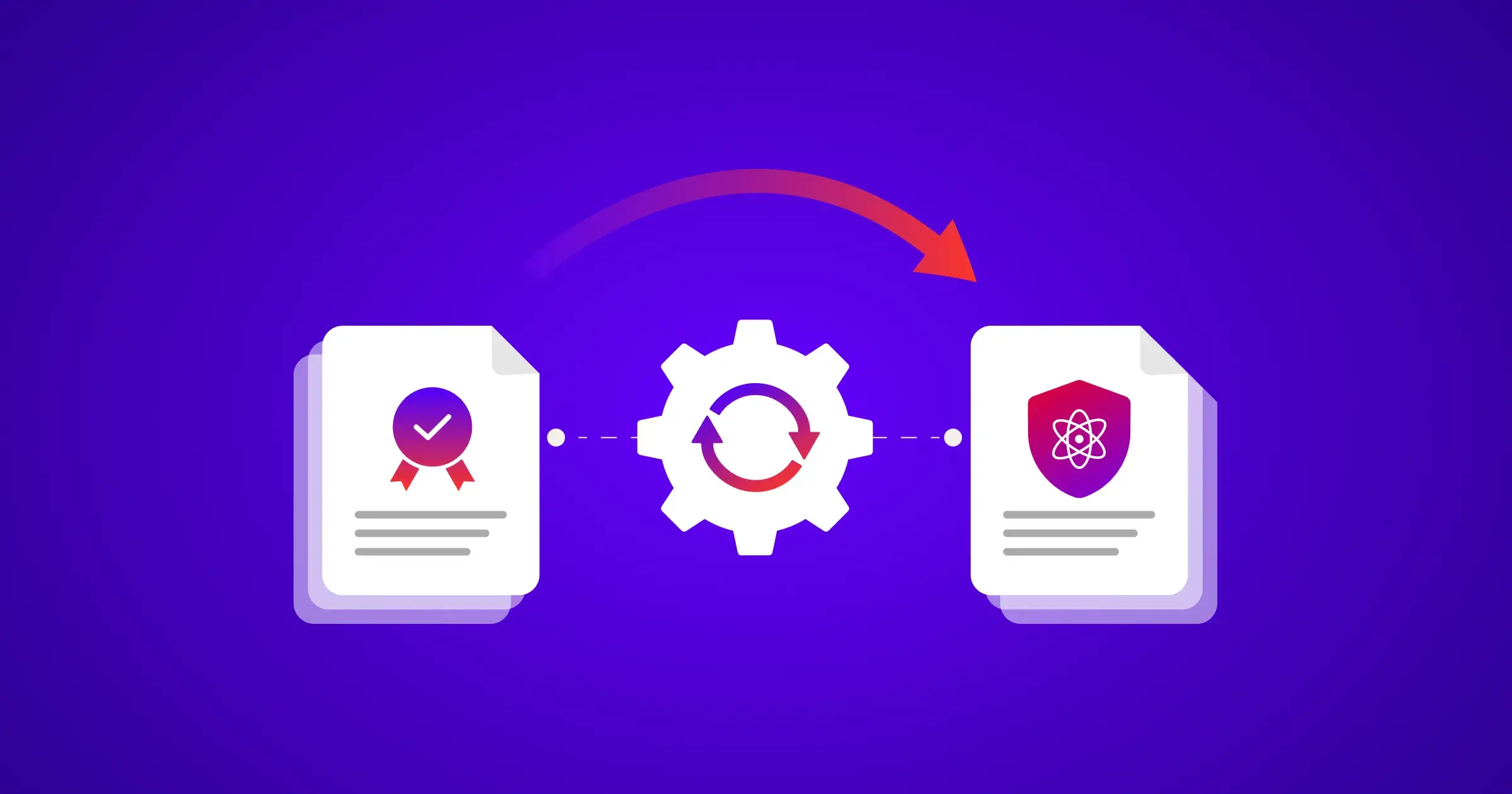
Changing the algorithm therefore means issuing new certificates at every level of the chain:
- Root certificate: The root signs itself, and anchors trust for everything beneath it.
- Intermediate certificate: The intermediate holds the certificate authority’s signing key and carries the root’s signature.
- End-entity certificate: Signed by the intermediate, this is the certificate installed on the system itself and the one clients check.
Hybrid and phased approaches can allow traditional and post-quantum certificates to coexist during the transition, but a fully PQC certificate hierarchy requires the trust chain to be migrated as well.
The number of certificates an organization holds sets the size of the migration, and the tools that issue, deploy, and track them decide how long it takes.
Crypto-agility in certificate management
Crypto-agility is the ability to change cryptographic algorithms across an environment on a defined timeline, while the systems that depend on them stay available. In certificate terms, it means reissuing and redeploying certificates on a different algorithm without a separate project for each application.
The same capability handles a distrusted certificate authority, a compromised key, or a change in internal key-length policy.
Limits of traditional CLM tools
Certificate management tools built for annual renewal cycles were designed for expiry, not algorithm change, so replacing the algorithm across an entire estate was rarely something they had to do. Inventories record expiry dates without complete visibility into key types, algorithms, dependencies, or cryptographic risk. Enrollment paths are hard-coded to a single certificate authority. Policy is applied only at the point of enrollment, which is why the rules never reach certificates that were issued earlier.
6 capabilities of a PQC-ready CLM platform
Each of the six is verifiable in a demo before a contract is signed, and the demo worth having runs against your own certificates rather than a vendor’s sample estate.
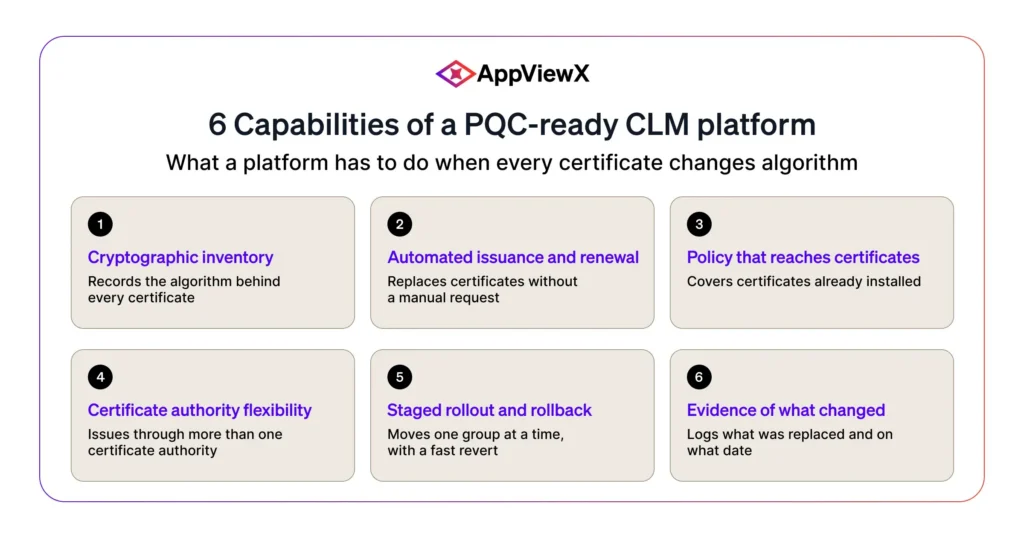
1. Cryptographic inventory
You can’t plan a migration without knowing which algorithm and key type each certificate uses, so the inventory has to record both. The fields that matter are the signature algorithm, the key type and length, the issuing certificate authority, and the system where the certificate is installed.
Certificates are spread across servers, cloud services, internal applications, and devices in the field. Certificates the platform never sees stay off the plan. Continuous discovery keeps the count current as teams deploy through the transition.
2. Automated issuance and renewal
Validity periods drop to 47 days for public TLS certificates in March 2029. The post-quantum transition lands on top of that: new roots and intermediates, reissued certificates across private hierarchies, and a second pass when hybrid certificates give way to pure post-quantum ones.
At that volume, certificates have to be requested, issued, installed, and checked without anyone filing a ticket. Any system left out of that runs on manual renewal eight times a year.
3. Policy that reaches certificates
Policy sets which algorithms, key lengths, and certificate authorities are approved. During a migration, that policy also has to cover the certificates already installed, setting which ones are reissued early and which run to expiry.
Estate-wide evaluation compares every certificate in the inventory against the current policy and flags what falls outside it. Remediation then moves those certificates onto the approved algorithm on the schedule the policy sets.
One policy update then covers every certificate the policy applies to. The share of the estate meeting the current standard becomes the progress figure a security team reports each month.
4. Certificate authority flexibility
Public certificate authorities depend on browser and root program timelines. Private certificate authorities depend on the software they run and the hardware security modules behind them. A platform tied to one issuer inherits that issuer’s schedule.
CA-agility moves issuance to whichever certificate authority supports the algorithm you need, with the applications behind it unchanged. Testing an issuance path against a second certificate authority during evaluation confirms the capability works in your own environment.
Hybrid and composite certificates pair a classical algorithm with a post-quantum one, but they don’t all behave the same with older systems. A composite certificate combines both into a single algorithm, so the relying party has to support that format to validate it. Other hybrid designs carry the post-quantum signature in an extension that older systems ignore, which is what keeps those systems working through the transition. Implementations are still settling across certificate authorities and libraries. Ask which certificate formats a platform supports today, and which integrations are named behind each one.
5. Staged rollout and rollback
Post-quantum signatures are much larger than the ones they replace. The standardized signature algorithms produce signatures measured in kilobytes where today’s are measured in tens to hundreds of bytes, and the certificates carrying them grow to match. A system that sets aside a fixed amount of space for a certificate, or that expects a connection to open within a set number of packets, can refuse one that is otherwise valid.
Embedded devices, older TLS libraries, and network appliances are where that shows up first, and the hash-based alternative produces signatures larger still.
That’s why rollout runs group by group, by application, environment, or device type, starting where a failure costs the least. The platform also needs fast rollback, since reinstating what worked clears a failed deployment quickly and leaves time to find the cause.
Every group that succeeds widens the set of systems already running post-quantum algorithms, and any group that fails stays small enough to fix inside a maintenance window.
6. Evidence of what changed
Regulators, customers, and boards ask what an organization has done about post-quantum readiness, and answering takes a record.
Platforms that log every issuance, renewal, and policy change hold that record already. Reporting on algorithm distribution across the estate turns that log into a progress figure, tracked over the course of the migration.
The same record answers the next review, since key lengths, certificate authorities, and expiry dates are all held in one place. Exportable reporting matters here, because audit reviews and board updates both work from documents.
Questions to ask a PQC-ready CLM vendor
Post-quantum support on a datasheet can mean a tested implementation or a line on a roadmap. Asking for specifics settles which one you are buying.
Answers to the first four questions tell you whether a platform can carry a migration at this scale. The last two tell you how much of it can run on post-quantum algorithms today. Hosting your own post-quantum certificate authority is more control than most organizations need to own.
| Question | What a complete answer covers |
| Which attributes does discovery record? | Every cryptographic field, with the issuer and the location of each certificate found |
| How does the platform reach every environment? | Named integrations for each platform where your certificates run, private issuers included |
| Which enrollment protocols and deployment targets are supported? | ACME, EST, SCEP, and direct deployment to the systems that terminate TLS |
| Does policy apply to certificates already issued? | Estate-wide evaluation with automatic remediation for anything outside the approved set |
| Which certificate authorities are supported for post-quantum issuance? | A named list, with the algorithms each one issues today |
| Which hybrid or composite formats are implemented today? | Formats in production use, with dated roadmap entries for the rest |
How AppViewX supports PQC-ready CLM
AppViewX CLM manages certificates across cloud, on-premise, and Kubernetes environments from a single platform. It supports the capabilities this transition depends on:
- Discovery across cloud, on-premise, and Kubernetes that records the signature algorithm, key type and length, issuer, and install location of every certificate it finds
- Renewal automation over ACME, EST, SCEP, and CMPv2, with direct push to load balancers, web servers, and Kubernetes ingress so replacement runs without a ticket
- Policy evaluated against the whole inventory rather than at enrollment only, so certificates issued before the rule changed are flagged and reissued on the approved algorithm
- CA-agility that switches issuance between public and private certificate authorities from the same workflow, so a post-quantum move needs no change to the applications requesting certificates
- Rollout by application, environment, or device group, with the previous certificate reinstated from the platform when a group fails
- A logged record of every issuance, renewal, and policy change, with exportable reporting on algorithm distribution across the estate

Tags
About the Author

Krupa Patil
Product Marketing Manager
A content creator focused on providing readers and prospective buyers with accurate, useful, and latest product information to help them make better informed decisions.