



Key takeaways
- Certificate authority management is the discipline of controlling which CAs issue certificates, under what rules, and with what oversight.
- A secure hierarchy issues certificates from lower tiers while the root key stays offline and private keys sit in hardware.
- A certificate policy and access controls, enforced as the CA signs, decide what it issues and to whom.
- As public TLS validity drops toward 47 days in 2029, automated discovery and renewal become the baseline.
- The ability to change CAs after a distrust event and to adopt quantum-safe algorithms keeps trust intact as cryptographic standards advance.
A certificate authority (CA) decides what your systems trust. Managing the CAs behind your certificates means running the trust hierarchy, the issuance policy, and the audit trail as one system, across public and private issuers. Sound certificate authority management keeps that trust governed and current as certificate lifetimes shrink and cryptographic standards shift to post-quantum algorithms.
What strong certificate authority management requires
Strong certificate authority management rests on three practices: a deliberate trust hierarchy, policy applied at the moment of issuance, and audit controls that tie every certificate to an owner. It covers the public certificates that browsers and external clients accept, the private certificates behind internal services and mutual TLS (mTLS), and certificates from cloud CA services.
Governing them as one estate keeps issuance consistent and each certificate traceable to the CA that signed it and the team responsible for it.
Browser root programs and the CA/Browser Forum have committed to shorter certificate lifetimes, mandatory automation support, and single-purpose CA hierarchies. Aligning certificate authority management with those requirements now keeps each change small and planned.
Start with a sound CA trust hierarchy
The hierarchy is the decision that sets how far a compromise can reach. Issuing everything from one key concentrates the risk there. A layered design keeps the trust anchor separate from daily issuance and leaves room to rotate and scope issuers over time.
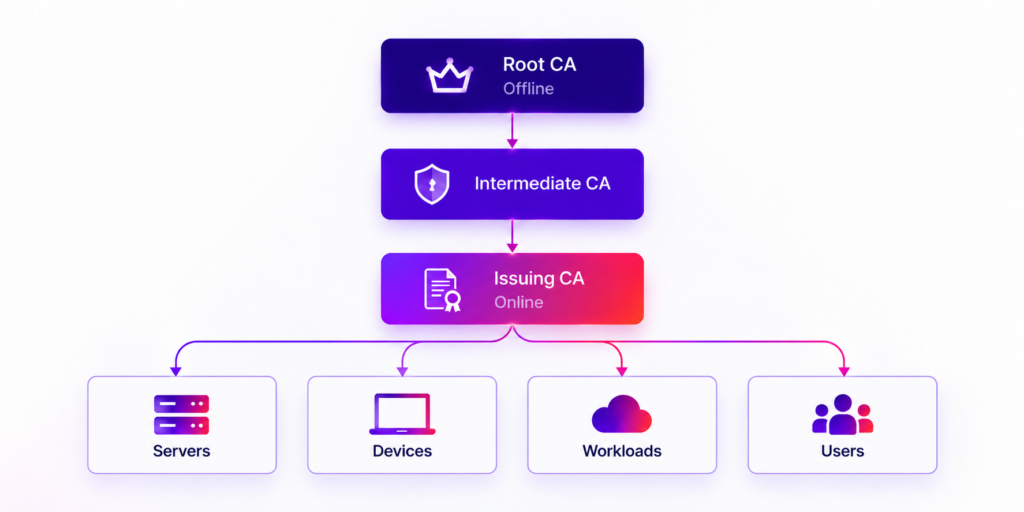
Root, intermediate, and issuing CA roles
Each layer of the hierarchy has a distinct job, and the roles should not blur. A root CA is the trust anchor. It signs subordinate CAs, stays offline, and comes out only for signed key ceremonies. An intermediate (subordinate) CA sits between the root and issuance and keeps the root key out of routine operations. An issuing CA signs the end-entity certificates that servers, devices, workloads, and users present. A registration authority (RA) validates requests before issuance and holds no signing key of its own.
Protect each CA according to its exposure. Keep root and high-value keys in a hardware security module (HSM). Constrain issuing CAs by name, extended key usage, and validity. Give every CA a documented purpose and a named owner. Root programs now apply term limits to root CAs. Treat every issuer as scoped and replaceable from the day you stand it up, whether it runs on a public CA or a modern private CA.
CA roles and how to protect each
A CA’s place in the hierarchy sets where its key belongs and how tightly to constrain it:
| CA Role | Function | Where the Key Should Live | Best-Practice Control |
| Root CA | Anchors the chain of trust and signs subordinate CAs | Offline, in an HSM | Used only in key ceremonies, with a strong key and a current algorithm |
| Intermediate (Subordinate) CA | Isolates the root and signs issuing CAs | HSM, offline or tightly restricted | Scoped by policy and layered between root and issuance |
| Issuing CA | Signs end-entity certificates for servers, devices, and users | HSM, online | Constrained by name, extended key usage, and validity, with issuance monitored |
| Registration Authority (RA) | Validates requests before the CA issues | No signing key, delegated approval | Identity checks and approval workflows enforced |
| Cross-Signed CA | Extends trust between hierarchies during migration | Governed by both parties | Time-boxed, scoped, and retired after the transition |
Enforce policy at the point of issuance
A CA issues whatever its policy allows. That policy is the primary control over the certificates it produces.
Certificate policy and practice statements
Two documents anchor issuance, and both need to be current. A certificate policy (CP) states what a CA issues and under what conditions. A certification practice statement (CPS) records how the CA operates to meet that policy. Together they define:
- allowed key sizes and algorithms
- validity limits
- naming and subject rules
- approved certificate profiles
- who may request what
A policy that lives only in a document does not constrain issuance. The issuing system has to apply it.
Policy and automation are now linked for publicly trusted CAs. Chrome Root Program Policy v1.8 requires every certificate authority under a Chrome-trusted root to support an automated issuance and renewal solution for every certificate profile it offers, effective March 15, 2027. At scale, enforcement has to be automatic.
Least privilege and separation of duties
Least privilege and separation of duties keep issuance accountable. No single person should request, approve, and issue a certificate without a check, and access to CA functions should follow role-based access control (RBAC). Sensitive actions such as adding a CA or running a key ceremony warrant dual control or a quorum. Shared administrative access to an issuing CA leaves no record of which team issued a given certificate.
A certificate lifecycle management platform enforces these separations across every connected CA from a single console, and enforcement holds steady as the number of issuers grows.
Govern the full certificate lifecycle
Managing a CA means managing everything it issues, because an untracked certificate is an untracked trust decision. The certificate lifecycle is where CA policy becomes visible and where gaps surface.
Discovery, renewal, and revocation
Discovery builds a live inventory of every certificate and the CA that issued it. Renewal replaces certificates before they expire. Revocation invalidates a compromised or superseded certificate through a certificate revocation list (CRL) or the Online Certificate Status Protocol (OCSP). Revocation checking has proven unreliable in browsers, which soft-fail when a status response is missing. That limitation pushed the industry toward shorter lifetimes and short-lived certificates that carry no revocation endpoints.
Public and private CAs serve different jobs. Public CAs suit anything browsers and external clients must trust. A private CA suits internal services, mTLS, and workloads where you set the policy and the validity. The Chrome Root Program removed client authentication from publicly trusted TLS certificates, moving those authentication workloads to private PKI. Automated issuance already runs at internet scale, with Let’s Encrypt issuing roughly 10 million certificates a day as the largest CA by volume.
Make CA operations auditable
If you cannot show who requested a certificate, which CA signed it, and who approved it, issuance is happening without governance.
Logging, transparency, and compliance
Tamper-evident logs, certificate transparency, and external audits make CA operations verifiable. Complete logs record every issuance and administrative action. Certificate transparency (CT) publishes issued certificates to public append-only logs, and Chrome requires signed certificate timestamps for publicly trusted certificates, exposing mis-issuance to anyone monitoring those logs. Publicly trusted CAs operate under the CA/Browser Forum Baseline Requirements and undergo WebTrust or ETSI audits. Internal teams can align their controls with recognized standards and produce evidence for an audit.
Automate issuance and renewal at scale
Automation absorbs the extra renewals that shorter certificate lifetimes create. A certificate that renews every few weeks stays current without manual work, and frequent renewal surfaces problems that long validity periods would hide.
Where to begin with CA management automation
Discovery comes first and maps every certificate and its issuing CA. Policy comes next and defines the profiles that renewals inherit. Enrollment and renewal come last, through the protocols the CA supports: the Automated Certificate Management Environment (ACME), Simple Certificate Enrollment Protocol (SCEP), and Enrollment over Secure Transport (EST).
Automated tools renew at roughly two-thirds of a certificate’s lifetime, turning a 47-day certificate into a predictable monthly cycle. AVX CLM, generally available, runs discovery, policy enforcement, and renewal across public and private CAs through these protocols. At that cadence, automated issuance and validation matter as much as automated renewal.
The road to 47-day certificates
Each cut in validity roughly doubles how often a certificate must renew.
| Effective Date | Maximum Public TLS Validity | Renewals per Certificate per Year (Approx.) | What It Means in Practice |
| Through March 2026 | 398 days | ~1 | Manual renewal remains workable for small estates |
| March 15, 2026 | 200 days | ~2 | Calendar-based tracking begins to slip |
| March 15, 2027 | 100 days | ~4 | Manual tracking struggles at scale |
| March 15, 2029 | 47 days | ~8 | Automated issuance, renewal, and validation become standard |
Ballot SC-081v3 sets a phased reduction in maximum public TLS certificate validity through 2029, and it reduces reuse of domain validation data to 10 days by March 2029. Renewal counts are illustrative and depend on domain count and renewal timing.
Stay CA-agile and quantum-ready
CA-agility and crypto-agility let an organization change issuers and algorithms without re-architecting. Both depend on a managed estate and are hard to retrofit once certificates sprawl.
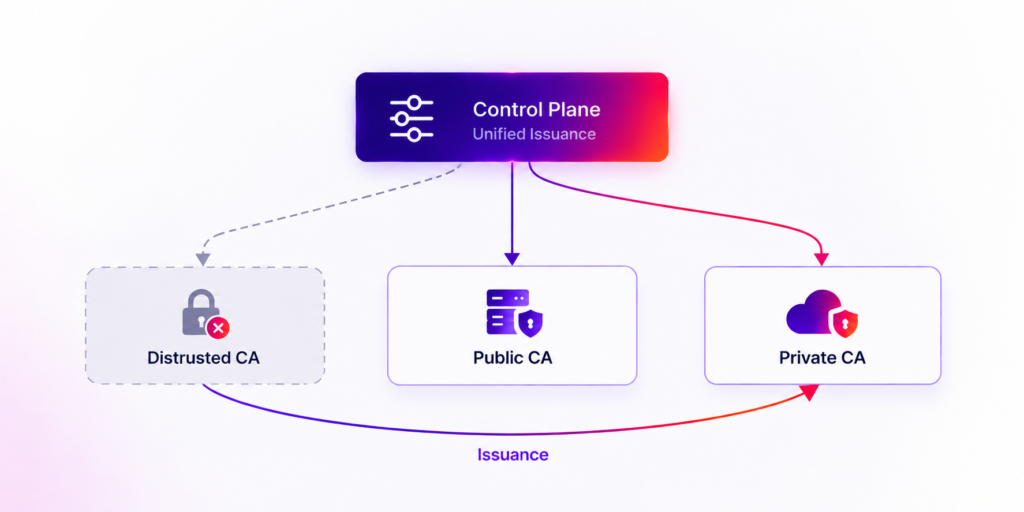
CA-agility is the ability to move issuance from one CA to another quickly, in response to a browser distrust event, a mis-issuance, or a CA compromise. Crypto-agility is the ability to change cryptographic algorithms across the estate as standards evolve. When the estate is already managed, moving between CAs or re-keying to post-quantum algorithms is a lifecycle operation on known certificates.
The quantum transition has a published timeline. NIST finalized its post-quantum cryptography (PQC) standards, FIPS 203, 204, and 205, in August 2024. NIST IR 8547 deprecates quantum-vulnerable public-key algorithms after 2030 and disallows them after 2035. Plan the CA strategy now to account for that transition.
Evaluating certificate authority tools
A CA management tool earns its place by enforcing decisions at issuance. The practical question for any tool is which capabilities are must-haves and which are optional for your estate.
Treat these as must-haves:
- Discovery that finds certificates across on-premise and cloud environments, including certificates issued outside official channels
- Support for public and private CAs together, with no lock-in to one CA
- Policy and role-based access control applied at issuance
- Automated enrollment and renewal through ACME, SCEP, and EST
- Audit-ready logging and reporting
Treat these as easy to oversell:
- Dashboards that report on certificates without enforcing policy
- Agents required on every host
- Features tied to a single CA that break portability
Match scope to the estate. A small internal-only environment may not need every capability, though discovery and automated renewal are the floor. Avoiding CA lock-in matters in any environment where you run more than one CA or expect to change one, and a CA-agnostic platform that integrates with public and private CAs, HSMs, and cloud services keeps existing investments in place while consolidating issuers without a rebuild.
How AppViewX approaches certificate authority management
You can bring every CA and certificate into view, apply policy at issuance, prove how any certificate was issued, and change issuers or algorithms when a distrust event or a standards deadline calls for it. That is where strong certificate authority management puts you, and it is what AppViewX is built to support.
AVX CLM discovers, issues, renews, revokes, and monitors certificates across public and private CAs from one place, while enforcing consistent policy and role-based access control. AVX PKI, generally available, provides a private certificate authority and root of trust, with keys held in HSMs and support for post-quantum algorithms. Together they deliver CA-agility and crypto-agility while keeping you free to move between CAs.
As the schedule tightens through 2029, teams that automate certificate authority management now will handle each change as part of normal operations.

Tags
About the Author