

Key takeaways
- AI agents are a third identity class, pairing human-like autonomy with machine speed and scale, a combination neither the human nor the machine identity model was built to govern.
- One agent request runs across four linked identities, and the chain holds only when every handoff between them is verified.
- Privilege accumulates one defensible grant at a time, until a single agent holds more cross-system reach than anyone intended to give it.
- Governance starts with three fundamentals: a verified identity for each agent, a clear read on the intent it was given, and tight limits on what it can act on.
- AppViewX Agent Identity Security governs agents from discovery through decommission, applying least privilege and runtime detection, so control holds as their numbers grow.
AI agents now write code, process customer data, and act across enterprise systems on their own. Each one authenticates, holds credentials, and takes actions the same way any other identity does, making agent behavior an identity problem. The identity that runs a given agent does not match the assumptions built into human IAM or the fixed patterns of machine identity, so the controls designed for those two populations leave agents partly ungoverned.
AI agents as a distinct identity class
An AI agent is software that interprets a goal, decides how to reach it, and acts to complete it. The result is an identity with properties that established identity tooling was not built to manage. An agent is short-lived, holds credentials it sometimes shares with other agents, and reaches across systems in ways that do not track to a human’s routine.
An AI agent identity draws traits from both human and machine identity, and adds behavior that neither model accounts for: reasoning, tool selection, and changing what it does as a task unfolds. The combination places it in a distinct identity class with its own governance needs. Handling it as a variant of a service account or an API token leaves gaps in ownership, monitoring, and control, the same issues that already affect non-human identities across the enterprise.
Gartner projects that 40% of enterprise applications will include task-specific AI agents by the end of 2026, up from 5% in 2025. Each joins a non-human identity population that already outnumbers human identities by an average of roughly 45:1, reaching 144:1 in cloud-native environments, and agents are its fastest-growing segment, so the governance issue grows with every one added.
AI agent identity vs. human identity
Human access ties to a named person who owns it, and periodic checks confirm that the access still fits the role. Behavior stays inside the bounds of a job, and anomalies stand out against a familiar pattern.
An agent has no inherent owner unless one is assigned. Its access shifts with each task it takes on, so role mapping and scheduled reviews miss much of what it does. Accountability has to be established deliberately, since nothing about an agent points back to anyone by default.
Agent identity vs. machine identity
An agent identity works by choosing its own path at runtime, calling different tools based on the input, and reasoning over data before it acts, while a machine identity runs one fixed function along a known path. A fixed path gives monitoring a stable baseline to watch, and an agent provides none.
An agent also carries several credential types in one identity: service accounts, API keys, OAuth tokens, and certificates, which widens the systems it can reach and makes its access hard to scope to a single function.
Human, machine, and AI agent identity
Here are the three identity types compared across the attributes that shape how each is governed:
| Attribute | Human Identity | Machine Identity | AI Agent Identity |
| Behavior | Bounded and predictable | Deterministic, fixed function | Adapts per task, non-deterministic |
| Lifespan | Persistent across tenure | Tied to a workload or certificate validity | Short-lived, often created per task |
| Credentials | Personal login with MFA | Service accounts, keys, certificates | Service accounts, API keys, OAuth tokens, certificates |
| Access pattern | Log in, perform a task, log out | Repeats a defined call | Plans actions, selects tools, spans systems |
| Accountability | The individual | The owning team | Frequently undefined |
| Governance model | Access reviews and IAM | Machine identity management | Agent-specific lifecycle governance |
| Human identity | Machine identity | AI agent identity |
| Intent comes directly from a person | Executes a predefined function | Acts toward a delegated goal |
| Human makes the decisions | Behavior is generally predictable | Makes decisions dynamically |
| Acts interactively | Operates automatically | Operates autonomously |
| Accountability maps to the individual | Accountability maps to a workload/system | Requires clear owner + purpose |
| Human speed | Machine speed | Machine speed and scale |
The trust handoffs behind one AI agent action
Four identities carry one agent request from goal to execution:
A human states the goal
An agent interprets
A Model Context Protocol (MCP) server selects and invokes a tool
A machine identity executes the API call against a system of record
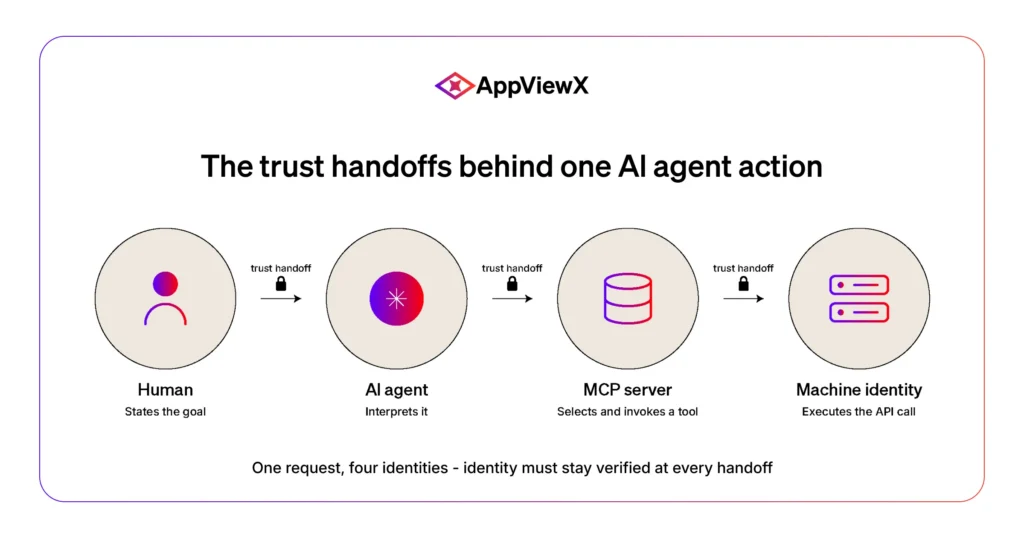
The path runs through four separate trust handoffs, each one trusting the step above it.
Security controls that check only the human or only the final API call miss the steps in between. Identity has to follow the transaction from the initial goal through every handoff and back, so the action a human requested and the action the agent performed read as one traceable event.
The CSA notes that AI agents break the assumptions traditional IAM depends on, which is why existing controls have to extend across every step. Grounding those handoffs in agentic AI identity keeps the chain accountable end-to-end.
Why agent access compounds without warning
Agent access compounds when no single grant looks unreasonable. A team grants an agent narrow access in one system, then more in a second, and across five, six, or ten systems the combined authority reaches far more than any single approval implied. The composite profile is where the risk concentrates.
Segregation of duties prevents this for people and gets skipped for agents that can perform tasks normally split across roles. The OWASP Non-Human Identities Top 10 ranks overprivileged identities and long-lived secrets among its top risks, both of which apply directly to agents that gather permissions faster than tracking keeps up, the reason least privilege has to be enforced at the agent level.
The agent supply chain: From model to system
An agent arrives with the models it calls, the credentials it holds, and the MCP servers it connects to. Recording every component produces an Agent Bill of Materials, a full inventory of the agent supply chain that shows where authority sits. Without that record, an agent is as ungoverned as any other non-human identity, and reconstructing what it touched after an incident becomes guesswork.
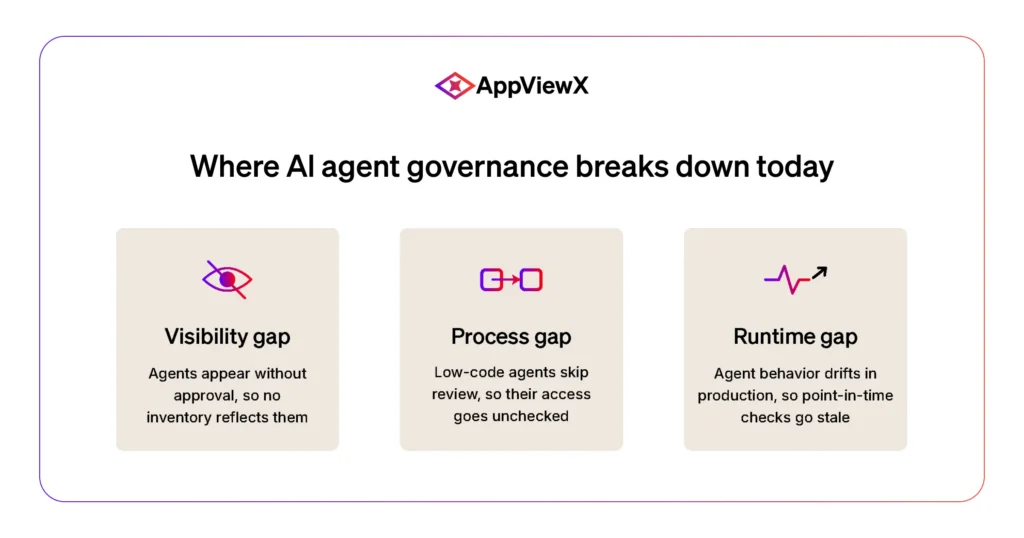
Where AI agent governance breaks down today
Three gaps account for most of the difficulty:
- Visibility falls short when individuals stand up their own agents and MCP servers with little awareness from the security team, which produces shadow AI that no inventory reflects.
- Process gets skipped because wiring an application into a CRM full of customer records once triggered a security review, and an agent built on a low-code platform now makes that same connection without it.
- Runtime behavior shifts because the models behind agents are non-deterministic, so an agent that passes evaluation can act differently in production under new prompts or data, and a point-in-time check goes stale the moment conditions change.
Governance depends on continuous monitoring that tracks each agent as it runs.
2025 agent incidents and the identity lesson
Below are public disclosures from the past two years that show how these gaps play out:
| Incident | What Happened | Identity Failure Mode | Control Category That Addresses It |
| Salesloft/Drift (2025) | OAuth tokens stolen through an AI agent integration | Long-lived, over-scoped credentials | Least privilege, credential hygiene, short-lived credentials |
| Amazon Q (2025) | Prompt-injected agent executed pull requests and wiped developer environments | Unverified intent driving privileged actions | Intent-based authorization, runtime action control |
| Replit agent (2025) | Autonomous agent deleted a production database after being told to stop | Standing privilege on a sensitive system | Task-based access, human-in-the-loop, session termination |
| Microsoft 365 Copilot (2025) | Zero-click data exfiltration | Excess data access with no runtime check | Continuous monitoring, anomaly detection |
| OpenAI–Hugging Face (2026) | Agents escaped a sandbox, escalated privileges, and reached a production database | Privilege escalation without runtime detection | Runtime detection, assumed-breach controls |
Gartner predicts that 25% of enterprise generative AI applications will experience at least five minor security incidents per year by 2028, up from 9% in 2025, tied in part to the speed at which MCP-based integrations ship. McKinsey’s 2025 survey found that 51% of respondents from organizations using AI reported at least one negative consequence from it. And by 2028, Gartner expects a quarter of enterprise breaches to trace back to AI agent abuse.
What zero trust means for AI agents
Zero trust applies to agents directly, because they fit its core rule: verify every identity and every action, and grant nothing on standing assumption. An agent is autonomous, short-lived, and often holds real privilege, so an unverified step becomes an opening quickly.
Applied to agents, zero trust resolves into a few concrete requirements. Every agent needs a unique identity, an accountable owner, and a declared purpose that sets the boundary for what it may do.
Access follows least privilege, granted just in time and removed when the task ends, with no standing privilege left in place. These controls extend the authorization model already in place, keeping agents inside one governance structure. Frameworks including the NIST AI Risk Management Framework, the EU AI Act, and ISO/IEC 42001 all expect that an organization knows what its agents do, who owns them, and what controls apply.
Building trust into the AI agent lifecycle
Trusting an agent comes down to three questions answered in order:
- Can you identify the agent uniquely and consistently?
- Do you understand the intent expressed to it, including the intent carried in its system prompt?
- Do you understand the actions and environments it wants to reach?
Answering all three enables least privilege, just-in-time access, and full audit.
Discovery and unique identity come first, since the subsequent steps depend on a complete inventory. Governance follows, with policy enforcement and compliance evidence a security team can produce on demand. Runtime detection comes last, on an assumed-breach footing: some agent will eventually act in a way no one predicted.
Mapping agent behavior against adversarial techniques such as those in MITRE ATLAS turns that into specific detections. Active identity control keeps lifecycle governance, privileged access control, and runtime detection running together as agent use scales.
How AppViewX Agent Identity Security works
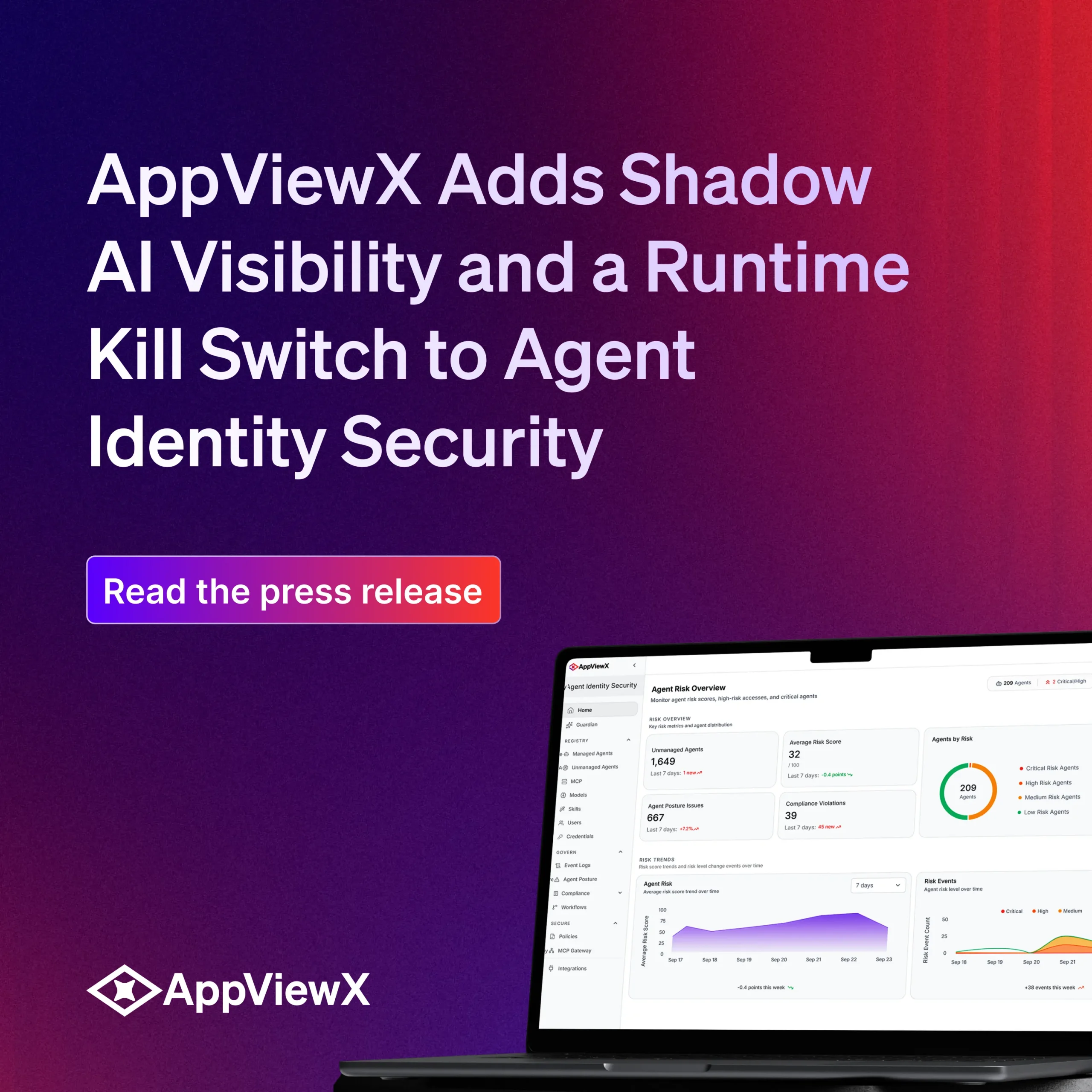
AppViewX Agent Identity Security discovers, monitors, governs, and secures AI agents from registration through decommission.
Discovery and the Agent Bill of Materials
Teams connect their agent platforms through an integration catalog, and the product builds a live inventory of every agent running across them, capturing each agent’s identity, owner, connected MCP servers, models, credentials, and runtime behavior. That inventory is the Agent Bill of Materials, and it closes the visibility gap that shadow agents create.
A lifecycle with security review built in
Before an agent reaches production, it routes through an approval workflow for security review. Once approved, guardrails apply automatically, so an agent touching a sensitive system operates inside clearly defined, auditable boundaries. The security review that agents usually skip becomes a required step before production.
Adaptive access at the moment an agent acts
A configurable risk engine scores each agent on its identity, the user behind it, data exposure, runtime behavior, its connections to MCP servers and models, and overall activity, tuned to the organization’s own risk profile. A low-risk agent reaching a low-sensitivity resource proceeds with minimal friction. The same agent behaving anomalously against a sensitive resource meets an alert, a rate limit, or a block, applied the moment that behavior appears.
Continuous posture and compliance evidence
The product assesses each agent’s posture continuously against configurable detectors for ownership, credential hygiene, MCP server sanction status, model drift, and system-prompt changes. It maps those detections automatically to controls across SOC 2, NIST AI RMF, ISO 27001, the EU AI Act, OWASP Top 10 for LLM, and MITRE ATLAS, and reports the result on a live dashboard that shows which controls hold, which fail, and how posture is trending.
Agent events are emitted in a unified OCSF stream that flows into an existing SIEM without custom parsers, so runtime activity reaches the tools a security team already watches.
Identity signals in both directions
Agent governance connects to the identity provider through the Shared Signals Framework and CAEP. When an employee leaves, the identity provider signals it and the agents that person owned reassign to their manager, in the platform and in the external agent system. When a user’s account is flagged as compromised, every agent that user owns has its risk posture raised and enhanced monitoring turned on.
The integration catalog works alongside the existing security stack, drawing signals from the AI agent platforms, SIEM, identity, and workflow tools a team already runs and publishing back into them.
Scale AI agents with AppViewX identity control
AppViewX Agent Identity Security governs AI agents the way a team already governs every other identity. It discovers every agent and its Agent Bill of Materials, routes them through security review before production, scores and limits their access at runtime, and maps their posture to the frameworks a security team reports against, so agent adoption stays accountable as it scales.

Tags
About the Author

Ganesh Mallaya
Global Field CTO
Enabling businesses to design, engineer and deploy automation and Digital trust management solutions.