




Key takeaways
- Non-human identities are digital credentials that authenticate machines, applications, and devices. Certificates serve as the foundational layer because they verify identity at the protocol level for every HTTPS connection, API call, and cloud deployment.
- Certificate failures cause immediate revenue loss through outages, while compromised credentials give attackers trusted system access.
- Machine identities outnumber human users 45:1 and are growing 44% year-over-year as cloud, AI, and containerization accelerate.
- The 47-day validity mandate requires eight times more renewals, while traditional IAM platforms lack discovery and automation at this scale.
- Organizations need agentless discovery, end-to-end automation, policy enforcement, and crypto-agility for requirements like post-quantum cryptography.
A non-human identity is the digital credential authenticating machines, applications, and devices across your infrastructure. Every customer transaction, API call, and cloud deployment depends on these credentials: digital certificates, cryptographic keys, and API tokens.
These credentials work like digital driver’s licenses for machines. When your browser connects to a website via HTTPS, a TLS certificate proves the server is legitimate. When a microservice calls an API, a certificate or token verifies the requesting application. When a container deploys in Kubernetes, certificates enable secure pod-to-pod communication.
Non-human identities span multiple credential types, each serving specific purposes:
- Digital certificates authenticate web servers and APIs via TLS/SSL
- SSH keys enable automated server access and deployments
- API tokens verify service-to-service calls
- Code-signing certificates prove software integrity
- Encryption keys protect stored and transmitted data
Machines require continuous, automated authentication. Your servers authenticate with every transaction, every millisecond.
Why certificates are the foundation of non-human identity
Digital certificates represent the most critical subset of non-human identities because they authenticate machine-to-machine communication at the protocol level. Every HTTPS connection, API call, container deployment, and cloud service interaction relies on TLS/SSL certificates to prove identity and establish secure encrypted connections.
Certificates differ from other credentials in critical ways:
- Infrastructure-level authentication – Certificates verify identity at the protocol layer, not just the application layer, like API tokens or SSH keys.
- Cascading failure impact – An expired API token breaks one application; an expired certificate breaks entire services, websites, and deployment pipelines.
- Continuous verification – Certificates authenticate every transaction, not just initial login, making them essential for zero-trust architectures.
Modern security frameworks increasingly rely on certificate-based authentication. Zero-trust architectures require continuous verification of every connection, and certificates provide the cryptographic foundation for that verification across hybrid and multi-cloud environments.
How non-human identities affect your business
Your revenue depends on machines that outnumber employees 45 to 1. When these identities fail, your business stops. When they’re compromised, attackers gain direct access to critical infrastructure and data causing financial and reputational damage. When unmanaged, you fail audits and lose customers.
Certificate outages cause immediate revenue loss
When a certificate expires on your e-commerce platform, customers can’t complete purchases. When certificates fail in your SaaS application, you breach service level agreements and trigger penalties. When authentication breaks in critical infrastructure, operations halt entirely.
Real examples:
- Airlines grounded flights after certificate failures
- Financial institutions locked customers out of mobile banking
- Healthcare providers delayed patient care
These were not caused by cyberattacks. They were preventable failures caused by expired or misconfigured certificates.
Compromised machine credentials enable breach escalation
A compromised certificate authenticates attackers as a trusted service across production systems, databases, and APIs simultaneously. Orphaned certificates (active after services are decommissioned) create persistent backdoors. Credentials with excessive permissions enable rapid lateral movement. Each unmanaged identity expands your attack surface.
SOC 2, ISO 27001, and PCI DSS all require proof that you know which certificates exist, who manages them, and that they meet standards. According to IBM Security research, the average cost of a data breach is $4.88 million. Failed audits delay deal closures. Prospects reject vendors without security maturity proof. Insurance premiums spike.
Operational burden without automation
Manual certificate management consumes engineering and IT resources that should focus on innovation. Teams track expiration dates in spreadsheets, coordinate renewals across email threads, and scramble to identify affected systems when certificates approach expiration. A single certificate renewal can require coordination between security teams who approve requests, DevOps teams who deploy certificates, and application teams who restart services.
This operational burden multiplies with infrastructure scale. Organizations managing thousands of certificates face constant fire drills. On-call rotations expand to cover weekend certificate deployments. The labor cost exceeds the certificate cost itself, yet provides no strategic value to the business.
Request a demo to see how AppViewX enables comprehensive
machine identity management at enterprise scale.
Non-human identities are growing exponentially
Organizations with 10,000 employees manage 500,000 to 1,000,000 machine identities. Non-human identities outnumber human users 45:1 and grow 44% every year.
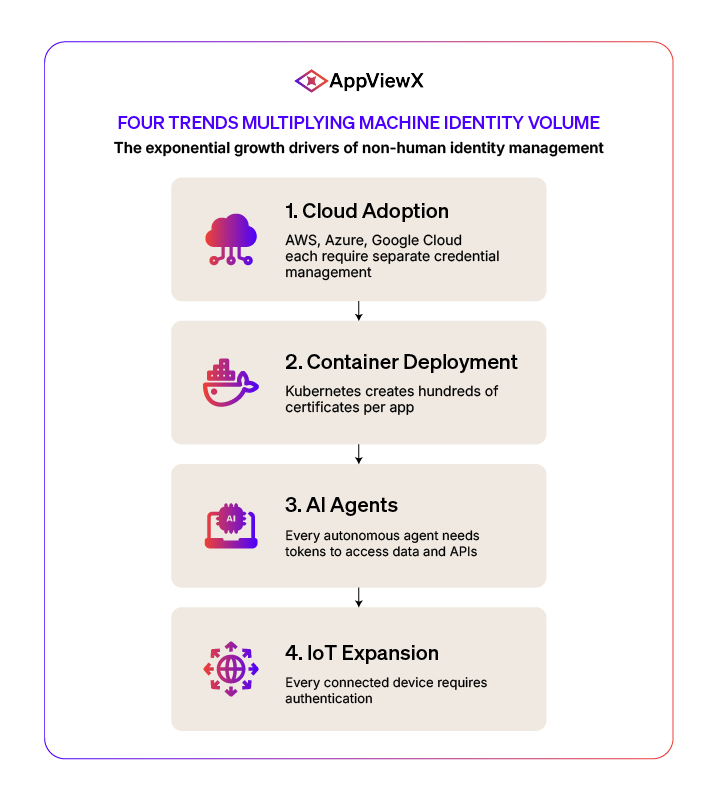
Four trends multiplying machine identity volume:
| Driver | What’s happening |
| Cloud adoption | AWS, Azure, and Google Cloud each require separate credential management |
| Container deployment | Kubernetes creates hundreds of certificates per app |
| AI agents | Every autonomous agent needs tokens to access data and APIs |
| IoT expansion | Every connected device requires authentication |
A customer-facing API certificate might be provisioned by DevOps, managed by platform teams, monitored by security, and relied upon by applications. When it expires, who owns the renewal? Traditional IAM assumes interactive users who reset passwords and approve MFA prompts. Machines authenticate programmatically, continuously, and at massive scale without any human intervention.
Traditional IAM platforms also lack certificate discovery capabilities. HR systems provide complete employee lists, but no equivalent exists for certificates provisioned through deployment pipelines, cloud services, and container platforms. This creates blind spots that lead to expired certificates and security gaps.
Why addressing machine identity management is urgent
Three converging forces create immediate pressure to modernize machine identity management. The CA/Browser Forum’s mandate reduces certificate validity to 47 days by 2029, requiring organizations to renew certificates eight times more frequently than current practice. AI and automation deployments are accelerating, with AI systems tripling in recent years and each autonomous agent requiring its own credentials.
Meanwhile, multi-cloud adoption has reached 89% of organizations, fragmenting certificate management across incompatible platforms. These trends intersect to create a perfect storm: more credentials, shorter lifespans, and greater infrastructure complexity. Organizations that wait to implement automated governance will face recurring outages, compliance failures, and security breaches that manual processes cannot prevent.
How to build automated machine identity management
Organizations need platforms that deliver visibility, automation, and governance at scale. The table below outlines the core capabilities required for effective machine identity management, explaining what each capability does, how to implement it, and the business impact it delivers.
| Capability | What it does | How to implement | Business impact |
| Smart discovery |
|
Run agentless scans | Know what depends on each certificate and who owns it |
| Closed-loop automation |
|
Integrate with CAs and configure workflows | Fewer incidents, lower costs |
| Policy enforcement |
|
Set policies and enable validation | Prevent non-compliant certificates and prove compliance |
| Crypto-agility |
|
Establish migration process | Ready for quantum-resistant algorithms by 2030 (NIST) |
Business benefits of automated machine identity management
Organizations implementing comprehensive machine identity platforms gain strategic advantages. Automated certificate management removes credential bottlenecks from deployment pipelines, enabling faster cloud migration and microservices adoption. Development teams ship features without waiting for manual provisioning.
Eliminating manual renewal labor, preventing outages, and streamlining compliance delivers measurable ROI. Engineering resources redirect from repetitive tasks to strategic initiatives. The automation infrastructure built today enables systematic responses to future cryptographic changes and post-quantum migration.
According to Gartner research, 63% of organizations worldwide have implemented zero-trust strategies. Machine identity management provides the certificate-based authentication foundation required for zero-trust architecture implementation, reducing attack surface and demonstrating security maturity to customers and partners.
What to look for in a machine identity management platform
Security-conscious organizations need platforms that deliver comprehensive capabilities at enterprise scale. When evaluating solutions, prioritize:
- Agentless discovery that scans entire environments without software installation, identifying certificates across on-premises infrastructure, AWS, Azure, Google Cloud, Kubernetes clusters, and IoT devices.
- End-to-end automation that generates certificate requests, submits to certificate authorities, deploys to infrastructure, and schedules renewals before expiration. Look for integration with multiple CAs to enable CA-agility without vendor lock-in.
- Policy enforcement and compliance that prevents non-compliant certificates before issuance, generates audit trails for SOC 2, ISO 27001, and PCI DSS, and provides executive visibility into cryptographic posture through dashboards and scorecards.
- Preparation for future requirements, including 47-day validity readiness and crypto-agility for post-quantum cryptography migration.
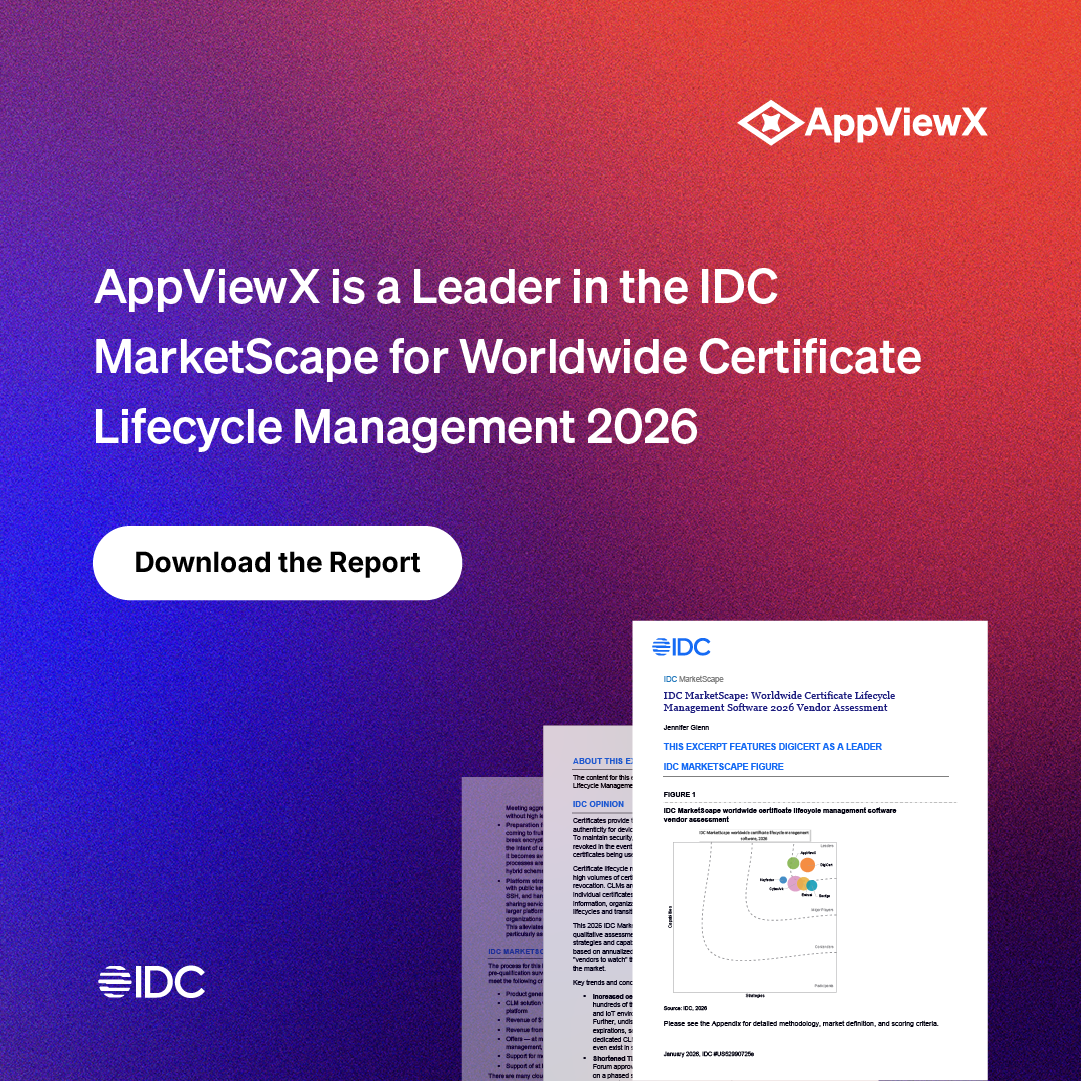
AppViewX, recognized as a leader in the 2026 IDC MarketScape for Certificate Lifecycle Management and Overall Leader by KuppingerCole, delivers these capabilities at enterprise scale, managing hundreds of thousands of certificates across global infrastructure.
Machine identities are multiplying faster than traditional management approaches can handle. Organizations that build automated governance now will prevent disruptions, strengthen security, and accelerate innovation.
Tags
About the Author

Rohan Ramesh
Director of Product Management, AppViewX
Product leader who has worked with global teams to successfully launch and scale enterprise products in cyber security, networking and cloud. Rohan is experienced in leading cross functional teams and managing multiple product portfolios.