

Key takeaways
- The top PKI management platforms in 2026 fall into three groups: legacy certificate authority tools, cloud CA services, and unified platforms that combine certificate lifecycle management with private PKI. The strongest fit depends on whether a team requires standalone issuance or full lifecycle automation with crypto-agility built in.
- CA-agnostic platforms give security teams the freedom to issue from any certificate authority and switch when needed, which matters more every year as validity periods shrink.
- Post-quantum readiness has moved from a roadmap item to a buying criterion since the algorithms are now standardized, and migration timelines are set.
- The platforms that win evaluations pair automated discovery and renewal with policy governance.
- For most enterprises leaving Microsoft ADCS, the right starting point is a platform with a guided migration path and native lifecycle automation.
Choosing a PKI management platform used to be a slow, infrequent decision, but when machine identities grew by 44% with a 144:1 ratio, everything changed. Each of those identities needs a certificate, and each certificate needs to be issued, tracked, renewed, and eventually retired.
For a fair and objective comparison of each leading platform, we measured each one against six criteria that separate capable tools from the rest:
- Lifecycle coverage from discovery through renewal and revocation
- CA independence from any single certificate authority
- Depth of automation across issuance, renewal, and deployment
- Post-quantum support for NIST-standardized algorithms
- Deployment flexibility across SaaS, on-premises, and hybrid
- Integration breadth with the systems teams already run
The sections below apply each of those criteria to the platforms most often shortlisted, then break down where each one succeeds.
The top PKI management platforms at a glance
The following table maps the leading platforms against each of the deciding criteria. This serves as a starting framework as capabilities shift quickly per vendor.
Platform comparison matrix
| Platform | Category | CLM Integrated | CA-Agnostic | PQC-Ready | Deployment |
| AppViewX | Unified Machine and Identity Platform | Yes | Yes | Yes | SaaS, on-prem, hybrid |
| Microsoft ADCS | Legacy CA | Limited | No | Limited | On-prem |
| DigiCert | CA + CLM + PKI | Yes | Partial | Yes | SaaS |
| Sectigo | CA + CLM + PKI | Yes | Partial | Developing | SaaS |
| Keyfactor | CLM + PKI | Yes | Yes | Yes | SaaS, on-prem |
| Entrust | CLM + PKI | Yes | Partial | Yes | SaaS, on-prem |
A pattern shows where tools built around a single certificate authority tend to pull customers toward that CA over time, limiting flexibility right when shorter certificate lifespans make flexibility valuable.
Platform-by-Platform breakdown
This comparison breaks down how each platform delivers in detail:
Unified platforms: AppViewX
AppViewX sits in the category that matters most for teams managing identity at scale, providing a single platform that unifies private PKI with full certificate lifecycle management. AppViewX bundles issuance and management so the same system that issues a certificate also discovers it, renews it, enforces policy on it, and retires it. Certificates get missed during handoffs between separate tools, and those missed certificates cause outages.
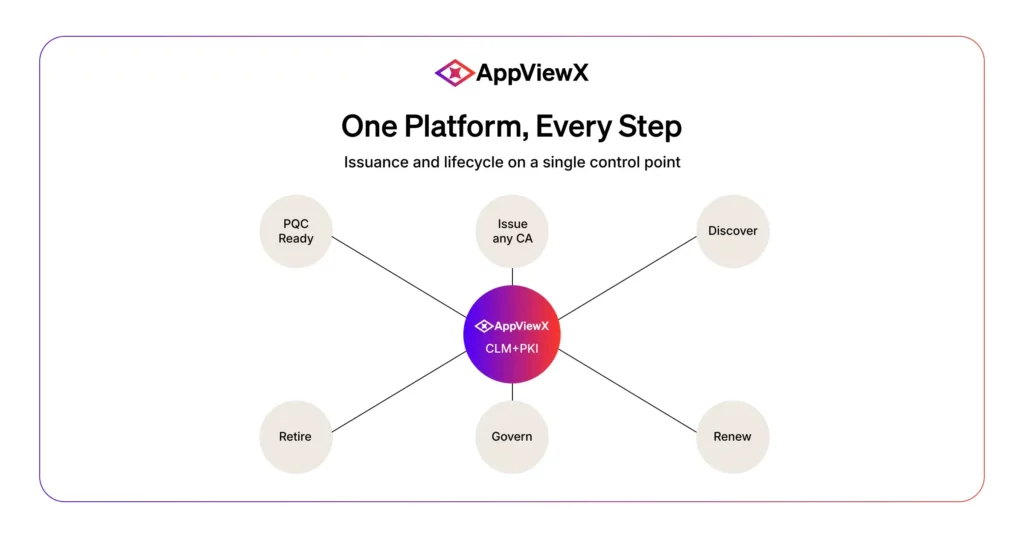
A few capabilities set it apart:
- CA-agnostic: Teams can issue from public or private authorities and move between them without rebuilding their workflows. This independence carries real weight as the industry shortens certificate lifespans, and certificate authority distrust events become more disruptive.
- Full chain certificate lifecycle management: The coverage runs from automated discovery across hybrid environments through closed-loop automation that renews and deploys certificates without manual steps.
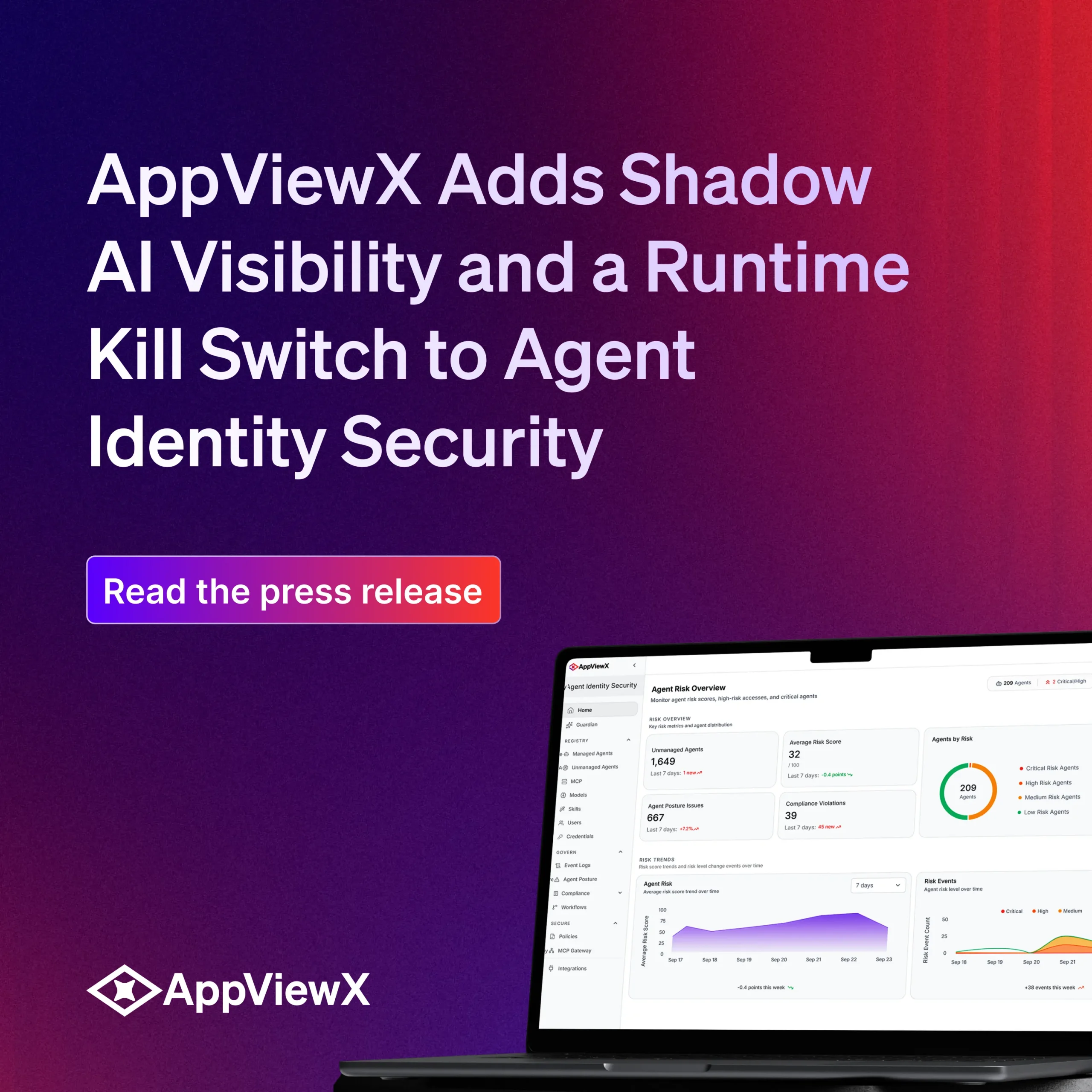
- Machine and agent identity management: The platform runs a full lifecycle for machine and AI agent identities alongside certificates and PKI, which matters as autonomous agents multiply and each one needs an identity that is issued, governed, and retired under one policy.
- Last-mile automations: Renewed certificates are pushed and bound to the endpoints that use them, with pre- and post-binding checks, so renewal reaches the server, load balancer, or workload.
That last point matters most in environments where workloads are short-lived by design, as Sysdig’s 2025 usage research found that 60% of containers now live for 60 seconds or less, making manual certificate handling impossible and rewarding automation that can keep pace.
On the issuance side, AppViewX runs as an enterprise-grade turnkey PKI. Teams can:
- Stand up certificate authority hierarchies and provision CAs in minutes
- Protect signing keys with FIPS 140-2 Level 3 hardware security modules or integrate your own
- Keep an air-gapped offline root for high-security environments
Meanwhile, on the quantum transition, AppViewX issues certificates using NIST-standardized post-quantum algorithms including ML-DSA and SLH-DSA, finalized in August 2024 as FIPS 203, 204, and 205, and supports hybrid composite certificates for teams running classical quantum-safe cryptography side by side. Paired with its crypto-agility capabilities, this lets organizations inventory cryptographic assets and shift algorithms as standards evolve.
AppViewX was named a leader in the 2026 IDC MarketScape for certificate lifecycle management software, and Forrester’s Total Economic Impact analysis puts the platform’s ROI at 302%.
It also supports modern enrollment protocols: ACME, REST, SCEP, EST, and CMP, allowing for automated issuance across Kubernetes, DevOps pipelines, IoT fleets, and traditional infrastructure from one control point. For teams that also need to govern machine and AI agent identities, that single point of governance becomes the platform’s real advantage, applying one consistent policy across every identity.
Legacy CA tools: Microsoft ADCS
Microsoft Active Directory Certificate Services (ADCS) anchored an internal PKI for two decades, remaining a reasonable fit for organizations whose certificate needs to stay inside a Windows and Active Directory environment. It ships with the operating system, integrates cleanly with domain-joined machines, and carries no additional licensing cost. For a small estate of internal certificates tied to Windows infrastructure, those qualities make it hard to argue against.
However, its limits show up as environments grow:
- ADCS is on-premises by design and was not built for cloud, container, or multi-cloud issuance
- It offers little native automation for discovery or renewal.
- It has no built-in way to find certificates issued outside its own hierarchy, leaving teams blind to the very sprawl that causes outages.
Teams scaling past their Windows estate often end up bolting on third-party tools to fill automation and visibility gaps and paying for a layered stack that a unified platform would replace. That is often the point where an ADCS migration comes in, particularly as the shift to shorter-term certificates makes manual renewal untenable.
CA-first suites: DigiCert, Sectigo, Entrust
DigiCert, Sectigo, and Entrust all come at PKI management from their public certificate authority roots. They each offer a strong, well-established trust foundation and have added certificate lifecycle management features over time. Entrust sits in this group differently, as it sold its public certificate business to Sectigo in 2025 and now centers identity, issuance, and post-quantum ready cryptographic solutions. For organizations that lean heavily on publicly trusted certificates and want issuance and management from one vendor, DigiCert and Sectigo remain credible options with a genuine public-trust pedigree.
However, because the management layer is built around the vendor’s own CA, the path of least resistance tends to keep issuance there, quietly eroding the CA independence. As certificate renewals become far more frequent, organizations benefit from automation that remains portable across CAs rather than being tied to a single vendor.
Their support for post-quantum issuance and cross-CA flexibility also varies between vendors and product tiers, so teams evaluating them should confirm exactly how much CA independence each one allows.
CLM + PKI: Keyfactor
Keyfactor comes closest as a functional comparison to a unified platform, providing certificate lifecycle management and PKI capabilities with CA-agnostic issuance and post-quantum support. For many teams, the choice is between Keyfactor and AppViewX, and three dimensions show where AppViewX pulls ahead:
- Platform breadth: AppViewX runs on a single code base across on-premises and SaaS with no bolt-on modules, so upgrades, patching, and feature parity stay consistent through a cloud transition.
- Deployment options: AppViewX is agentless by design and ships native Kubernetes certificate automation.
- Automation depth: AppViewX spans no-code (500+ out-of-the-box workflows), low-code (drag-and-drop builder), and full-code automation, with built-in last-mile automation and pre- and post-binding checks.
Teams that treat machine identity as a single growing surface will weigh breadth of governance heavily, which favors a platform built around unified identity.
Must-have vs. Nice-to-have capabilities
The split below separates what a serious enterprise platform should require from what is genuinely optional:
Capability priority matrix
| Capability | Must-Have | Nice-to-Have |
| CA-agnostic issuance | Yes | No |
| Automated discovery and renewal | Yes | No |
| Post-quantum algorithms (ML-DSA, SLH-DSA) | Yes | No |
| Protocol support (ACME, SCEP, EST, CMP) | Yes | No |
| Policy governance and enforcement | Yes | No |
| HSM integration | Yes | No |
| Self-service issuance portals | No | Yes |
| Custom reporting dashboards | No | Yes |
| White-label branding | No | Yes |
For a capability to be considered a must-have, it must be able to perform the following: protect against outages, support the shift to shorter-lived certificates, or ready an organization for the post-quantum transition, with validity periods shrinking down to 47 days by March 2029 under CA/Browser Forum Ballot SC-081v3, which passed with 29 votes in favor and none against, manual renewal stops being viable well before the deadline. The phased schedule has reached 200 days since March 2026 and continues to 100 days in 2027, so the pressure builds every year.
The optional features improve the experience but rarely decide whether an organization stays secure. A useful way to pressure-test a vendor is to ask how many of the must-have capabilities the platform delivers natively, since add-ons and partner integrations add cost and integration complexity.
Where to start with platform selection
Begin by shortlisting from the environments a team runs:
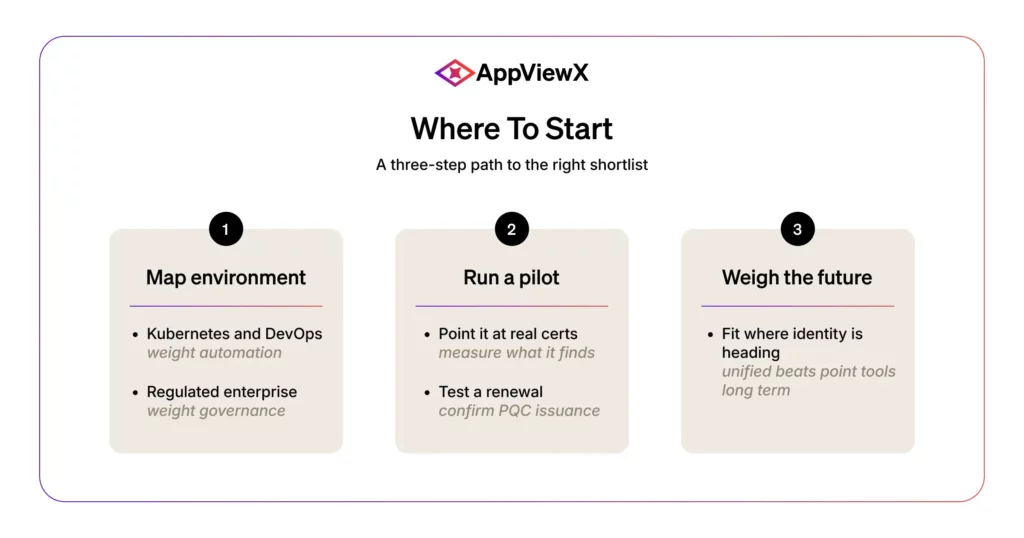
- Kubernetes and DevOps should weigh automation and API-first issuance.
- A regulated enterprise should weigh governance, HSM support, and audit depth.
- A team leaving Microsoft ADCS should treat a clean migration path as non-negotiable.
From there, run a focused pilot. Point the platform at a real slice of certificate inventory, measure what it discovers that the team did not know about and confirm it can issue PQC-safe certificates today. A platform that surfaces unknown certificates fast and renews them without handholding earns its place on the list.
Weigh fit against where identity management is heading. Gartner predicts that by 2028, 70% of CISOs will adopt identity visibility and intelligence platforms to shrink their attack surface, so a platform that already unifies certificate and machine identity management is the safer long-term bet.
See a demo of how a unified platform handles discovery, automation, and PQC issuance in a single workflow.
Why AppViewX comes out ahead
Held against the six criteria we established at the start, the platforms separate clearly: Legacy CA tools serve narrow, Windows-bound use cases. CA-first suites offer trusted issuance with some pull toward their own authority. Ultimately, unified platforms cover the widest ground overall, and among them, AppViewX leads in the combination that matters most, with integrated certificate lifecycle management, CA-agnostic issuance, native post-quantum support, and the flexibility to deploy as SaaS, on-premises, or hybrid.

Tags
About the Author

Krupa Patil
Product Marketing Manager
A content creator focused on providing readers and prospective buyers with accurate, useful, and latest product information to help them make better informed decisions.