

Key takeaways
- Securing SSL certificates against AI risk requires three operational controls: comprehensive discovery to find every identity, continuous automated renewal to keep pace with agent velocity, and centralized policy enforcement to maintain governance at scale.
- AI agents create machine identities at scale and velocity that outpace traditional certificate management processes.
- Shorter certificate lifespans make automation essential. Manual renewal processes cannot keep pace with continuous machine identity issuance.
- Identity sprawl creates blind spots where unmanaged certificates sit outside visibility, giving attackers valid credentials to exploit undetected.
- Post-quantum cryptography migration is a present concern. Adversaries are capturing encrypted traffic today to decrypt once quantum capability matures, so crypto-agility must be built in now.
- A unified certificate lifecycle management platform consolidates discovery, automation, governance, and crypto-agility into a single system. Scattered tools cannot enforce consistent governance at scale
AI adoption is adding autonomous agents to enterprise systems faster than security teams can track them. Each one authenticates, calls APIs, and moves data without a person involved, and like the servers and services already in place, it can only be trusted if it presents a valid credential, most often a certificate.
The certificate layer that once covered a predictable set of domains and servers now underpins a fast-growing population of autonomous workloads.
Securing SSL certificates in this environment is less about any single renewal and more about keeping visibility and control as machine identities increase. At its core, this is a scale problem
Why AI changes the SSL certificate equation
The core certificate challenge is the same as it has always been: keep every certificate accounted for, valid, and renewed before it expires. AI has not changed that in kind, it has changed it in scale. AI introduces a new class of identity that grows faster, lives shorter, and operates with less human oversight than anything before it.
Traditional certificate management assumed that certificates were mapped to a known set of servers and applications. The definition of good certificate management has not changed, but the volume and velocity it must handle have grown sharply.
Understanding the different types of machine identity
Machine identity is one label covering a range of identity types that behave very differently. How each one is created and how long it lives is what determines how hard it is to manage.
| Type | What it authenticates | Typical lifespan |
| Service account | Applications and services running automated tasks | Months to years, often long-lived |
| API key or token | System-to-system API calls | Hours to months |
| SSL certificate | Machine-to-machine connections and server identity | Days to a year, and shrinking |
| Workload identity | Cloud workloads, containers, and CI/CD jobs | Minutes to hours |
| AI agent identity | Autonomous agents acting across systems and tools | Seconds to minutes, created on demand |
As identities shift from living for months or years to turning over in minutes, issuing and renewing their certificates stops being a scheduled task and becomes a continuous one.
AI agents multiply machine identities
Machine identities already outnumber human ones by roughly 50 to 1 across most enterprises, and AI agents are widening that gap.
As organizations move agents from pilots into production, the count of machine identities climbs into territory that manual tracking was never built to handle. The growth comes from several directions at once:
- Each agent deployed adds a new identity that needs its own certificate, so the count climbs with every deployment.
- Agent interactions expand what must be governed. Every new system an agent authenticates to is another trust relationship to authorize, monitor, and revoke.
- Automated workflows spawn identities continuously. Short-lived workloads generate and retire credentials constantly throughout the day instead of once per year on a renewal cycle.
The result is a larger, more dynamic identity estate where certificates are issued and retired continuously.
Every agent needs a verifiable identity
An AI agent is only trustworthy if other systems can verify it is what it claims to be. That verification depends on a cryptographic identity, and a certificate is the most common and reliable way to establish one, the same mechanism that secures your APIs and services today.
An agent depends on this identity at every stage of its lifecycle: it is issued one when created, presents it to open a connection, and must pass verification before any service it calls will trust it. Agent sprawl, therefore, drives certificate sprawl.
The distinction that matters are between an identity that is issued and one that is governed. An agent can obtain a certificate in seconds, but without an owner, an expiry policy, and a place in a central inventory, that credential becomes a blind spot the moment it exists.
Managing AI identity and certificates as one problem is what keeps the trust layer coherent as the environment grows.
How AI introduces certificate risk
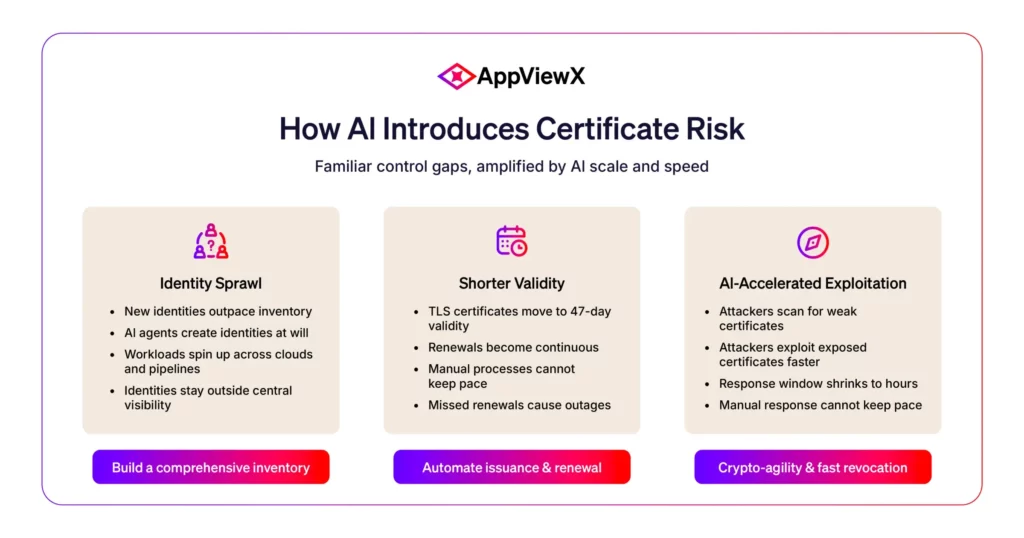
AI does not create new certificate risks. It amplifies familiar control gaps, widening them at a scale and speed that manual processes cannot match.
| Risk vector | Why AI amplifies it | What it takes to control |
| Identity sprawl | Agents create credentials outside central visibility | Continuous discovery |
| Shorter validity periods | Renewals outpace manual capacity | Automated renewal |
| AI-accelerated exploitation | Attackers find weak certificates faster | Crypto-agility and fast revocation |
Identity sprawl
When certificates and keys are issued faster than they can be cataloged, unmanaged identities accumulate. Each one is a valid credential that no one is watching, which widens the attack surface without anyone deciding to.
AI agents compound this by generating identities automatically, often in cloud and pipeline environments that sit outside the visibility of central security teams.
The gap is rarely a single dramatic failure. It is the steady buildup of certificates and keys that are issued but never recorded in an inventory, leaving more live credentials in the environment than any team can see, monitor, or revoke. An attacker who steals one of them can use it to authenticate into systems, and because no one is tracking that credential, the access can go undetected for months.
Shorter validity periods
Certificate lifetimes are shrinking, and the pressure lands on two different parts of your estate. Public-facing AI services running over HTTPS fall under the industry move toward 47-day TLS certificates by 2029. Internal agents and workloads are a separate case: they typically run on private PKI with lifetimes already far shorter than 47 days, sometimes hours.
Either way, the direction is the same. Renewal stops being a calendar event and becomes a continuous operation, and manual tracking cannot keep pace. A single missed renewal on a production agent means a broken connection or a service that suddenly stops trusting another.
AI-accelerated exploitation
The same automation that helps defenders also help attackers. AI lets adversaries scan for expired, weak, or exposed certificates and act on what they find faster than a manual response can match.
A credential that once might have gone unnoticed for weeks can now be discovered and abused in a far shorter window.
That compression is the shift that matters, because the time you have to respond is no longer measured in days.
How you can secure SSL certificates against AI risks
Getting started does not have to be complicated, and you do not have to act on everything at once. The table below lays out the actions to take and when each becomes necessary.
| Action | When to act | What it addresses |
| Discover and inventory certificates, keys, and machine identities | Immediately | Identity sprawl and blind spots |
| Automate certificate issuance and renewal | Immediately | Shorter lifespans and missed renewals |
| Enforce centralized policy and ownership | 1–5 years | Configuration drift and slow revocation |
| Apply least-privilege to agent identities | 1–5 years | Agent sprawl and over-privileged credentials |
| Build crypto-agility and CA-agility | Long term | Algorithm and CA changes at scale |
| Migrate to post-quantum cryptography | Long term | Harvest now, decrypt later attacks |

Futureproofing for post-quantum cryptography
Two forces are reshaping the cryptography behind every certificate you hold: shrinking certificate lifespans and the shift to post-quantum algorithms. Preparing for them now is an advantage, leaving it for later turns a routine shift into a scramble:
1. Continuous renewal is the new normal. Public-facing AI services will renew more often as TLS lifetimes shorten. Internal workloads are already on their own faster cycle, running short-lived certificates and workload identities that only automation can keep up with. Building for continuous reissuance now means every future cut lands without disruption.
2. Post-quantum cryptography is arriving. NIST has finalized its first post-quantum standards, and the transition away from today’s algorithms will eventually touch every certificate and key you hold, with US federal guidance targeting a phase-out of quantum-vulnerable cryptography by 2035. What makes this a present concern, well before large-scale quantum computers arrive, is harvest now, decrypt later: adversaries can capture encrypted traffic today and store it to decrypt once quantum capability matures.
Forward-thinking organizations are positioning now, so these shifts arrive as ordinary operations, built on crypto-agility.
The principles of effective certificate security
Effective certificate security rests on a few principles that hold whether you manage hundreds of certificates or hundreds of thousands: consistent visibility, automated action, and enforceable policy.
You cannot protect what you have not found. Comprehensive discovery gives you a single, current inventory of every certificate across:
- On-premises networks and internal services
- Public, private, and multi-cloud environments
- Containers, workloads, and CI/CD pipelines
This is the foundation, because every other control depends on knowing what exists.
Automate certificate renewal
Removing humans from the renewal path is the most effective step. Automated issuance and renewals allow you to:
- Eliminate missed-expiry outages
- Let your team operate at machine scale without adding headcount
- Enforce consistency, so every certificate is provisioned the same correct way
Enforce policy and ownership
At scale, certificates need clear owners and a consistent policy applied automatically. With centralized policies and clear ownership, you can:
- Keep key lengths, algorithms, and certificate authorities aligned to your standard
- Catch a non-compliant certificate at issuance
- Give every certificate an accountable owner, so it can be rotated or revoked quickly
Without ownership, urgent action stalls while teams work out whose certificate it is. Together, policy and ownership keep a growing estate from drifting out of compliance as it expands.
Extending certificate governance to AI agents
The same model that secures your certificates extends naturally to the AI agents that depend on them. Discovery, automation, and policy apply to AI agent identities just as they do to traditional machine identities
Discover machine identities
Bring AI agents and automated workloads into the same inventory as your certificates. Seeing agents and their credentials together gives you one accurate picture of every identity operating in your environment.
The value of a unified view is that it reflects reality: an agent and the certificate it relies on are a single trust relationship, and splitting them across systems is how gaps form.
One inventory also means one place to answer the questions that come up under pressure, such as which agents exist, what each can access, and which credentials are about to expire.
Apply least-privilege controls
Each machine identity should only carry the access it needs, and only for as long as it needs it. To enforce least-privilege, start with these three controls:
- Scope privileges to the agent’s actual function
- Bind every identity to a managed lifecycle
- Retire machine identities automatically once they are no longer in use
This keeps a compromised or abandoned agent from becoming a standing liability.
Manage certificates and AI identities with a CLM
Discovery, automation, policy, and agility work best on a single platform, not scattered across separate scripts and tools.
Certificate lifecycle management consolidates the full lifecycle, issuance, renewal, revocation, and policy into a single system that scales with your environment.
That consolidation is what makes consistent governance achievable as machine and agent identities multiply.
A capable platform should cover all of these:
- Complete certificate discovery and inventory: a single, current record of every certificate and key in your environment, so nothing goes untracked.
- Automated issuance and renewal: certificates are reissued without human intervention, so none lapse into an outage.
- Centralized policy and ownership: consistent standards are enforced at issuance, and every certificate has an accountable owner.
- Crypto-agility and CA-agility: algorithms and certificate authorities can be changed across the estate without disruption.
- Post-quantum readiness: the estate is prepared for the migration to quantum-resistant cryptography before it becomes urgent.
- AI agent identity governance: agent identities are held to the same controls as certificates and keys, so none operate ungoverned
How AppViewX secures machine and AI agent identities
AI has expanded the machine identity estate and accelerated how fast it changes, which turns consistent certificate management from a background task into a security priority.
AppViewX gives security teams one platform to discover, automate, and govern certificates, keys, and AI agent identities across multi-cloud and hybrid environments. It automates the full certificate lifecycle, enforces policy centrally, and includes crypto-agility and post-quantum readiness, so shorter lifespans, post-quantum migration, and AI agent growth become routine operations instead of disruptions.

Tags
About the Author

Krupa Patil
Product Marketing Manager
A content creator focused on providing readers and prospective buyers with accurate, useful, and latest product information to help them make better informed decisions.