

Key Takeaways
- SSL certificate verification is expanding in scope: shrinking validity periods and 10-day DCV reuse windows by 2029 mean manual processes will not scale.
- The four essentials of SSL certificate verification include chain-of-trust validation, cryptographic compliance, endpoint configuration, and policy enforcement.
- A phased approach, starting with comprehensive discovery, then automating policy and verification rules, and scaling to complex environments, gives teams a structured path to full automation without disruption.
- Your CLM platform should be CA-agnostic, protocol-flexible (ACME, EST, CMP), and capable of closed-loop remediation.
- Crypto-agility is the bridge between today’s verification requirements and tomorrow’s post-quantum migration; build it into your platform evaluation now.
What Happens during SSL Certificate Verification?
SSL certificate verification isn’t just about checking for expiration dates or identifying the Certificate Authority (CA). It comprises a series of layered processes such as validating the chain of trust, checking for cryptographic standard compliance, verifying endpoint configurations, and ensuring all organizational policies around CAs and certificates are adhered to.
The scope of the verification process is also expanding, after the CA/Browser Forum’s approval of Ballot SC-081v3. The ballot introduces a phased reduction schedule running from March 2026 through March 2029, covering both certificate validity periods and domain control validation (DCV) data reuse windows. By 2029, the domain control validation (DCV) reuse periods will shorten to 10 days, requiring certificate verification for almost every renewal.
We know that expired or poorly-configured certificates can put your security posture at risk. Now the question is: how can your organization verify and renew certificates spread across hybrid environments at scale as renewal deadlines keep shrinking? Under the same ballot, maximum certificate validity has already dropped from 398 days to the current 200 days, with a further reduction to 47 days coming by March 2029.
According to Qualys SSL Pulse’s June 2025 report, over 29% of the top 150,000 surveyed sites were not able to follow SSL/TLS best practices. The issues tied to this failure, incomplete certificate chains and weak ciphers, can be effectively addressed by certificate lifecycle management automation because it is built to catch and remediate them before they escalate.
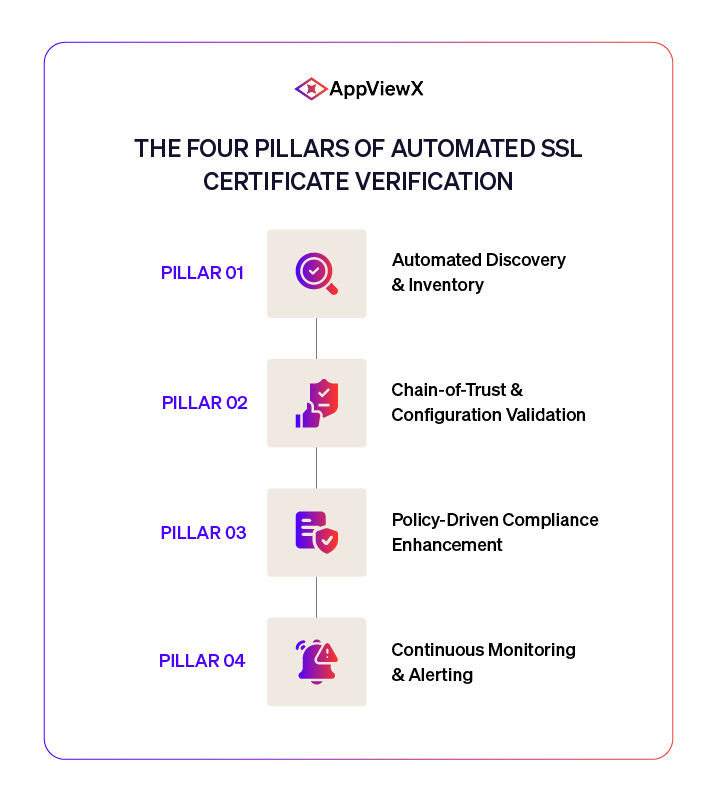
The Four Essentials of Automated SSL Certificate Verification
An automated SSL certificate verification system is built on four cornerstones that are designed to effectively validate certificates even at scale:
Automated Discovery and Inventory
You cannot verify what you cannot see, which makes automated certificate discovery the essential first step. Run an automated discovery scan to identify certificates across on-premises infrastructure, cloud platforms, load balancers, CDNs, container orchestration systems, and IoT endpoints.
For discovery to be genuinely effective, it needs to be broad, deep, and truly CA-agnostic, with out-of-the-box support for a wide ecosystem of CAs and PKI endpoints so you are not limited to a single provider or forced to build custom connectors for every environment. Pre-built integrations allow certificates to be imported directly into your inventory, reducing the risk of gaps that would otherwise leave certificates outside your verification scope. The result is a centralized inventory capturing the full picture for each certificate, including owner, location, expiration date, issuing CA, and compliance status.
AppViewX Smart Discovery covers this end-to-end, feeding findings from across your entire environment into a centralized inventory that serves as the single source of truth for your verification workflows.
Chain-of-Trust and Configuration Validation
With your inventory established, automated verification can systematically check each certificate’s chain of trust. During this process, the platform verifies that the certificate’s issuing CA is trustworthy, that all intermediates are accounted for and ordered accordingly, and that the end-entity certificate itself is correctly configured. Traditional and manual checks tend to miss these underlying configuration details, leading to audit failures. For example, an end-entity certificate might appear valid on its own, but if its intermediate certificate is either expired or missing, the entire chain breaks. When this happens, it can take IT teams hours of troubleshooting to identify the root cause, disrupting business operations in the process.
Beyond chain validation, automated configuration checks thoroughly scan vulnerabilities, such as weak cryptographic keys (RSA keys below 2048-bit), deprecated algorithms, mismatched Subject Alternative Names (SANs), and TLS protocol misconfigurations. The Qualys SSL Pulse report found that 15% of outages are due to expired or missing certificates. CompareCheapSSL’s State of SSL 2026 report shows that 9% of servers still use obsolete ciphers to cater to legacy systems. By automating these verification processes, you transform an error-prone, manual process into a seamless, reliable verification system that can surface any issues from the get-go.
Policy-Driven Compliance Enforcement
Verification is only as strong as the policies behind it. A reliable certificate automation solution helps establish and enforce rigorous security and cryptography policies, from approved CAs, certificate templates, algorithm standards, to minimum key lengths. This ensures that every certificate within your infrastructure is validated against your specific security requirements. Such policy enforcement is essential for organizations that must comply with strict regulatory mandates such as PCI-DSS, HIPAA, and the NIST Cybersecurity Framework.
When evaluating certificate automation solutions, compliance policy enforcement and reporting capabilities should be a key consideration. These features can help centralize the policy definition and apply rules consistently across your whole certificate environment. Pair it with crypto-agility (the ability to quickly adapt to evolving cryptographic requirements), and your policy enforcement process can give you a leg up in preparing for cryptographic transitions such as the eventual migration to post-quantum algorithms.
Continuous Monitoring and Alerting
To maintain compliance, continuous monitoring is a must. Real-time detection of hidden certificates, tracking of expiration deadlines, and alerting on policy violations and unauthorized issuance together keep your certificate environment protected 24/7. This is especially important when 47-day renewal cycles come around because it leaves little to no room for errors in the renewal cycle.
Closed-loop automation is particularly valuable here. When a certificate approaches its expiration date or drifts from policy, the system automatically triggers the renewal process from certificate validation through to installation, without waiting for manual intervention. This creates a self-healing certificate environment.
Evaluating Certificate Automation Protocols
Automating your certificate checks is only half the battle. To ensure absolute compliance, the protocol you choose to automate renewals must align with your verification strategy. Here is how the major automation protocols stack up when it comes to built-in verification:
| Protocol | Verification in Renewal | What This Means for Your Setup | Best Suited For |
| ACME (RFC 8555) | Built-in for every cycle | Domain control validation is mandatory and cannot be skipped. It is the strongest fit for automated verification, especially under 47-day renewal cycles. | Public-facing web servers and cloud-native applications |
| CMP (RFC 4210) | Built-in – configurable | Policy checks and cryptographic compliance can be enforced at the protocol level — certificates that violate standards are rejected before issuance, not discovered after. | Complex enterprise PKI with custom CAs |
| EST (RFC 7030) | Partial – enrollment only | Device identity is verified at initial enrollment, but subsequent renewals do not re-verify, a potential gap in environments where device posture changes over time. | IoT devices and internal PKI environments |
| SCEP Legacy |
Partial – shared secret only | No cryptographic policy enforcement is built in. Your CLM platform’s policy engine must compensate, making SCEP insufficient on its own for compliance-sensitive environments. | Microsoft environments and network infrastructure |
| REST APIs
CA-specific |
Manual – custom implementation | Verification logic must be explicitly built into the integration – powerful when done well, but blind spots emerge wherever implementation is incomplete. | DevOps pipelines and CI/CD certificate workflows |
In a study conducted by Mordor Intelligence, the global Certificate Authority market is said to have reached $208.7 million in 2025 and is expected to hit roughly $396.6 million by 2031, which is a growth rate of about 11.3%. This shows the sheer volume of certificates managed by organizations on a daily basis and the ever-growing need for automated lifecycle solutions that can help businesses stay ahead of the demands.
What Do I Look for in a Certificate Lifecycle Automation Platform?
Before you even think about interacting with vendors, you should be able to separate non-negotiable features from ones that can add value to your organization as your security posture matures. The table below outlines the different capabilities you should look for when choosing a certificate lifecycle automation platform and just how important those features are:
Feature Evaluation Criteria for Certificate Lifecycle Automation
| Feature | Priority | Why It Matters |
| CA-agnostic discovery across hybrid environments | Must-have | Ensures no certificates are missed, regardless of issuing CA or deployment location |
| Automated chain-of-trust validation | Must-have | Catches incomplete chains and misconfigurations before they cause failures |
| Policy engine with customizable rules | Must-have | Enforces your organization’s specific crypto and compliance standards |
| Real-time expiration alerting | Must-have | Critical under 47-day lifecycles where the margin for error is minimal |
| Integration with ACME, EST, and SCEP | Must-have | Ensures protocol flexibility across diverse infrastructure |
| Crypto-resilience scoring and PQC readiness | Nice-to-have (becoming essential) | Helps protect against quantum threats and algorithm transitions |
| Visual dashboards and executive reporting | Nice-to-have | Valuable for compliance audits and board-level communication |
| Self-service portal for certificate requests | Nice-to-have | Reduces bottlenecks but is not essential to verification automation |
Don’t forget to check for CA-agility or the ability to rapidly switch between certificate authorities. Should your certificate management system encounter any CA distrust incidents or changes in pricing or compliance requirements, you will have a solution that can handle them efficiently.
How do I Automate SSL Certificate Verification?
When automating your SSL certificate verification, a phased approach will provide your team with actionable steps that will enable them to build and scale automation without causing disruptions and deliver desired results. Here’s how to break it down:
Phase 1: Discovery (Weeks 1 – 3)
Having a comprehensive picture of your certificate infrastructure is the best starting point. Establish full visibility over your entire certificate environment before you jump to automating anything.
The goal of this phase is to build a single source of truth or a centralized inventory that can track all the certificates within your organization.
Be sure to…
- Run automated certificate discovery scans across your whole infrastructure (on-premise servers, cloud platforms, load balancers, container environments, and CDNs) to eliminate any blind spots.
- Catalog and organize your certificates into a single, centralized inventory based on specific metadata (issuing CA, key algorithm and length, expiration dates, deployment locations, etc.).
- Flag immediate risks like expired certificates that are still being used, certificates with weak keys, and unverified certificates.
- Assign certificate ownership for clear accountability and to ensure the efficiency of verification workflows.
- Establish your crypto baseline by documenting which certificate data (protocol versions, algorithms, key lengths, etc.) are currently in use.
Phase 2: Policy and Verification Automation (Weeks 4 – 8)
Once your inventory is ready, you can start by turning your security and compliance requirements into automated verification rules that can be incorporated into your certificate lifecycle. This will eliminate the need for manual intervention and thereby reduce human errors.
Be sure to…
- Define your verification policies that cover your full compliance posture, including approved CAs, algorithm standards, and minimum key lengths.
- Integrate with your chosen Certificate Authorities by utilizing standard automation protocols (ACME or EST).
- Install closed-loop automation workflows that can address verification failures by connecting them directly to remediation, without waiting for manual escalation.
- Connect your CLM platform to your ITSM tools so that verification failures automatically generate tracked incidents rather than relying on manual reporting.
- Test your policies before enforcing them to see which certificates will fail to work with your imposed rules.
Phase 3: Scale and Optimize (Months 3 – 6)
The last phase is all about extending automation where necessary. You can do this based on which systems are growing fastest or carry the most operational complexity. This will also help your security team prepare for cryptographic transitions, preventing any speed bumps when migration timelines accelerate.
Be sure to…
- Enable automated verification in Kubernetes and containerized environments so your system can manage certificates regardless of volume or validity period.
- Add IoT devices to your verification scope, as these devices are often deployed at scale in constrained environments where manual renewal is impractical.
- Implement crypto-resilience scoring to identify certificates using algorithms flagged for post-quantum migration, so your team is prepared when migration timelines accelerate.
- Optimize and refine your policies according to operational data case exemptions.
- Consolidate and align your PKI architecture with your automation goals. Explore enterprise PKI modernization strategies that can allow your infrastructure to support growing and complex verification demands.
Modernize Your SSL Certificate Lifecycle Automation with AppViewX
Shrinking validity periods, tightening DCV reuse windows, and the approaching transition to post-quantum cryptography are raising the bar for every organization managing certificates at scale. Manual verification workflows won’t hold up — and the margin for error is only getting smaller.
AppViewX offers the smart discovery, closed-loop automation, and policy enforcement you need to stay ahead, whether you’re building your certificate infrastructure from the ground up or modernizing an existing one.
Book a demo now and discover how AppViewX can bring your certificate verification system under control at any scale.
Tags
About the Author

Krupa Patil
Product Marketing Manager
A content creator focused on providing readers and prospective buyers with accurate, useful, and latest product information to help them make better informed decisions.