

AppViewX Autumn 2026 Product Update
A quantum computer capable of breaking today’s encryption doesn’t exist yet. However, cybercriminals are already harvesting your encrypted data and traffic today, stockpiling it for the moment quantum computing is available, making classical cryptography obsolete. And when this happens, your data will already be in their hands, and no patch or security solution will ever bring it back.
This is the threat landscape that defines 2026, and it’s why quantum readiness has moved from a future planning topic to an urgent board-level imperative. It is also why we have significantly expanded AppViewX Quantum Trust Hub (QTH) and our overall post-quantum cryptography (PQC) capabilities in the AppViewX Autumn 2026 release to enable end-to-end quantum readiness for cryptographic discovery, assessment, and PQC migration.
The Deadline Is Real
NIST finalized its first post-quantum cryptography standards in 2024 with FIPS 203, 204, and 205. On October 27, 2026, it put those standards on a schedule with its new transition guidance, NIST IR 8547: RSA and elliptic-curve algorithms, at every key size, will be deprecated after 2030 and disallowed after 2035. For federal high-value and high-impact systems, the deadlines arrive even sooner. Executive Order 14412 and OMB Memorandum M-26-15 require them to adopt PQC for key establishment by December 31, 2030, and for digital signatures by December 31, 2031. And NIST positions its guidance as a blueprint for critical infrastructure and other organizations, too.
Every day that passes under the current “harvest now, decrypt later” threat model adds another day’s worth of financial records, health data, intellectual property, and government secrets that may already be in an adversary’s archive, waiting for the day they can read them.
The Y2K crisis in 2000 had a fixed deadline, and the industry met it. Y2Q is a different threat entirely. There is no patch to deploy and no fixed date for when the threat arrives. NIST has now set a compliance timeline, but data harvested today doesn’t wait for 2035. Adversaries are already harvesting encrypted data today, betting that quantum decryption capability will arrive before enterprises finish migrating. That bet is more reasonable than most security teams want to admit.
The critical distinction of Y2Q: A cryptographic algorithm change must be right, complete, and executed before the window closes, and NIST notes that past cryptographic transitions have taken 10 to 20 years. In addition, this cannot be a point-in-time exercise but rather an ongoing program that focuses on crypto-agility and quantum-secure posture management.
Certificates Are the Tip of the Iceberg
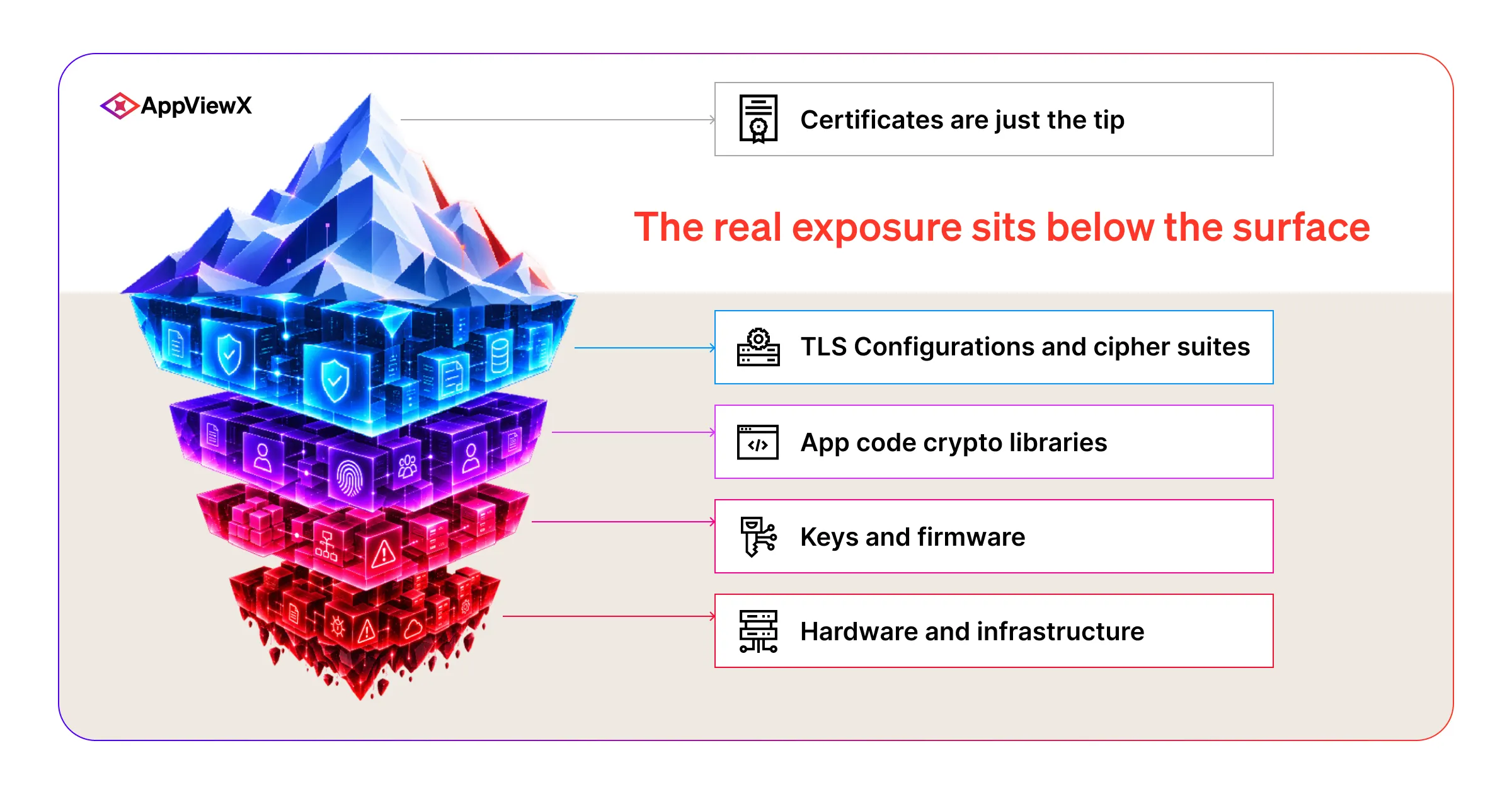
When organizations begin thinking about PQC migration and quantum readiness, the conversation usually starts with certificates. But certificates are only the identity layer. The real cryptographic attack surface lives much deeper.
Deploying a PQC certificate secures authentication, but if the TLS handshake still negotiates RSA, the session remains exposed to harvest-now-decrypt-later. Crypto libraries are embedded directly in application source code that no external scanner will ever reach. Firmware signing keys and HSM key material can’t be rotated remotely, baking in exposure windows measured in years. Network devices and load balancers may be running crypto that simply cannot be upgraded in place.
Focusing on certificates alone while ignoring this deeper stack creates a false sense of progress. NIST’s transition guidance points to the same stack: an application’s protocols, cryptographic libraries, hardware modules, and PKI all need updating for PQC. Migration requires full-stack cryptographic visibility, inventory, and risk assessment to enable prioritized remediation. That’s exactly what Quantum Trust Hub is designed to deliver.
Your Path to Quantum Readiness with AppViewX
AppViewX Quantum Trust Hub has been purpose-built from the ground up to address the complete PQC readiness challenge, not just the certificate layer. With the Autumn 2026 release, we’ve significantly deepened the capabilities across all three pillars of a complete migration program.
Discovery and Inventory: Agentless and agent-based discovery builds a single continuously updated inventory of cryptographic assets across certificates, TLS configurations, cipher suites, and application code libraries, with support for keys coming soon to cover the full attack surface.
Risk-Based Prioritization and Remediation: Every asset is assessed and categorized as Quantum Vulnerable or Quantum Resistant with detailed remediation steps to be taken, while prioritization of the quantum-vulnerable assets is anchored in business context. A cipher suite on a revenue-critical payment system does not pose the same risk as one in a development environment. Quantum Trust Hub makes sure you fix what matters first.
Crypto agility in action swaps algorithms and issues PQC or hybrid composite certificates on demand, rotating keys at scale without re-architecting applications. Quantum Trust Hub pairs natively with AppViewX PKI to roll out ML-DSA and SLH-DSA certificates (FIPS 204/205) and hybrid composite certificates that remain backward compatible with non-PQC systems while being quantum resistant for those that have upgraded.
Governance and Policy Enforcement: Custom PQC policies enforce and sustain your quantum security posture over time, ensuring every new certificate and configuration meets quantum-ready standards from day one. Quantum Trust Hub also generates a full cryptographic bill of materials (CBOM) with audit-ready compliance reporting.
AppViewX CLM works alongside Quantum Trust Hub and treats certificate lifetime as a security control that enables crypto agility. As the industry moves toward 47-day maximum certificate validity, driven by the CA/B Forum, automated lifecycle management becomes the practical mechanism for defeating harvest-now-decrypt-later attack windows. AppViewX CLM automates renewal across all major CAs, cloud environments, Kubernetes, and IoT, with event-driven mass revocation and certificate issuance to replace vulnerable certificates across the estate in minutes when algorithms are deprecated.
AppViewX PKI supports enterprises at every stage of quantum migration. It issues hybrid composite certificates (classical and PQC bundled in one cert for backward compatibility) alongside PQC-only certificates using NIST-standardized ML-DSA and SLH-DSA, so teams can migrate at the pace their infrastructure allows rather than waiting for full PQC readiness across every system. HSM-backed roots secure the root of trust, automation via ACME, REST, SCEP, and EST connects any system or workflow, and native CLM integration closes the loop on certificate lifecycle management from issuance through expiry and revocation.
AppViewX Code Signing extends quantum readiness into software supply chain trust. As PQC adoption accelerates, signing keys become a critical attack surface: a binary signed with a quantum-vulnerable key is as exposed as any certificate. AppViewX Code Signing supports HSM-backed PQC key generation for end-to-end quantum-safe signing workflows, ensuring that software, firmware, and artifact integrity remain trustworthy through the transition. Policy-driven signing controls and native CI/CD pipeline integration mean quantum-ready signing scales across engineering teams without introducing new operational overhead.
AppViewX SSH can help organizations replace static SSH keys with short-lived, certificate-based authentication, bringing the same lifecycle discipline used for TLS to SSH access. Automated issuance, rotation, and revocation eliminate standing exposure from orphaned keys, while centralized visibility ensures no SSH credential goes unaccounted for as the quantum migration progresses. Long-lived SSH keys are among the least visible cryptographic liabilities in the enterprise, and a prime target for harvest-now-decrypt-later attacks.
Autumn 2026 Product Update: New Quantum Readiness Capabilities
The Autumn 2026 release delivers additional enhancements across the AppViewX portfolio that accelerate enterprise PQC migration programs at every stage.
Agentless PQC Crypto Discovery via Qualys Integration: For organizations already running Qualys for vulnerability management, Quantum Trust Hub now integrates directly with existing scan infrastructure to discover PQC-relevant crypto assets without a new agent deployment. Frictionless onboarding, immediate inventory.
CBOM/SBOM Upload for Quantum Readiness Analysis: Import cryptographic bills of materials and software bills of materials produced by other solutions, such as EDRs, CSPMs, and third-party scanners, directly into Quantum Trust Hub for centralized analysis. A single dashboard view across the entire supply chain and application stack, with version-aware, prioritized remediation guidance.
ServiceNow Integration and Controlled Remediation: PQC inventory findings now flow directly into ITSM workflows in ServiceNow, with intelligent ticket grouping (one ticket per remediation scope, not per finding) and end-to-end tracking from discovery to closure. This is the integration that prevents migration programs from stalling at the handoff between security and IT operations.
Post-Quantum Certificate Lifecycle Management: AppViewX CLM now handles the full lifecycle of PQC certificates: discovery, PQC CSR generation, enrollment with PQC-capable CAs, and automated deployment to endpoints. The complete remediation loop, not just discovery.
HSM-Backed PQC Key Generation for PKI and Code Signing: Generate and protect post-quantum keys inside existing HSM infrastructure. Support for PQC algorithms across all supported HSM integrations gives teams a clear path to quantum-safe PKI hierarchies and code signing workflows without replacing hardware.
What Else Is Shipping This Autumn
Beyond quantum readiness, the Autumn 2026 release also delivers three capabilities your teams use every day, improving how you operate, automate, and govern your PKI, CLM, and SSH programs right now.
Prevent Certificate-Related Outages: ACME ARI (RFC 9773) support introduces server-driven renewal windows that make 47-day certificate lifetimes operationally practical and accelerate response when a CA needs to mass-reissue certificates. AI agents can now trigger CLM operations, including renewals, revocations, and regenerations, through natural language via MCP enhancements, extending automation into certificate workflows. AWS coverage expands with private key discovery from ACM and automated discovery and lifecycle management for certificates stored in S3 buckets. DCV automation enhancements add bulk parallel domain revalidation and automatic pre-submission validation checks to remove a key bottleneck in short-lived certificate workflows.
Modernize PKI, Cut Cost and Risk: A new CA policy framework lets administrators define reusable policy configurations derived from CPS documents, applied consistently during CA creation and renewal to reduce configuration drift. HTTP CRL publishing support for port 80 endpoints address real-world compatibility requirements in environments with legacy relying-party validation paths. Enhanced ADCS-to-AppViewX PKI migration tooling better supports large environments with multiple concurrent migration runs, adding clearer progress visibility and preventing duplicate migration attempts.
Secure Every Machine and Workload Identity: Support for GCP Workload Identity Federation eliminates long-lived service account keys in favor of short-lived federated credentials: fewer audit findings, lower incident-response cost, and a more scalable authentication model that aligns with zero trust. Unmanaged, long-lived SSH keys are replaced with short-lived certificates that expire automatically. Automated Code Signing installation in Azure DevOps CI/CD pipelines ensures consistent, secure signing across every build and release without manual intervention.
The Quantum Migration Starts Now
The Autumn 2026 release of AppViewX Quantum Trust Hub reflects a conviction we hold firmly: Quantum readiness is not a point-in-time exercise but rather an ongoing cryptographic posture management program.
AppViewX gives you the solution to see your full cryptographic estate, prioritize what to migrate based on real business risk, and execute that migration at enterprise scale before quantum-vulnerable algorithms are deprecated after 2030.
The harvest is already underway. The question is whether your migration is too. Learn more about AppViewX Quantum Trust Hub and the Autumn 2026 release.
Tags
About the Author