


Key takeaways
- Automating SSL certificate renewal requires full visibility into every certificate across your environment, along with policies that handle renewals without manual intervention. This protects organizations from preventable outages, security gaps, and compliance failures as certificate volumes grow.
- Without automated discovery and inventory, sprawling certificates across cloud, containers, and apps lead to blind spots and unexpected failures.
- Expired or unmanaged certificates can cause outages, erode trust, and expose organizations to compliance and security risks.
- A mature automation approach proactively monitors, renews, and deploys certificates without manual intervention.
- Selecting SSL automation tools requires considering a full lifecycle, scalable platforms, and strategic partner selection based on factors such as visibility, compliance, and efficient certificate management.
Why SSL certificate renewal can’t be left to manual processes
SSL/TLS certificates secure every connection in your enterprise. As organizations grow, the volume of certificates quickly exceeds what manual processes can handle.
This challenge is compounded by a global industry shift toward compressing certificate lifecycles. Major browser authorities are moving toward shorter validity periods, meaning renewals must happen more frequently than ever before. In this environment, relying on a manual process can be a serious risk.
What automated SSL renewal actually looks like
For many organizations, certificate automation exists somewhere on the roadmap but remains poorly defined in practice. Understanding what a mature, automated certificate lifecycle actually looks like, in concrete operational terms, is essential before evaluating any strategy or tooling.
Step 1: Make certificate management a proactive process
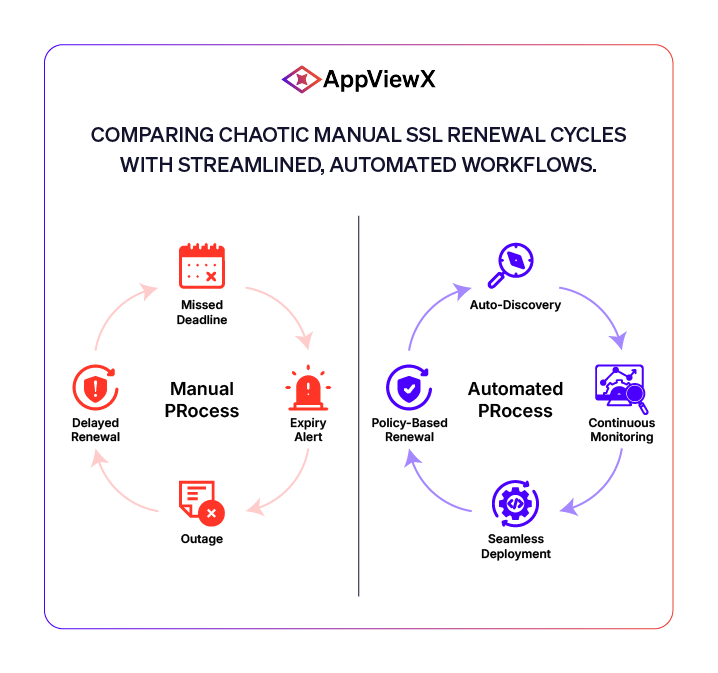
Manual certificate management is inherently reactive. Teams respond to expiry alerts, scramble to locate the right certificate, coordinate across departments, and hope nothing is missed.
Automation inverts this entirely. Rather than waiting for a problem to surface, a fully managed certificate lifecycle treats every stage, from issuance through renewal and revocation, as a continuously orchestrated process. Expiry events are anticipated weeks or months in advance. Renewals are triggered, executed, and deployed without a ticket being raised or a developer being pulled away from their primary work. The shift from reactive to proactive is not just an operational improvement; it is a fundamental change in how security is maintained at scale.
With AppViewX, every stage of the certificate lifecycle, from issuance to renewal, is automated, so your team is never caught off guard. See how AppViewX can take certificate management off your plate. Talk to our experts to learn more.
Step 2: Attain complete visibility of all certificates
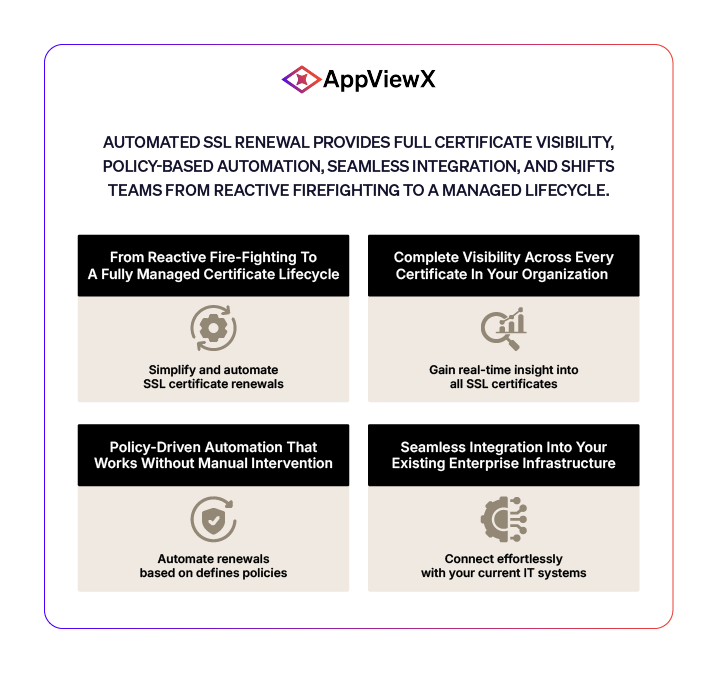
You cannot manage what you cannot see. For most enterprises, the first and most critical step toward automation is comprehensive certificate discovery, building an accurate, continuously updated inventory of every certificate across on-premises infrastructure, hybrid environments, cloud platforms, containers, and third-party services. Without this foundation, automation has no reliable surface to operate on.
NIST SP 1800-5 makes the case plainly: organizations must maintain a complete picture of what assets exist, where they are, and how they are being used before any meaningful security control can be applied. Certificates are no different.
A certificate that is not in your inventory is a certificate that will not be renewed, and a certificate that will not be renewed is an outage waiting to happen. Effective discovery goes beyond periodic scans, capturing certificates across load balancers, firewalls, web servers, and Kubernetes clusters, and presenting them through a centralized management console that gives security and operations teams a single source of truth.
Step 3: Achieve policy-driven automation
Once visibility is established, automation can be governed by policy rather than by individual action. Policy-driven certificate lifecycle automation means defining the rules once, which certificates require renewal at what threshold, which certificate authorities are authorized, what cryptographic standards must be enforced, and letting the system execute against those rules continuously.
Role-based access controls ensure that the right teams retain oversight without creating bottlenecks. Renewal, provisioning, and revocation all happen according to predefined logic, with audit trails generated automatically for compliance purposes. The result is a system that maintains itself, enforcing your security standards consistently regardless of team size, infrastructure complexity, or certificate volume.
Step 4: Integrate your existing enterprise infrastructure
Automation only delivers its full value when it fits within the tools and workflows your teams already use. Enterprise certificate management cannot operate as a silo. It needs to connect with the platforms your organization already relies on, from ITSM and DevOps tools to cloud providers and security systems, without requiring custom development or manual handoffs at each step.
Out-of-the-box integrations with platforms such as ServiceNow, GitHub, Jira, Slack, and PagerDuty ensure that certificate events surface in the right places, and that renewals or remediation can be triggered from within the tools engineers are already working in every day. This level of integration is what separates enterprise-grade automation from point solutions that solve one problem while creating friction everywhere else.
The hidden costs of manual certificate management
According to EMA Research’s 2024 IT Outages report, unplanned IT downtime now costs organizations an average of $14,056 per minute, rising to $23,750 per minute for large enterprises.
Manually updating certificates also carries a huge opportunity cost. When your senior developers are tasked with tracking down expiration dates or manually updating server configurations, they are not focusing on your organization’s core functions.
The growing challenge of certificate sprawl
As companies move to modern, cloud-based infrastructure, the number of certificates they need to manage has exploded due to the number of tools being used. This phenomenon, known as certificate sprawl, makes it nearly impossible for IT teams to maintain complete visibility.
In cloud-native environments, this challenge compounds further. Instead of managing a fixed set of servers, teams are dealing with hundreds of short-lived services, each requiring its own certificate.
Without an automated system to track every certificate, a single missed renewal can bring down critical services without warning. Ensuring that as your infrastructure grows your security remains seamless and invisible requires complete, centralized visibility across every entry point, without relying on constant manual oversight to hold it together.
The business risks of poor SSL certificate management
Mismanaged certificates are not purely a technical concern. The consequences ripple outward into operations, reputation, regulatory standing, and security posture. Understanding these risks in concrete terms is the first step toward addressing them.
Operational disruption and downtime
| Organization | Primary Cause of Failure | Business Impact |
| Spotify | Expired wildcard certificate | Global service outage for millions of users |
| SpaceX | Expired ground station credential | Global satellite internet blackout |
| Cisco | Embedded hardware certificate expiry | Over 20,000 customers lost SD-WAN connectivity |
| Bank of England | Internal infrastructure certificate expiry | Halt of payment settlements processing billions of pounds |
The most immediate consequence of a poorly managed certificate environment is outages. A single expired certificate, buried in a legacy system or overlooked during a migration, is enough to bring down critical services without warning.
High-profile examples show that no organization is safe: Spotify suffered a global outage when a wildcard certificate lapsed, SpaceX’s Starlink went dark due to an expired ground station credential, and Cisco saw over 20,000 customers lose SD-WAN connectivity because of an embedded hardware certificate. Even the Bank of England saw billions in settlements halt when an internal infrastructure certificate expired.
Reputational damage and customer trust
When a certificate expires publicly, end users do not see a technical error. They see a browser warning telling them the site is not secure. For many customers, that is enough to abandon a transaction, question a relationship, or take their business elsewhere. The reputational fallout from even a brief outage can outlast the incident itself, particularly in industries where trust is a core part of the value proposition.
Poor certificate hygiene signals to customers and partners that security is not being taken seriously, even when the root cause is something as routine as a missed renewal. For enterprise security leaders, the question is not just whether customers notice, it is whether they stay.
Compliance and regulatory exposure
Regulatory frameworks including GDPR, HIPAA, PCI-DSS, and SOX all carry expectations around encryption standards and data protection controls. Certificates are a foundational layer of those controls. When certificates fall out of compliance, whether through weak cryptographic standards, unauthorized certificate authorities, or simply expired credentials, organizations open themselves to audit failures, remediation costs, and in serious cases, significant fines.
GDPR alone carries penalties of up to 4% of global annual revenues, while HIPAA violations can reach $1.5 million per incident category per year. Maintaining continuous compliance requires not just issuing compliant certificates, but enforcing policies consistently across every environment and demonstrating that governance throughout the audit process. For organizations operating across multiple cloud providers and geographies, that is a significant undertaking without the right automation in place.
Security vulnerabilities and attack surface
Expired or unmanaged certificates do not just cause outages. They create exploitable gaps in your security perimeter. Certificates that are not properly tracked can linger beyond their intended use, remain associated with decommissioned services, or be issued outside of sanctioned processes entirely. Each of these scenarios widens the attack surface.
As API-driven architectures become the norm, with services communicating constantly across internal and external boundaries, the integrity of every certificate in that chain matters. According to Akamai’s 2025 State of Apps and API Security report, there were 311 billion web attacks recorded in 2024 alone, a 33% year-over-year increase, with APIs emerging as the primary target.
Selecting an enterprise-grade automation strategy
Selecting the right automation strategy is no longer a luxury; it is a requirement for operational resilience. As certificate lifespans continue to shorten, manual tracking via spreadsheets becomes a mathematical impossibility, leading to cascading outages and security gaps. An enterprise-grade strategy must move beyond simple “reminders” and toward a fully orchestrated lifecycle that handles discovery, issuance, and installation without human intervention.
Buy vs. build: The executive dilemma
The “Buy vs. Build” debate is a classic executive crossroads. Many internal IT teams believe they can solve the problem by writing custom scripts for specific environments. However, these homegrown solutions rarely scale, often lack the cross-platform compatibility needed for complex ecosystems, and create “technical debt” when the original developers move on.
In contrast, a purpose-built platform offers immediate time-to-value and a roadmap for emerging threats. Investing in a proven platform ensures your security posture evolves alongside industry standards without taxing internal engineering resources.
Ultimately, “building” creates a tool you have to maintain forever, while “buying” provides a service that grows with you. For most organizations, the cost of maintaining a homegrown script far outweighs the investment in a professional platform that guarantees uptime and security.
Centralized governance vs. decentralized execution
When designing automation, organizations must balance control and agility. Centralized governance ensures consistent policies, approved certificate authorities, and enterprise-wide visibility, reducing risk and simplifying audits.
At the same time, execution needs to be decentralized. DevOps and application teams must request, deploy, and renew certificates within their workflows to maintain speed and efficiency. The most effective approach separates policy from execution: governance stays centralized, while day-to-day operations are distributed. This provides control without slowing innovation.
Criteria for an automation partner
Before evaluating vendors, organizations must first define what “success” looks like for their own environment. Certificate automation is not one-size-fits-all. The right criteria depend on your infrastructure complexity, regulatory obligations, risk tolerance, and growth trajectory.
Assess your pain points
Start by assessing your biggest pain points. Are outages caused by missed renewals? Is there a lack of visibility across business units? Are compliance audits exposing inconsistent policies? Your evaluation criteria should directly address the operational and security gaps you are trying to eliminate.
Scale and diversity of your environment
Consider the scale and diversity of your environment. If you operate across multiple clouds, business units, or certificate authorities, interoperability and centralized visibility may be critical. If you are in a highly regulated industry, policy enforcement and audit reporting may carry more weight. The key is aligning platform capabilities with your enterprise realities.
Define long-term requirements
It is also important to define long-term requirements, not just immediate fixes. Certificate lifespans are shrinking, environments are becoming more dynamic, and automation demands will only increase, particularly with the continued growth of cloud-native platforms such as Kubernetes. The criteria you establish today should support where your organization will be in three to five years, not just where it is now.
How AppViewX automates SSL certificate management
AppViewX delivers end-to-end certificate lifecycle automation across discovery, issuance, renewal, deployment, and revocation. The platform provides centralized visibility, policy-driven workflows, and integration with multiple Certificate Authorities and enterprise tools, ensuring compliance and eliminating manual effort. Teams can proactively manage cryptographic standards and prevent outages across hybrid and multi-cloud environments.

Tags
About the Author