


Key takeaways
- Your CLM architecture is a multi-year commitment that determines whether CA changes, acquisitions, audits, and the post-quantum transition show up as workflows or as migration projects. CA-agnostic CLM preserves that optionality for multi-CA enterprises; CA-native CLM trades it for single-vendor simplicity in stable, single-CA estates.
- The deciding factor is automation depth across every CA you use, not feature counts or procurement preferences.
- TLS validity dropped to 200 days in March 2026 and drops to 47 days by 2029, which means roughly eight renewals per certificate per year, a load that only architecture-level automation handles cleanly.
- A CA exit on CA-native CLM typically requires a CLM migration on top of the CA migration. CA-agnostic CLM absorbs the same change as a configuration workflow.
The real decision in picking a CLM platform is between two ways of building the CLM layer. CA-native CLM is built by a Certificate Authority to manage its own certificates with maximum depth, while CA-agnostic CLM is built independently to operate across every CA you use at equivalent depth. The choice shapes how your team handles CA changes, acquisitions, audits, and the 2026 to 2029 shift to shorter certificate lifespans.
A quick clarification before the framework. A Certificate Authority and a Certificate Lifecycle Manager are not alternatives. A CA issues certificates. A CLM discovers, governs, and renews them. The architectural choice is between two ways of building the CLM layer above your CAs.
CA-native vs. CA-agnostic CLM: the architectural difference
The two architectures split on a single question: who built the platform, and which CAs are designed to manage end-to-end? The answer determines automation depth, sourcing flexibility, and how expensive a CA change becomes three years from now.
What is “CA-native CLM”?
A CA-native CLM is built by a Certificate Authority to manage its own certificates with maximum depth. It integrates tightly with the parent CA’s issuance API, validation flow, and account hierarchy. Most native platforms can also manage certificates from other CAs, but the depth is uneven. Discovery may work uniformly. Renewal automation, policy enforcement at issuance, and last-mile endpoint binding usually do not.
What is “CA-agnostic CLM”?
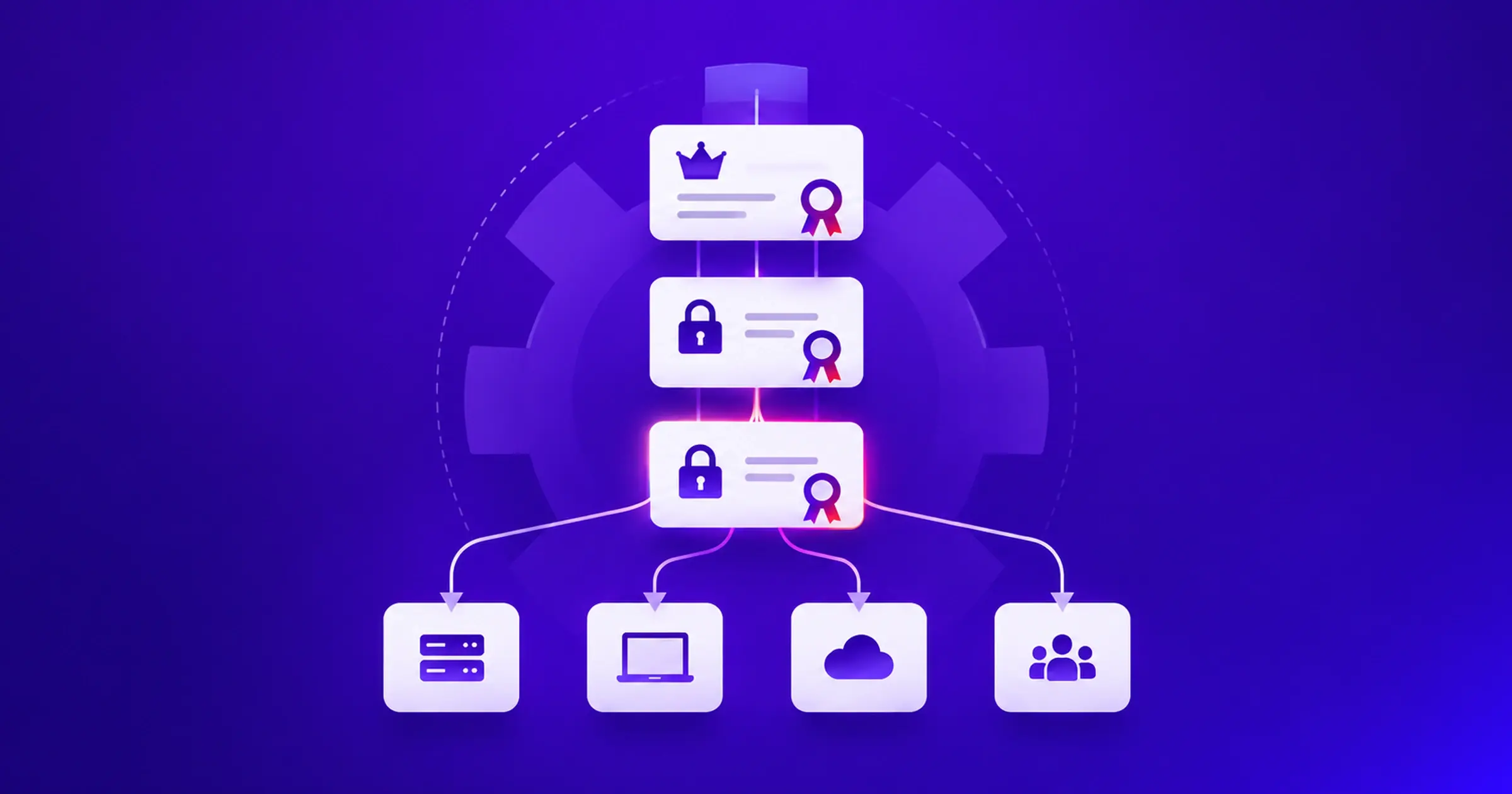
A CA-agnostic CLM is built independently of any Certificate Authority. Every CA is a managed integration at equivalent depth, with the same discovery, same policy enforcement, and same automation across public CAs, private internal PKI, and ACME-issued cloud certificates. Switching a CA is a configuration workflow, not a re-platform.
The architectural difference shows up at the points where CLMs typically fail at scale, including multi-CA workflows, policy enforcement at issuance, last-mile endpoint binding, and crypto-agility transitions. The table below makes the differences concrete:
| Dimension | CA-native CLM | CA-agnostic CLM |
| Depth across CAs | Deep on parent CA, uneven on others | Uniform across every supported CA |
| CA-switch capability | Migration project | Configuration workflow |
| Policy enforcement at issuance | Within the parent CA’s policy model | Centralized across every CA |
| Last-mile endpoint binding | Tight for parent CA’s typical deployments | Built for heterogeneous environments |
| Sourcing leverage | Tied to parent CA’s pricing | Buyer retains leverage |
| Audit independence | CLM and CA share a vendor | CLM is separate from any CA |
| M&A absorption | Acquired CA inventory often migrates | Acquired inventory absorbed natively |
| Crypto-agility scope | Limited to the parent CA’s PQC roadmap | Uniform across every CA |
A decision matrix: matching CLM architecture to your reality
Most organizations match more than one profile below. The more rows you occupy, the stronger the case for CA-agnostic, because each profile raises the cost of single-CA lock-in.
Single-CA organizations
You issue from one CA, you have no plans to diversify, and your environment is low-regulatory. CA-native works fine here. Procurement is simpler, support runs through one vendor, and you skip the contract overhead of a separate CLM. It holds up as long as none of those variables change.
Multi-CA enterprises
You already issue from multiple CAs, often without realizing it, because cloud providers, regional teams, and acquired business units each made their own decisions. Multi-cloud certificate estates pick up new CAs as cloud adoption matures. A CA-native platform handles one of them well. The others run on partial integrations or drop back to manual workflows, which is where outages and audit findings come from.
Regulated industries: why does audit favor CA neutrality?
Frameworks like NYDFS 500, HIPAA, FedRAMP, and NERC CIP increasingly require unified certificate inventory and policy enforcement across every issuance source. When the CLM and the CA share a vendor, the auditor’s question shifts from “show me your certificate inventory” to “show me the parts of your inventory that CLM can actually see.” CA-agnostic platforms answer the original question.
M&A-active organizations
Every acquisition brings new CA relationships. CA-agnostic CLM picks up the acquired inventory by adding the new CA as a managed integration. CA-native CLM either forces a CA migration on the acquired entity or runs a parallel CLM deployment until the migration finishes, both of which push integration synergies out by months to quarters.
Public-trust plus private PKI hybrid estates
If you run public TLS externally and private PKI for internal services, machine identities, or Zero Trust enforcement, you need one platform that handles both. CA-agnostic CLM does this natively. CA-native CLM bolts private PKI onto a platform built for public-trust issuance, which works until your private PKI gets serious.
| Evaluation criteria | CA-native CLM | CA-agnostic CLM |
| Single-vendor procurement | Strong fit | Adds a contract |
| Multi-CA automation depth | Uneven across CAs | Uniform across CAs |
| Sourcing leverage with CAs | Tied to parent CA’s pricing | Preserved across renewals |
| Absorbing acquired CAs | Migration project | Configuration workflow |
| Audit independence from CAs | CLM and CA share a vendor | Independent of any CA |
| PQC readiness across CAs | Tied to parent CA’s roadmap | Uniform across CAs |
Where CA-native CLM works best
CA-native CLM is not a weak option in every environment. It has two genuine advantages that compound within a single-CA estate, and one specific profile where it’s the right call.
Tight feature parity with the issuing CA
When a CA ships a new validation method, profile type, or issuance protocol, the native CLM supports it first. If your business depends on a specific CA’s features like proprietary validation flows, ACME extensions, or custom profile types, the native platform cuts the wait between release and production use. For teams whose certificate workflows ride on one CA’s roadmap, that wait matters more than it looks.
Single-vendor procurement and support
Procurement teams often prefer one contract, one support line, one renewal cycle. For a single-CA organization with no plans to diversify, this cuts overhead. Vendor management costs drop, security reviews move faster because the CA and CLM share a compliance posture, and incident response runs through one team instead of two.
Where CA-agnostic CLM genuinely wins
For most large enterprises, CA-agnostic CLM matches the way their certificate estates already run.
Multi-CA reality at enterprise scale
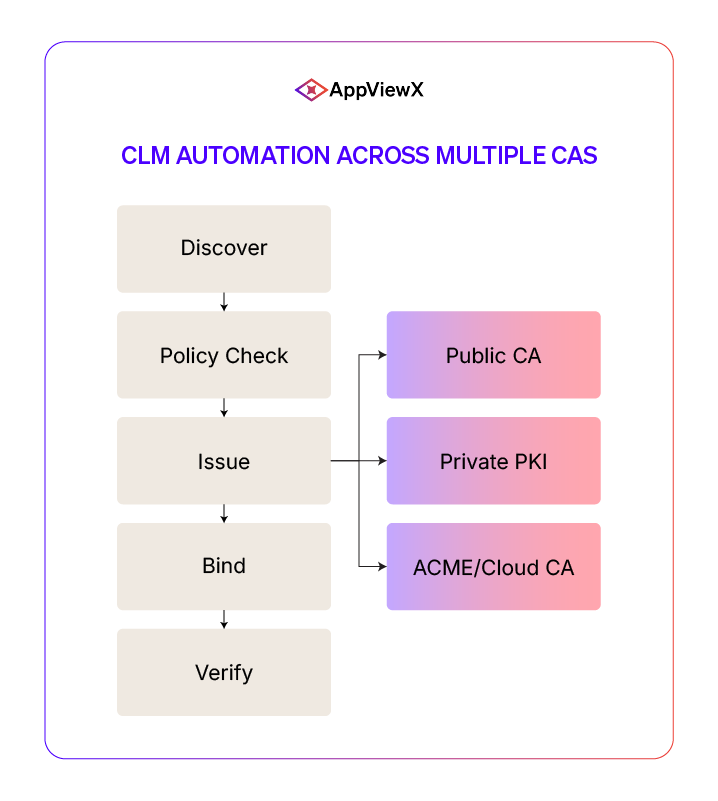
Closed-loop automation in a CA-agnostic platform works like this. Continuous discovery picks up a certificate approaching expiry. The platform checks it against policy, generates the CSR, calls the issuing CA’s API, pulls the new certificate, binds it to the endpoint, and verifies the bind. No human touch. Same flow whether the upstream CA is public or private.
CA-native platforms run this loop cleanly for their parent CA. Most cannot run it uniformly across the three or four CAs an enterprise has on the books.
What does sourcing leverage actually look like in practice?
Sourcing leverage means you can renegotiate CA contracts on price, terms, validation methods, and SLAs without your CLM platform getting in the way. With a CA-agnostic platform, switching CAs is a configuration. Add the new CA as a managed integration, define the issuance policy, and automation starts routing renewals through it. With a CA-native platform tied to your incumbent CA, the same switch usually means a CLM migration on top of the CA migration.
Google’s Chrome Security team announced that Chrome would stop trusting new TLS certificates issued by Entrust after November, 2024, citing a pattern of compliance failures over six years. Teams on CA-agnostic platforms ran the change as a workflow. Teams on CA-native platforms tied to that CA ran layered migrations. This Entrust distrust analysis walks through what the recovery looked like.
M&A consolidation without re-platforming
When two companies merge, their certificate estates merge too. The acquired entity rarely runs the same CA, the same policy model, or the same automation. CA-agnostic CLM picks up the new CA, the new policies, and the new endpoints as additions to your existing deployment. CA-native CLM usually forces a choice. Migrate the acquired estate to the parent CA, run two CLM platforms in parallel, or leave acquired certificates on manual workflows. None of those scales.
Post-quantum crypto-agility across every CA
NIST finalized the first three post-quantum cryptography standards, FIPS 203, FIPS 204, and FIPS 205, in August 2024. NIST IR 8547 transition guidance calls for traditional algorithms to be deprecated by 2030 and disallowed by 2035. Crypto-agility needs three things working together:
- Visibility into every certificate by algorithm and key size
- A policy that can trigger algorithm replacement at the next renewal
- Automation that applies it across every CA you use
The two architectures handle them differently:
- CA-agnostic platforms apply all three uniformly across every CA in your estate
- CA-native platforms apply them at whatever pace the parent CA chooses
PQC readiness is what separates platforms that absorb the 2030 algorithm deprecation as a configuration update from those that hit it as a multi-year migration project, and the PQC readiness guide covers the visibility, policy, and automation patterns that make uniform CA-side execution possible in production.
4 questions to ask before you evaluate any CLM vendor
Vendor demos answer the questions vendors want to answer. These four answer the ones that actually predict architectural fit. If you don’t know your own answer to all four before you take a single demo, the demo will steer you.
1. How flexible does your sourcing strategy need to be?
If your CA relationships are fixed and your procurement plan rests on consolidation, native is defensible. If you expect to renegotiate CA contracts, switch CAs for cost or compliance, or run a backup CA for resilience, agnostic keeps that door open.
2. What would a CA exit actually cost you?
Add it up:
- Re-issuance across every endpoint
- Validation across every region
- Updates to internal automation that hardcodes CA-specific APIs
- If your CLM is CA-native, a CLM migration stacked on top of the CA migration
Most teams that run this math once find that the CLM-migration line item is the one they did not see coming.
3. Does your audit and compliance posture demand CA neutrality?
If your audit framework demands vendor separation, this becomes a control question. Independent CLM platforms produce cleaner audit trails. Inventory reads the same across every CA, policy enforcement runs from one place, and the platform has no reason to favor one CA over another. In regulated industries, that separation is becoming a control requirement, not a preference.
4. How deep does automation go across every CA you use?
This is the one that matters most. CA/Browser Forum Ballot SC-081v3, passed in April 2025, dropped maximum TLS validity to 200 days in March 2026, with 100 days coming in 2027 and 47 days in 2029. By 2029, every public TLS certificate will renew roughly eight times a year. Manual workflows don’t survive that load. Watch what vendors demo carefully. A clean automation flow on one CA proves nothing about the same flow running uniformly across three. This analysis of automating 47-day lifecycles covers what enterprise-scale automation actually takes.
How to choose the best CLM platform: a 90-day evaluation plan
Three phases, thirty days each, run in order. Phase 1 builds the ground truth. Phase 2 turns it into a scoring system. Phase 3 puts vendors against it.
Days 1-30: Build your certificate inventory and CA footprint audit
Run discovery across every environment:
- Cloud accounts
- Kubernetes clusters
- On-prem infrastructure
- Certificate transparency logs
Tag each certificate by:
- CA
- Endpoint
- Owning team
Most organizations finish this phase with two surprises. Their CA footprint is wider than they thought, and ownership is unclear for a meaningful slice of the inventory. The integrated CLM approach covers what continuous discovery should produce.
Days 31-60: Define future-state requirements and vendor scoring criteria
Turn your inventory into requirements:
- Automation depth needed per CA
- Audit and compliance constraints
- PQC roadmap
- M&A trajectory
- Minimum integrations with the infrastructure you already run
Build a scoring matrix weighted to your environment, not to a generic feature checklist. Spend the full thirty days here, because the scoring matrix is what Phase 3 runs on.
Days 61-90: Pilot, score, and make the call
Three steps to make the call:
- Pilot two or three platforms against a real slice of your estate, not a sandbox demo
- Score each one against the matrix you built in Phase 2
- Make the call based on the scores
This guide to the 47-day mandate is a useful reference for what automation depth needs to look like under the new validity timeline.
How AppViewX delivers CA-agnostic CLM at enterprise scale
AppViewX is the CA-agnostic CLM platform that the framework above describes. The architecture, the automation depth, and the audit posture map directly because the platform was built for the exact scenarios this framework covers.
- Multi-CA depth. Closed-loop automation runs the same flow across every supported CA, from discovery to last-mile endpoint binding.
- Sourcing leverage. CA-switch is a workflow, not a migration project. You keep negotiating power across renewal cycles without rebuilding your CLM stack.
- M&A absorption. Acquired CA inventories are absorbed into your existing deployment, supported by Smart Discovery across cloud and on-prem. No parallel CLM deployments, no full re-platforms.
- Post-quantum readiness. The crypto-agility and PQC readiness solution applies the same visibility, policy, and automation across every CA in your estate, aligned with the NIST 2030 deprecation and 2035 disallowance timeline.
- Audit independence. AppViewX is an independent CLM, with no shared vendor relationship with any CA.
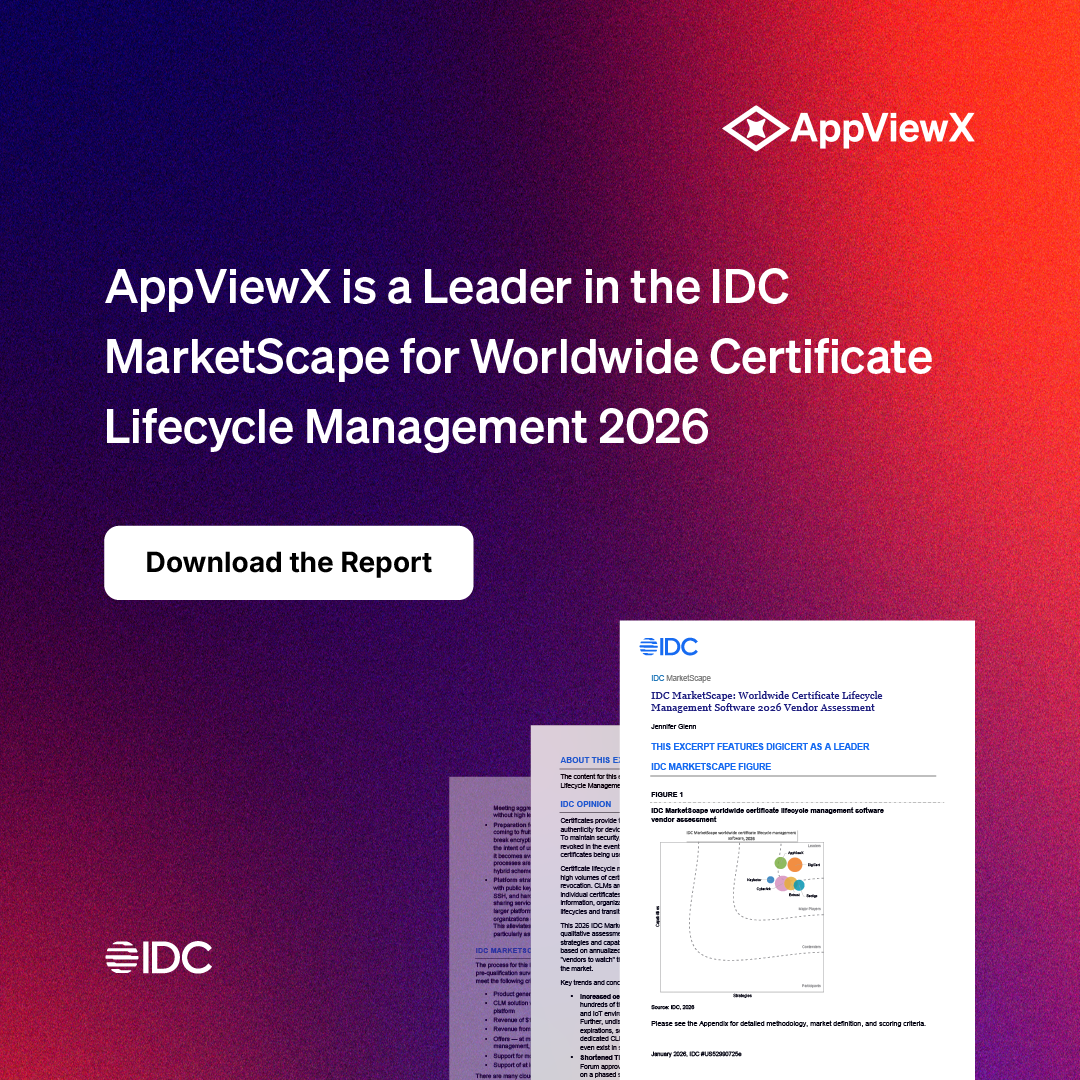
AppViewX was named a Leader in the IDC MarketScape: Worldwide Certificate Lifecycle Management Software 2026 Vendor Assessment, recognized for lifecycle depth, automation, and enterprise-scale operations.

Tags
About the Author

Ganesh Mallaya
Global Field CTO
Enabling businesses to design, engineer and deploy automation and Digital trust management solutions.