

Key takeaways
- SCEP automates certificate enrollment, letting devices obtain certificates without manual issuance. That simplicity has made it a widely-used protocol for mobile and network device certificate enrollment, though it comes with security challenges.
- SCEP is primarily an enrollment protocol. It does not provide certificate lifecycle management capabilities, such as inventory management, ownership tracking policy enforcement, and revocation.
- SCEP’s common weaknesses include reliance on shared password authentication and external revocation mechanisms, and limited lifecycle visibility into issued certificates , which together create both security and operational risks.
- SCEP is not quantum-safe on its own, and with NIST’s post-quantum standards now finalized, organizations need a way to adopt the new algorithms without retooling every device individually.
- A certificate lifecycle management platform closes these gaps, adding the visibility, automation, and crypto-agility that SCEP lacks.
SCEP automates a repetitive security problem: getting trusted certificates onto devices without anyone issuing them by hand. At scale, certificates run into the thousands across phones, laptops, routers, and VPN clients, and issuing and renewing that many manually just isn’t feasible, especially with reduced certificate lifespans.
SCEP handles the first step in a certificate’s life: enrollment, when a device gets its identity. Since this is where certificate management begins, the way enrollment is handled determines how much risk and overhead follow downstream.
Why SCEP exists
SCEP began as a Cisco effort to get certificates onto network hardware without an engineer configuring each device by hand. It spread because it is simple, and today it is widely supported by most mobile device management (MDM) platforms, network equipment, and operating systems. Most organizations still rely on it because it is already embedded in their device-management workflows.,
What SCEP does well:
- Lightweight: it asks very little of the device.
- Widely supported: it runs almost everywhere, across vendors and platforms.
- Single-purpose: it focuses on one job, enrollment with minimal overhead.
SCEP is one of several enrollment protocols, each built for a different job:
| Protocol | Best for | Authentication |
| SCEP | Mobile and network devices | Shared password |
| EST | Devices needing stronger security | Mutual TLS / client-based authentication |
| ACME | Automated, high-volume issuance, such as web certificates | Domain validation |
EST is the more secure successor of SCEP for devices, and ACME dominates automated web-certificate issuance. Despite EST existing for years, SCEP remains the dominant enrollment protocol for everyday mobile and network device enrollment because of legacy support and broad interoperability.
Where SCEP falls short
The same minimalism that made SCEP popular is also what limits it. The gaps that matter most:
- It stops at enrollment. SCEP is primarily an enrollment protocol; managing the certificate lifecycle and keeping the certificate valid, current, and trusted is left to the organization. That covers most of a certificate’s actual life, so the moment a certificate is issued, responsibility for it falls to whatever processes the organization has bolted on. When those processes are manual or missing, when a certificate passes its expiry date without anyone realizing, it takes down multiple services with it.
- Authentication is weak. A device proves it is allowed to enroll using a shared password, often the same one reused across many devices or built into configuration profiles. If an attacker obtains that password, they can enroll their own device and have it accepted as trusted on the network. When the same password is being used by multiple devices, the rogue device is hard to distinguish from a legitimate one.
- No visibility. SCEP provides no built-in inventory or visibility into where certificates are deployed, who owns them, or when they expire . Without a separate inventory, an organization cannot answer basic questions such as how many certificates exist, which are about to expire, or which belong to devices that are no longer in use, which is exactly the blind spot that leads to outages and failed audits.
- It is not quantum-ready. The protocol was built around RSA-style cryptography and has no native path to post-quantum algorithms. As those standards become organizations relying heavily on SCEP will likely need device, platform, and PKI updates to support post-quantum cryptography, particularly in environments where enrollment configurations are distributed across many systems.”.
Each of these gaps is something an organization has to solve elsewhere, because SCEP itself will not.
How does SCEP work?
Every SCEP exchange typically has two players. The client is the device itself, a phone, laptop, router, or VPN client, which generates its keys, builds the certificate request, and asks for a certificate. The server is the certificate authority (CA) or a registration authority (RA) sitting in front of one, which receives the request, validates it, and returns a signed certificate.
The protocol is a small rulebook. It defines a fixed set of operations, the format each message takes, and how the device authenticates its request. The core operations are:
| Operation | Purpose |
| GetCACaps | Ask the server which features and algorithms it supports |
| GetCACert | Download the CA’s certificate so the device can trust and encrypt to it |
| PKCSReq | Submit the actual certificate signing request |
| GetCertInitial | Poll for a request that is awaiting approval |
| GetCert / GetCRL | Retrieve an issued certificate or a revocation list |
The request itself is a standard certificate signing request (CSR) holding the device’s details and public key. It is encrypted so it stays private on the way to the server, sent over HTTP or HTTPS, authenticated with the shared password, and has traditionally relied on older RSA-based or ECC-based cryptography.
The certificate enrollment flow
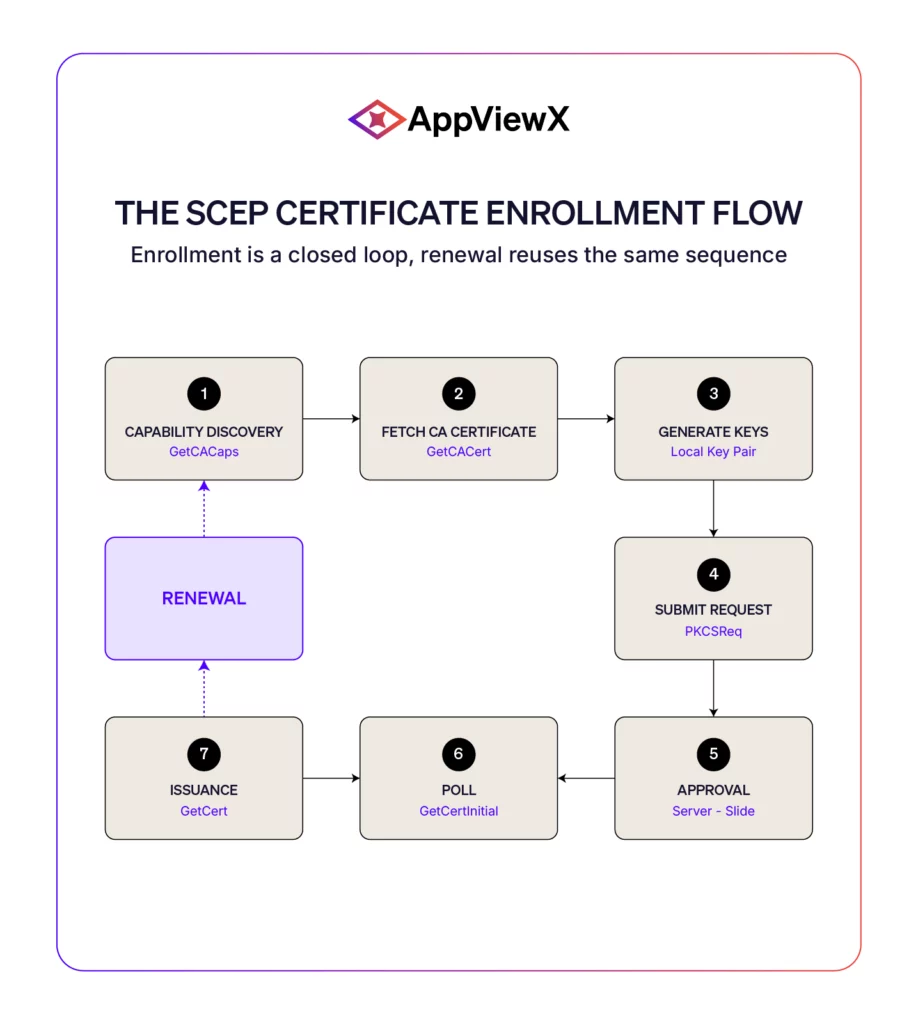
A typical enrollment runs through a predictable sequence:
- Capability discovery: the device sends GetCACaps to learn what the server supports.
- Fetch the CA certificate: using GetCACert, the device downloads and and verifies it according to the deployment’s trust settings.
- Generate keys: the device creates its key pair locally; the private key never leaves the device.
- Submit the request: the device sends a PKCSReq containing its CSR, protected by SCEP’s message format and authenticated with a challenge password.
- Approval: Depending on the server policy, the request is approved automatically when the password checks out, or routes the request to an admin, leaving it pending.
- Poll: for pending requests, the device checks back with GetCertInitial until approved or rejected.
- Issuance: the CA returns the signed certificate, and the device installs it alongside its private key.
Renewal walks the same path, sometimes authenticating with the existing certificate instead of the shared password or a different deployment-specific mechanism.
Is SCEP secure?
SCEP has lasted decades, but its simplicity comes with trade-offs. The main concerns:
| Concern | Why it matters | Impact |
| No built-in certificate status validation | No real-time certificate status check | Compromised certificates stay trusted until revocation is checked externally |
| Depends on external CRL or OCSP infra | Revocation lists are hard to retrieve | Ongoing trust checks are unreliable |
| Shared challenge password | Weak authentication | Rogue devices can enroll |
SCEP has no built-in way to check, in real time, whether a certificate it issued earlier is still valid. Relying systems must use external CRL or OCSP checking. If a device is lost or compromised, protection depends on how quickly revocation is published and how reliably other systems check it. .,
The shared challenge password compounds the problem: when the same secret is used across devices, a leak does not just affect a single device, but rather the whole system.
None of this makes SCEP unusable; it makes it something to deploy carefully:
- Issue a unique, single-use enrollment password rather than one shared password.
- Transport every request over TLS.
- Keep enrollment windows short so passwords have less time to leak.
- Approve requests against a known device inventory instead of trusting any request with the right password.
SCEP and certificate lifecycle management (CLM)
SCEP issues certificates, but it does not manage them, and that gap is where the real exposure lives. A certificate lifecycle management (CLM) platform sits above the protocol and closes it, turning a bare enrollment mechanism into a governed, auditable process.
Mapped against the gaps SCEP leaves open:
| What SCEP leaves out | What a CLM platform adds |
| No central inventory or ownership visibility of issued certificates | Full inventory and visibility across the fleet |
| Renewal is not centrally managed by SCEP itself | Certificates renewed before they expire |
| No built-in revocation management | Compromised certificates pulled centrally |
| Weak, shared enrollment auth | Policy controls on who and what may enroll |
AppViewX does this without the usual constraints:
- Its own SCEP server: no dependency on Microsoft’s NDES.
- Acts as the registration authority: it sits between the devices and the CA, validating every request.
- Works with any CA: it is not locked to a single vendor’s certificate authority.
- Central control: SCEP enrollment is managed alongside every other certificate in the environment.
SCEP and post-quantum cryptography
Quantum computing threatens the cryptography on which certificates are built. A powerful enough quantum computer could break the RSA and elliptic-curve algorithms in use today, and attackers are already preparing for it: under “harvest now, decrypt later,” data captured now can be decrypted once the hardware exists.
In response, NIST has finalized post-quantum standards meant to replace those vulnerable algorithms. Adopting them is increasingly a priority for governments and regulatory bodies worldwide. The question for any enrollment protocol is now how well it can carry them.
Is SCEP quantum-safe?
As of early 2026, standard SCEP implementations do not support post-quantum algorithms. The reasons are built into the design:
- SCEP’s cryptographic mechanisms and capability negotiation were designed around traditional public-key algorithms such as RSA and ECC. .
- Post-quantum signature schemes produce much larger keys and signatures than the formats were meant to carry.
The real answer is not a single upgraded protocol; it is crypto-agility. Because no organization can predict exactly when or how the migration will land, the goal is to be able to change algorithms across a whole fleet without re-engineering each device. A lifecycle management platform delivers that by handling the protocol on the organization’s behalf, so the shift from classical to post-quantum cryptography happens centrally rather than endpoint by endpoint.
How AppViewX closes the SCEP gap
SCEP is worth keeping; it does enrollment well. The exposure comes from everything it does not do, and that is the ground AppViewX covers:
- See every certificate. A single inventory keeps track of every certificate that is issued, so nothing lapses without warning.
- Automate renewal and revocation. Renewals happen on schedule, well before any lapses, and certificates are revoked the moment a device compromise is detected.
- Govern enrollment. Policy controls decide which devices may enroll, reducing the reliance on shared enrollment passwords.
- Manage every protocol in one place. SCEP, EST, ACME, and CMP are handled together, across any certificate authority.
- Stay quantum-ready. Crypto-agility lets you move an entire fleet to post-quantum algorithms centrally, not device by device.
Tags
About the Author

Krupa Patil
Product Marketing Manager
A content creator focused on providing readers and prospective buyers with accurate, useful, and latest product information to help them make better informed decisions.