


Summary
- Google’s recent research reveals that quantum vulnerabilities targeting elliptic curve cryptography (ECC) are more feasible than previously estimated, compressing the timeline for when today’s cryptographic foundations could be at risk
- Post-quantum cryptography (PQC) readiness is not a simple algorithm swap. It requires system-level transformation across protocols, wallets, hardware, and governance, making early action critical
- The “harvest now, decrypt later” threat means quantum vulnerabilities are already a present risk, not a future one.
- PQC migration is especially challenging in decentralized systems like cryptocurrency networks, where there is no central authority to mandate or coordinate upgrades quickly
- Organizations serious about quantum vulnerabilities need operational infrastructure to discover, rotate, and govern cryptographic assets at scale as part of a practical PQC readiness strategy
For years, the conversation around quantum computing and modern cryptography has lived in the “future problem” category. Important, yes, but often deprioritized in favor of more urgent security fires. Google’s recent disclosure on quantum vulnerabilities affecting cryptography used by cryptocurrencies changes that framing in a meaningful way because the margin for inaction is shrinking.
As someone who has worked across post-quantum cryptography (PQC), cryptographic migration, and quantum-safe strategy, I see this moment as a turning point for how we collectively approach long-horizon security risks embedded deep within cryptographic systems.
What Google’s new research actually means for digital security
Let’s start by grounding the discussion.
Google’s research does not claim that today’s quantum computers can break Bitcoin, Ethereum, or other cryptocurrency networks. What it does show is that the quantum resources required to break elliptic curve cryptography (ECC) are lower than previously estimated. That matters because ECC underpins most modern public-key cryptography, including the digital signature schemes used by nearly all major cryptocurrency wallets and blockchains.
Two additional aspects of the disclosure stand out:
- The research focuses on credible future attack feasibility against cryptography, not speculation.
- Google deliberately withheld exploit-enabling details and instead used zero-knowledge proofs so the results could be independently verified without giving attackers a roadmap.
Why the disclosure method matters as much as the finding
That second point is just as important as the cryptographic findings themselves because it addresses one of the hardest problems in security disclosure: how do you prove something is real without making it worse?
Publishing full exploit details invites replication. Withholding them entirely invites dismissal. Zero-knowledge proofs thread that needle so Google can demonstrate the validity of the findings without giving anyone the means to act on them.
In the context of quantum research targeting foundational cryptography, that distinction isn’t academic. The actors who would benefit from a detailed exploit roadmap are sophisticated, motivated, and paying close attention. Getting the disclosure right at this level can be the difference between warning the world and arming it.
Responsible disclosure in a quantum world is a security control
In classical security research, responsible disclosure is well understood: find a vulnerability, notify the vendor, allow time to patch, then publish. In the quantum era, it becomes even more critical and more nuanced. Quantum vulnerabilities are different because:
- They target foundational cryptography, not implementation bugs
- They have long lead times
- Exploitation may arrive suddenly after years of apparent safety
- Systems at risk especially decentralized cryptocurrency networks often cannot be patched quickly or unilaterally
By engaging governments, the cryptocurrency ecosystem, and academia before publication, Google modeled what mature quantum-era disclosure should look like: inform without destabilizing, warn without accelerating harm.
As more quantum-relevant cryptographic research emerges in the months and years ahead, this approach shouldn’t be viewed as exceptional. It should become the expected standard.
The challenge of updating hard-coded security
From my experience helping organizations assess and ensure quantum readiness, the biggest risk isn’t Shor’s algorithm it’s organizational and ecosystem inertia around cryptography.
Unlike traditional software vulnerabilities, where a patch can be tested and deployed in days, cryptography is deeply and deliberately embedded into the architecture of the systems that depend on it. In cryptocurrency networks, this goes even further. Cryptography is the foundation on which consensus, ownership, and trust are built. That makes migrating away from elliptic curve cryptography an exercise in rebuilding while the plane is still flying.
Migrating away from ECC is not a single technical decision. It is a multi-layer operational challenge:
| Migration Challenge | What It Requires |
| Protocol-level cryptography changes | Updates to core network and communication protocols |
| Wallet and key-management upgrades | New tooling and infrastructure for end users and developers |
| Consensus across decentralized communities | Coordination across distributed stakeholders with no central authority |
| Backward compatibility considerations | Ensuring legacy addresses and systems remain functional during transition |
| Long-tail user behavior | Accounting for lost keys, dormant wallets, and legacy addresses |
All of that takes time. And time is exactly what accelerating progress in quantum computing erodes. This is why Google’s emphasis on starting now matters far more than the exact qubit numbers in the paper.
Could today’s stolen data be unlocked in the future?
Quantum threat discussions often focus on enterprises and governments, but cryptocurrencies are not immune to “harvest now, decrypt later” risk.
Public keys exposed on-chain today through normal cryptocurrency transactions are protected only by current-generation cryptography. Assets secured under cryptographic assumptions believed to be “good for decades” may not have that luxury. Once quantum attacks against ECC become viable, there is no retroactive fix for previously exposed cryptographic material.
If you design systems assuming attackers will wait, you are designing defensively. If you assume they already are, you build resilience.
How long will it actually take to secure the world against Quantum?
One misconception I often encounter is that post-quantum cryptography is simply about swapping algorithms. In reality, PQC represents a system-level transformation.
Post-quantum cryptographic algorithms tend to:
- Use larger keys and signatures
- Affect performance, storage, latency, and bandwidth
- Require changes across software, hardware, protocols, and processes
For cryptocurrency ecosystems, this means governance changes, staged protocol upgrades, extensive testing, and user education not just cryptographic research.
The encouraging sign is that some blockchain ecosystems have already begun this work. Others need to accelerate decisively.
Why this matters beyond cryptocurrency
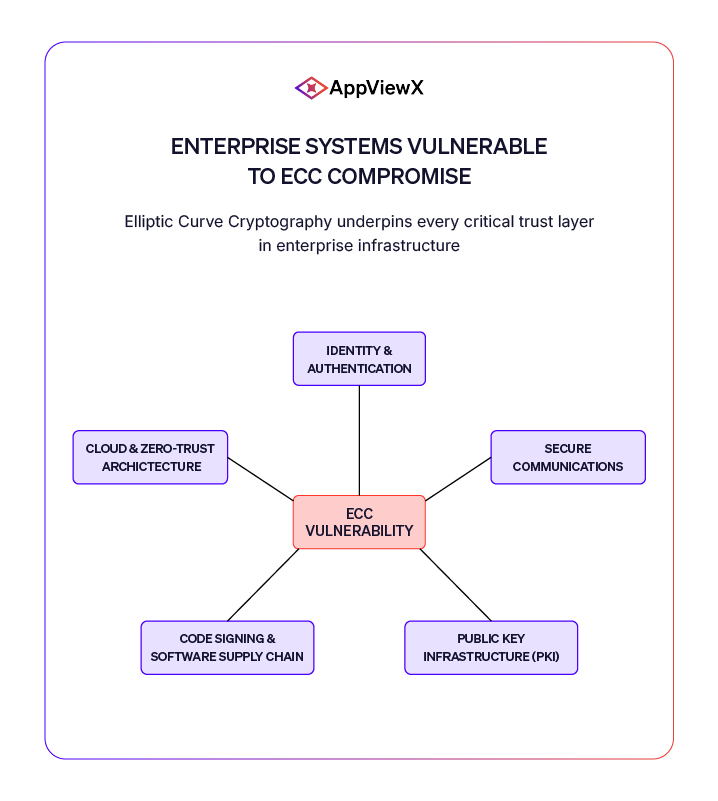
While Google’s research is focused specifically on the cryptography underpinning cryptocurrency networks, it would be a mistake to read it as a narrow, sector-specific finding. Cryptography doesn’t observe industry boundaries. The same elliptic curve algorithms under scrutiny in this context are woven into TLS certificates, code signing, authentication systems, VPNs, and virtually every other trust mechanism that modern enterprise infrastructure depends on.
Put simply, if the timeline for ECC vulnerability compresses in one domain, it compresses everywhere. And organizations that have been treating post-quantum readiness as someone else’s problem, or as a future problem, may find that future arriving ahead of schedule.
| Infrastructure Domain | Cryptographic Dependency |
| Identity and authentication systems | Digital certificates and public key infrastructure |
| Secure communications | TLS/SSL protocols relying on ECC-based key exchange |
| Public Key Infrastructure (PKI) | Certificate issuance, rotation, and trust chain validation |
| Code signing and software supply chains | Signature verification built on classical asymmetric cryptography |
| Cloud and zero-trust architectures | Mutual authentication and encrypted session management |
Cryptocurrencies simply make the issue more visible and more unforgiving because trust failures are immediate and economically observable.
My take: This is a call for preparedness, not panic
Quantum safety should not be driven by fear or hype. It should be driven by engineering discipline and realistic cryptographic risk assessment.
Google’s disclosure is effective precisely because it resists sensationalism. It treats quantum risk the way mature security teams treat seismic risk: unlikely today, catastrophic if ignored, and entirely worth preparing for early.
The organizations and ecosystems that will succeed in the quantum transition are not the ones issuing the loudest statements, but the ones steadily modernizing their cryptographic foundations now.
Where AppViewX fits in the quantum-safe transition
The hardest part of post-quantum readiness isn’t finding the right algorithms. NIST has already done that work for us. The more challenging problem is operationalizing cryptographic change across complex, distributed enterprise environments where certificates number in the tens of thousands and manual processes simply cannot keep pace. Knowing what needs to change is one thing, but having the infrastructure to actually change it systematically, at scale, and without disruption is another problem entirely.
That’s where platforms like AppViewX become essential. AppViewX helps organizations move from quantum awareness to quantum readiness by providing:
- Cryptography and certificate discovery
Visibility into where classical cryptography (certificates, keys, algorithms) is deployed across applications and infrastructure are prerequisites for any PQC migration. (link to cert scan) - Crypto-agility and lifecycle automation
The ability to rotate, replace, and manage cryptographic assets programmatically, enabling staged transitions from ECC-based cryptography to post-quantum or hybrid cryptographic models. - Policy-driven governance and compliance
Enforced cryptographic standards help organizations align with emerging quantum-safe guidance without relying on manual coordination across teams. - Foundation for hybrid and future-ready architectures
Many quantum-safe roadmaps will involve hybrid cryptography (classical + PQC). AppViewX provides the operational control plane required to manage that complexity without disrupting business systems.
In short, while post-quantum cryptography addresses the “what”, platforms like AppViewX address the “how,” translating quantum-safe strategy into executable, repeatable operations.

Tags
About the Author