



If one topic dominated Identiverse 2026, it was AI agent identity. A year ago, this concept appeared only in a handful of forward-looking sessions. This year, it anchored keynotes, crowded vendor booths, and drove hallway debates. But while almost everyone at the conference was focused on the challenge of simply seeing or inventorying these agents, the real market demand is shifting toward a much harder question: control.
AI agent discovery is table stakes
Much of the current vendor landscape centers purely on discovery: finding agents, building an inventory, and surfacing their activity logs. While establishing a baseline registry is a necessary first step, visibility alone does not give a security team the mechanism to contain a compromised or malfunctioning agent.
Control is the real challenge because AI agents operate as autonomous, non-deterministic actors that dynamically invoke applications, process sensitive data, and execute actions across enterprise systems. Their runtime behavior and often-ephemeral access create a critical control gap: agents hold real privileges, while security teams lack consistent mechanisms to constrain, govern, or revoke what those agents can do.
Gartner predicts that by 2027, 40% of enterprises will demote or decommission autonomous AI agents due to governance gaps identified only after production incidents occur. This is why the practitioners we spoke with at Identiverse consistently pushed past basic visibility, narrowing their focus to two important functional capabilities:
1. Runtime Enforcement: Every new AI agent introduces a net-new entity with attached privileges, compounding risk across an attack surface. Controlling this privilege requires more than static provisioning. It means establishing strict boundaries at the moment an identity is issued, maintaining a least-privilege baseline while the agent runs, and having the runtime enforcement capabilities to kill access the moment a policy is violated.
2. Agent Lifecycle Management: This is a foundational control, but it dictates long-term security. An agent’s identity is not a “set and forget” configuration. It must be issued, its credentials must be dynamically rotated, and its policies must remain consistent at scale. Crucially, each identity must eventually be revoked and retired.
Residual access is one of the most persistent risks in enterprise security, because access tends to outlive the reason it was granted. When an agent is redeployed or decommissioned, its credentials, tokens, permissions, and connected service accounts often stay live: standing access that no longer has a purpose or an owner but still authenticates. No one is monitoring it, so anomalous use raises no flags, and an attacker can inherit that foothold without ever breaking authentication.
It is the failure of the last step in the lifecycle. Provisioning gets attention because it is how things start working, while retirement gets skipped because nothing breaks when it is forgotten. That is exactly why the risk sits there unowned, and why revocation must be an automated part of the identity lifecycle rather than a manual afterthought.
AI agents magnify the problem, because they operate autonomously and mint credentials at high velocity. Residual access compounds far faster than any manual review can catch, which turns rotation and deprovisioning from a periodic compliance exercise into a continuous one.
According to Gravitee’s 2026 State of AI Agent Security survey, only 34% of organizations have a documented process to pause or revoke an agent’s access. The majority have no defined way to pull an agent’s privileges when something goes wrong, and without programmatic revocation, every agent leaves behind stale permissions and orphaned credentials.
Built to govern, not just observe
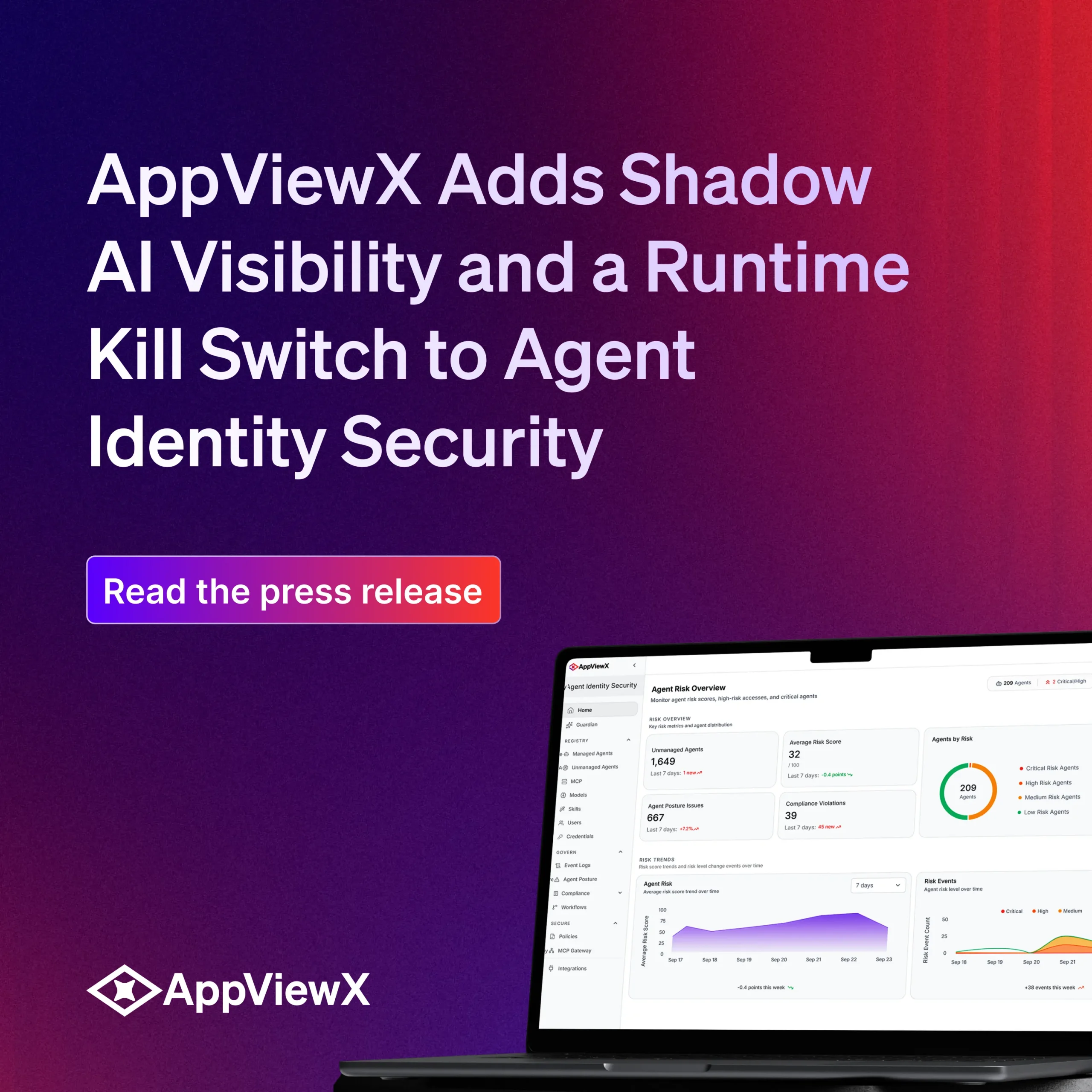
This demand for purpose-built identity-level governance for AI agents is precisely why we launched Agent Identity Security at Identiverse, and it’s a logical evolution of our core platform built for modern certificate lifecycle management, PKI, and post-quantum cryptography (PQC) readiness.
With Agent Identity Security, we are giving enterprises the technology to treat agent security as a fundamental cryptographic trust problem, instead of a simple monitoring tool.
We are introducing full lifecycle management capabilities to govern every agent’s identity lifecycle from deployment to decommissioning, continuous posture monitoring, ownership tracking, and automated remediation to maintain a compliant, resilient security posture.
This is also where post-quantum cryptography becomes an important consideration. AI agent identities rely on certificates, keys, and tokens that may use quantum-vulnerable public-key algorithms. With post-quantum standards now available, organizations should ensure that identities issued today support cryptographic agility and can migrate to quantum-resistant algorithms without disruption.
That is the same crypto-agility AppViewX already provides for certificates and machine identities, applied to agents. Governing an agent’s identity and keeping its cryptographic foundation current are not separate jobs. They are the same discipline, which is why agent identity belongs on a platform built for it rather than bolted onto a monitoring tool.
Rather than just surfacing shadow AI or inventorying agents, the AppViewX platform delivers actionable full operational control across three layers:
- Continuous Discovery and AIBOM: We map the entire agent estate including underlying LLMs, credentials, and configured identities, consolidating them into a centralized AI Bill of Materials (AIBOM). From this unified foundation, the platform automates full credential lifecycle management, allowing security teams to continuously track identity ownership and detect configuration drift in real time.
- Adaptive, Task-Based Access: We move beyond static entitlement, enforcing fine-grained, least-privilege policies at the identity level and integrating directly with existing IAM and PAM tools to dynamically restrict agents to only the tools and data required for their active task. This architecture ensures that agent credentials can be dynamically rotated and policy-hardened throughout their active lifespan.
- Real-Time Threat Detection: Through our automated Guardian Agent tool, Agent Identity Security monitors for non-deterministic behavioral anomalies, giving teams context-aware intelligence and guided remediation to pause or terminate an identity before a privilege misuse escalates into a breach.
By grounding agent governance in cryptographic reality, AppViewX ensures that enterprises can accelerate AI adoption without trading off control, compliance, or structural security.
Built for control, ready for quantum
AI agents are highly dynamic machine identities, executing continuous task-based handoffs, interacting via MCP servers, and generating an unpredictable trail of credentials. By centering agent governance on a native PKI foundation, we give CISOs a single, post-quantum-ready control plane to manage both legacy machine infrastructure and agentic workloads in one motion.
If you are evaluating tools in this space, the question worth pressing is less about what a product can find and more about what it lets you do once you have found it.
Schedule a demo today to see how to move from visibility to control.
Tags
About the Author