

Key Takeaways
- PKI teams must have a phased automation strategy to stay ahead of certificate management trends
- A zero trust architecture depends on machine identity
- Machine identities now far outnumber human identities
- Cryptographic agility is crucial to post-quantum readiness; by 2028, PKI teams must be able to handle hybrid certificate environments
- Vendor evaluation requires careful study, separating marketing claims from operational realities
The modern landscape of machine identity for PKI teams
Machine identities play a vital role in protecting your data. Often, they come in the form of credentials, such as certificates, tokens, or keys, that allow non-human entities within an organization to perform automated tasks.
The rise of cloud adoption, microservices architectures, and streamlined DevOps practices has driven a surge in demand for machine identities. CyberArk’s 2024 Identity Security Threat Landscape Report found that human identities in your usual enterprise environments are now outnumbered by machine identities by 45 to 1.
This shift from perimeter-based security to identity-based security poses both a hurdle and an opportunity for PKI teams. With machine identity becoming the cornerstone of enterprise trust, mastering machine identity management, or non-human identity management, is crucial to helping organizations gain a competitive advantage.
But how exactly can PKI teams build the operational capabilities to manage it at scale?
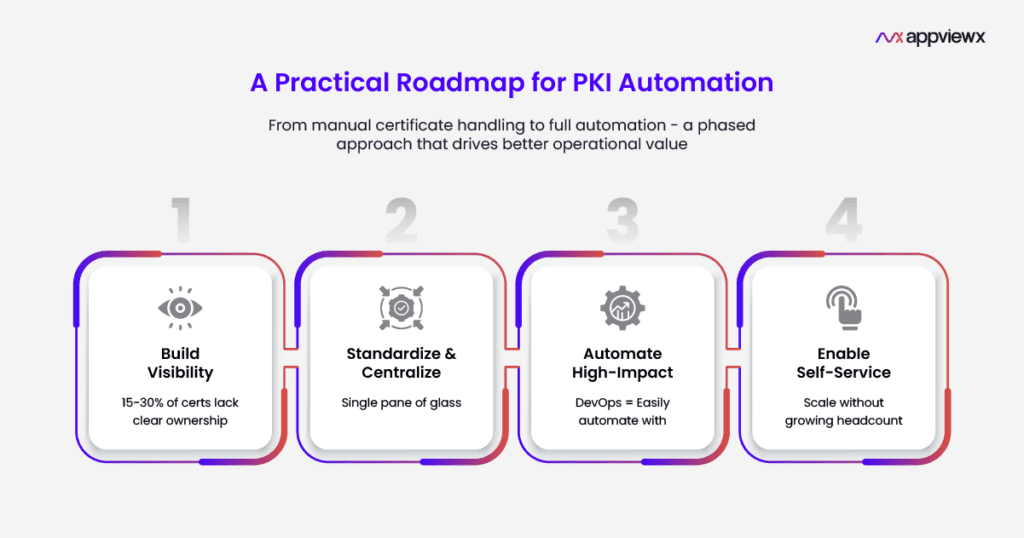
Where to start: A practical roadmap for PKI automation
Going from manual certificate handling to full automation is no simple task. It involves making informed decisions that depend on one another. PKI teams need to adopt a phased approach that drives better operational value.
Phase 1: Build Visibility
Visibility is the foundation of effective automation. Leading organizations discover that up to 30% of certificates lack clear ownership, which can hinder renewal processes. Comprehensive discovery should deliver actionable reports with key certificate details, such as expiration dates, issuing CA, and more, enabling teams to take control from day one.
Your automated certificate discovery feature should be able to scan certificates from:
- Public certificate authorities
- Private certificate authorities (Microsoft AD CS, EJBCA, etc.)
- Cloud provider certificate services (AWS ACM, Google Cloud Certificate Manager, etc.)
- Web servers
- Container orchestration platforms
- Code signing certificates and SSH keys
Phase 2: Standardize and Centralize
The next phase is about consolidating certificate management to gain control at scale. Organizations streamline operations and set the stage for automation by unifying tools and environments under a single platform, standardizing templates and policies, and establishing clear ownership.
Phase 3: Automate High-Impact Use Cases First
This is where automation comes into the picture. However, it should focus on certificates that:
- Need a significant amount of manual work
- Protect sensitive data or critical systems that could cause outages in the event of certificate expiration
- Frequently expire or require more attention
A good example of early automation candidates is DevOps teams that are integrating certificates into CI/CD pipelines, because they usually have a high volume of certificate requests and go through the most friction from manual operations.
It is worth noting that automation must be an integration into existing workflows in lieu of introducing additional processes.
Phase 4: Enable Self-Service with Guardrails
Turning PKI from a request-processing system into an effective self-service platform is the focus of the last phase. Development teams may request certificates via self-service portals without contacting PKI teams, but only for specific certificates that fall under agreed policies.
A policy-driven approach guarantees that:
- Certificates are automatically validated in accordance with organizational standards
- Every certificate lifecycle event is tracked for compliance reporting
- Unusual activities are flagged and generate real-time alerts
With this model, PKI processes can be scaled without affecting PKI headcount. This is vital considering that a gap of 4 million cybersecurity professionals worldwide was identified by the cybersecurity workforce shortage, as documented by ISC².
Machine Identity in a Zero Trust Architecture
Now that we have a clear roadmap for PKI automation, let’s talk about zero trust architecture.
Both the public and private sectors rely on the CISA Zero Trust Maturity Model for their implementation framework for zero trust principles. And it’s no secret, machine identity is indispensable to this framework.
The model’s core principle, “never trust, always verify”, argues that workloads, APIs, and automations all require the same rigid authentication as human users, which means zero trust is pointless without machine identity. Every connection must be verified and encrypted to ascertain that it originated from authorized and reliable networks.
For PKI teams, the implications are glaringly significant, with certificate volumes rising as organizations transition from perimeter-based authentication to workload-level verification. The 2023 CNCF Annual Survey shows that over 84% of organizations use containers in production, each of which may require its own identity. Meanwhile, Google’s BeyondCorp model for short-lived credentials has led to the shrinking of certificate lifespans. And with instant provisioning turning into the norm, on-demand workloads cannot wait for manual approval.
All of these amalgamate into the key challenges that PKI teams face today: certificate management at an unprecedented scale, on-demand workloads, compliance with various regulatory frameworks, and enabling self-service.
The evolving role of PKI teams in Machine Identity Management
In the past, PKI operations primarily focused on processing certificate signing requests, managing certificate authorities, and ensuring internal policy compliance. Now, PKI professionals have evolved from certificate authority administrators into identity architects.
A single deployment may require multiple certificates for service authentication, API security, and encrypted communications, making it quite a challenge for PKI teams to keep up with the pace. The priority for modern PKI teams nowadays is to balance security requirements with developer velocity demands.
Key challenges PKI teams face today
There are several operational challenges that PKI teams face today, such as the following:
- Certificate Management Across Hybrid Environments
Perhaps the biggest pain point for many PKI teams today is managing multiple certificates across hybrid environments, as each environment has its own set of tools, APIs, and management platforms. According to the Flexera 2024 State of the Cloud Report, 89% of organizations now utilize multi-cloud environments, adding an extra layer of work for PKI teams. - On-Demand Workload Support
Supporting on-demand or short-lived workloads often affects the operational speed of traditional systems. Standard certificate processes designed for servers with multi-year lifespans cannot handle workloads that require immediate certificate distribution and real-time cancellation. This kind of speed must be handled by your certificate lifecycle management platform. - Compliance Across Regulatory Frameworks
Every organization has its own special regulatory frameworks. Those in the finance sector must adhere to PCI-DSS compliance, SOX, and regional banking regulations. Healthcare services need to comply with HIPAA requirements. - Enabling Self-Service
While ideal, this feat calls for sophisticated policy engines, role-based access management, and approval automation. This is due to the fact that organizations need certificates to be provided as quickly as possible, and each certificate should meet organizational standards.
Evaluating Machine Identity management platforms
As PKI professionals, it is essential that you are able to properly discern vendor claims, especially when they promise top-tier capabilities and smooth integration. A structured approach to inquiries can help you separate marketing strategies from reality.
Integration Depth
Scrutinizing integration claims is crucial, given that “integration” is a broad term that may refer to anything from native API connectors to customer-focused documentation. You may want to ask yourself questions like “How long does the integration process last?” or “Are the integrations natively-maintained or customer-maintained?” when trying to understand integration depth.
Scalability Evidence
“What are the infrastructure requirements for effective deployments?” and “Are there any consumer references comparable to our projected scale?” are just some of the questions you should ask yourself when thinking of scaling your PKI automation with the help of a vendor. When talking about enterprise scale, vendors may perceive it in different ways. Some services may be able to handle thousands of certificates at a time, but struggle to manage hundreds of thousands. Perhaps some require sophisticated architectures to scale horizontally.
Cryptographic Flexibility
Cryptographic flexibility has now transitioned from theoretical to practical thanks to the finalization of NIST’s post-quantum cryptography standards. So when you decide to team up with a vendor, you might try asking questions like “Can your platform handle large-scale algorithm migration for existing certificates?” or “What post-quantum algorithms does your platform support?”
Vendor Evaluation Scorecard
| Evaluation Criteria | What to Ask | Red Flags |
| Discovery Capabilities | What certificate sources should be scanned? | Manual-only discovery and limited CA assistance |
| Automation Maturity | What is the percentage of lifecycle operations that may be automated with scripting? | Extensive scripting for even the most basic workflows |
| Integration Ecosystem | What is the number of existing integrations, and what is the average deployment time? | The need for professional services for every integration |
| Compliance Support | Do the compliance frameworks have native reporting templates? | No existing compliance templates and no automated log exporting capabilities |
| Cost of Ownership | What is the total cost of platform licensing? | Integration costs are not included, and some key features are priced as add-ons |
| Vendor Viability | What is the vendor’s track record with enterprise PKI deployments? | Limited and unclear enterprise references |
Preparing for Post-Quantum Cryptography
In 2024, NIST released the first three finalized post-quantum cryptography standards, marking a pivotal milestone in moving away from cryptographic algorithms vulnerable to quantum computing threats.
While this may not be an immediate concern for PKI teams, it should never be left as an afterthought. Quantum computers cannot breach RSA or ECC encryption, but existing attack models (“harvest now, decrypt later”) could expose sensitive data, such as health and financial records.
So how can you equip your team for this scenario? By leveraging cryptographic agility.
What is Cryptographic Agility?
Simply put, cryptographic agility is the ability to switch cryptographic algorithms instantly across certificate architectures without having to restructure systems or undergo a tedious migration process. It requires:
- A certificate management system that utilizes algorithm selection as a parameter instead of as a limitation
- An automated certificate renewal and replacement process
- Support for certificates with both post-quantum and regular algorithms to meet transitional compatibility requirements
- A complete certificate inventory system
Cryptographic Agility for Quantum Readiness
By 2028, PKI professionals will be navigating an entirely different cryptographic landscape. They must be equipped to handle high-complexity certificate environments that hold both ML-KEM and ML-DSA certificates alongside traditional RSA and ECC. Using platforms that lack cryptographic agility can lead to bottlenecks that could divert resources from strategic initiatives.
The importance of a well-planned transition before algorithms expire cannot be overstated, as emphasized by the NIST Special Publication 800-131A, which also discusses the nuances of transitioning cryptographic algorithms. PKI teams that have started working on their cryptographic agility as early as now will be well-suited to respond to any algorithm deprecation without having to restructure their systems.
With AppViewX’s cryptographic agility capabilities, PKI teams will be able to track algorithm usage, establish clear migration policies, and seamlessly adapt their certificate infrastructure.
Designing an actionable Machine Identity Strategy
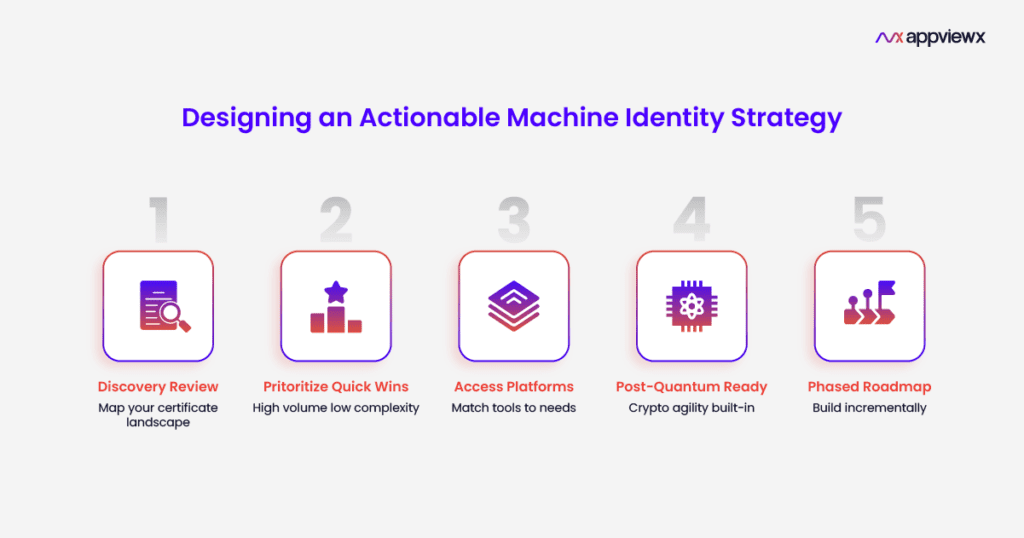
To design a practical machine identity strategy, you must know exactly what you’re working with. You can start with a discovery review of your certificate infrastructure to determine the scope of your environment and identify any pain points from the get-go. Then, prioritize high-volume, low-effort certificates to free up your team’s bandwidth for more complex work. From here, you can begin assessing platforms against your specific requirements. It is also imperative that you make sure your system supports cryptographic agility, even if post-quantum cryptography is years away. Lastly, build a phased roadmap with a strategic sequence that aligns with immediate business gains and long-term goals. This approach will give you a competitive advantage that will position your PKI team at the forefront of certificate management modernization.
Evaluating Machine Identity Management platforms: What PKI teams should prioritize
It’s important to clearly distinguish between features that are necessary for day-one operations in contrast to those that offer more value over time.
Such distinction is key to effective implementation timelines that add value to your operations. When an organization attempts to release different features simultaneously, delays occur.
Must-Have vs. Nice-to-Have Features
| Feature Category |
Must-Have Features |
Nice-to-Have Features |
| Discovery & Visibility | Automated discovery among certificate authorities; Real-time certificate management & expiration alerting | AI-driven risk detection and assessment; Certificate scoring |
| Automation | Complete lifecycle automation; API-first architecture | Self-sustaining certificates; Intuitive renewal scheduling |
| Integration | CI/ CD pipeline integration; Native connectors for major cloud services (AWS, Azure, etc.) | Low-code workflow builder; Custom connector framework |
| Policy & Governance | Role-based access; Policy templates; Extensive audit tracking | Policy testing; Automated compliance reporting |
| Scalability | Multi-certificate support; High-availability architecture | Cross-region deployment; Edge certificate management |
| Cryptographic Agility | Dynamic algorithm support; Certificate template flexibility | Post-quantum algorithm readiness; Hybrid certificate assistance |
With AppViewX’s automation platform, PKI teams can build on foundational capabilities such as discovery, inventory, and even basic automation. As operations mature, they can enable advanced features in increments.
Level-up your Machine Identity Strategy
Oftentimes, PKI teams find themselves needing to meet both security requirements and business demands. But when handled with efficiency, a well-designed machine identity strategy and the right tools can give your certificate management workflow a leg up.
With AppViewX’s commitment to empowering PKI teams, you can have total control over certificate lifecycle automations and easily achieve cryptographic agility for post-quantum readiness. By integrating with existing systems, AppViewX can help you drive business without sacrificing governance and implementing drastic changes.
Get started on your machine identity management strategy by booking a demo now.
Tags
About the Author