


Key takeaways
- Java certificate automation requires centralized discovery, policy-driven renewal, and CA integration across all environments to handle shorter certificate lifecycles and evolving compliance requirements without manual overhead
- Organizations running thousands of certificates across cloud and on-premises environments need centralized discovery and clear ownership to maintain control when scaling
- Certificate automation maturity progresses from discovery through inventory management, policy enforcement, and ultimately CA and crypto-agility
- When evaluating platforms, prioritize: continuous discovery, automated renewal workflows, policy enforcement at renewal, and flexibility across multiple certificate authorities
- Building an automated certificate infrastructure now positions organizations to navigate post-quantum cryptography migration and regulatory shifts without major future remediation
Java powers a significant portion of the world’s enterprise software. It runs customer portals, financial systems, internal business tools, and the microservices that connect them. And underneath all of it, digital certificates are quietly doing the work of keeping those systems secure and trusted.
For most organizations, managing those certificates has been a background IT function. That is changing. With certificate validity periods shrinking, environments growing more distributed, and compliance requirements tightening, Java certificate management has moved from a maintenance task to a strategic priority.
Forward-thinking organizations are already building the automation infrastructure to handle it. The ones that do will be better positioned operationally, more resilient to cryptographic change, and ahead of the compliance curve as new mandates take effect.
What is Java certificate management?
Java applications, whether they’re powering your customer portal, processing transactions, or connecting your internal services, rely on digital certificates to prove their identity and encrypt their communications.
These certificates live inside files called keystores, which act as a secure vault storing the credentials each application needs to function. It holds the certificates that allow your applications to communicate securely with other systems, verify their identity, and encrypt data in transit.
Managing those certificates means making sure they’re valid, trusted, up to date, and replaced before they expire. When that process is manual, it means someone on your team is tracking expiration dates by hand, running command-line tools, and updating individual files across every server and environment where your Java applications run.
Certificate lifecycle management automation replaces that manual process with a system that discovers every certificate across your environment, monitors its health, and renews it automatically, before anyone has to think about it. With 47-day validity periods arriving by 2029, automation is quickly becoming a baseline operational requirement.
How Java certificate management affects your CLM strategy
Most organizations manage certificates across multiple environments and certificate types, from Java keystores to code signing certificates. Without a unified approach, these environments operate independently with separate tools, policies, and ownership models.
Java certificate automation is most effective when it’s part of a broader certificate lifecycle management strategy that treats all certificate types as part of the same governance framework. This means the same discovery capabilities that surface Java keystores also identify TLS certificates across your cloud and on-premises infrastructure. The same policy enforcement that governs Java renewals applies to every certificate in your environment.
A centralized CLM platform eliminates fragmentation, ensures consistent cryptographic standards across all certificate types, prevents duplicate tooling and operational overhead, and gives leadership a unified view of certificate risk across the entire business.
Why Java certificate management is a business decision
For years, certificate management sat firmly in the domain of IT, handled by a small team with spreadsheets and calendar reminders. That model is breaking down. Shorter certificate lifespans, growing application environments, and tightening compliance requirements have turned this into something that leadership needs to understand and plan for.
Certificate validity is shrinking fast
The CA/Browser Forum approved a phased reduction in TLS certificate validity in April 2025. By 2029, maximum validity drops to 47 days, which means the renewal burden on your team multiplies significantly.
Java is everywhere in your stack
Java powers a significant portion of enterprise software worldwide, from customer-facing applications to internal business tools. Each of those applications carries its own certificates, and the average enterprise manages more than 23,000 certificates across its environment. Most organizations have no single place where all of those certificates are tracked and governed.
Cloud environments add another layer of complexity
Most enterprise Java applications no longer run on-premises exclusively. They run across various cloud applications, often alongside on-premises infrastructure in a hybrid setup.
Each cloud environment introduces its own certificate requirements and expiration schedules. Without a centralized approach to certificate lifecycle management, teams end up managing cloud certificates in one place and Java certificates in another, with no unified view across either.
This fragmentation grows with every new service your organization deploys. Each new application added to AWS, Azure, or GCP brings its own certificate configuration that needs to be tracked, governed, and renewed on its own schedule, independently of everything else running in your environment.
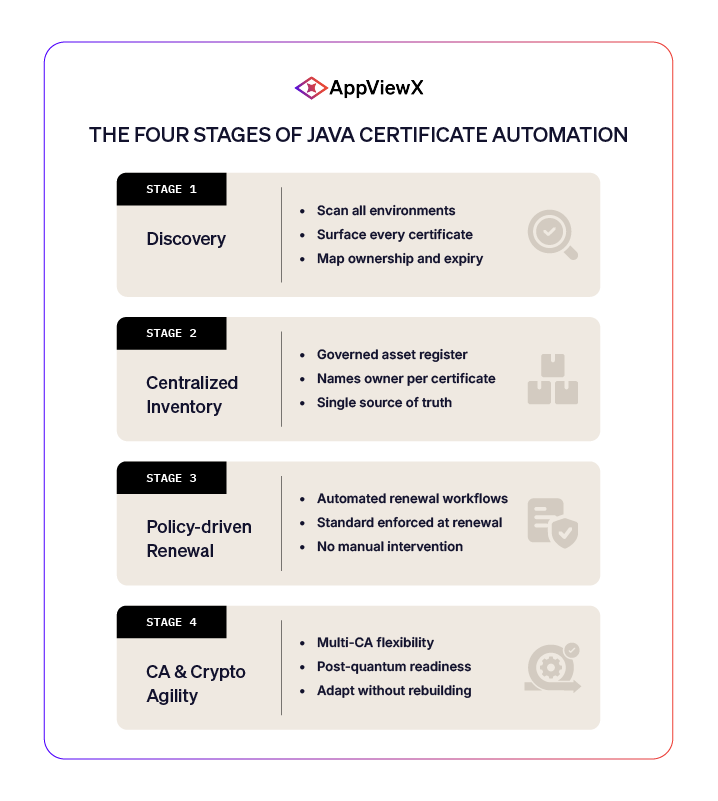
The four stages of Java certificate automation
Most organizations don’t go from manual to fully automated overnight. It happens in stages, and each stage delivers measurable value on its own.
-
Discovery: know what you have
You cannot manage what you can’t see. The first step is running a discovery scan across your entire environment to surface every certificate, where it lives, who owns it, and when it expires. For most organizations, certificates turn up in places nobody expected, tied to applications that haven’t been actively managed in years.
-
Centralized inventory and ownership
Discovery produces a list. This stage turns that list into a governed asset register with a clear owner assigned to every certificate. That accountability is what makes everything else possible. Most organizations discover during this stage that certificates have changed hands multiple times, been provisioned by teams that no longer exist, or are tied to applications with no clear owner. Establishing that ownership register is not just an operational step. It is a governance decision that determines how quickly your organization can respond when something goes wrong.
-
Policy-driven renewal automation
Once you have visibility and ownership in place, renewal becomes systematic. Certificates are renewed automatically against the standards your security team has defined, without manual intervention. This is what closed-loop automation looks like in practice.
-
CA-agility and crypto-agility
The final stage is the most strategic. CA-agility means your infrastructure isn’t locked to a single Certificate Authority. Crypto-agility means you can adapt to new cryptographic standards, including post-quantum requirements, without rebuilding your certificate infrastructure from scratch.

How to get started with Java certificate automation
Before evaluating any platform or committing to a roadmap, it helps to know where your Java certificate management program actually stands. This checklist will help you take the first steps towards automation.
| Area | What to confirm |
| Certificate inventory | A complete, current record of every certificate exists across all environments |
| Ownership | Every certificate has a named person or team accountable for it |
| Cryptographic standards | Minimum key lengths, approved CAs, and validity thresholds are documented and enforced |
| Renewal automation | Certificates are renewed automatically before expiration, without manual intervention |
| Unified visibility | Cloud and on-premises environments are managed from a single view |
| Audit trail | Every certificate operation is logged and available for compliance reporting |
Most organizations find gaps across several of these areas. NIST’s certificate lifecycle framework recommends proactive renewal and continuous discovery as the baseline for any enterprise PKI program. Starting with smart discovery gives you the foundation on which everything else builds. From there, closed-loop automation and compliance policy enforcement can be introduced at a pace that works for your organization.
How to evaluate your Java certificate automation program
Before selecting a platform or building a business case internally, it is worth stepping back to assess where your organization actually stands today. The right starting point depends entirely on what you already have in place.
Certificate inventory
Do you have a complete, current inventory of every certificate across your entire environment, including cloud and on-premises?
- Certificates often hide in unexpected places, tied to applications nobody actively manages.
- Assess whether smart discovery is automated and continuous, or a one-time manual effort.
Ownership
Can you identify the owner of any certificate within minutes, not hours?
- When a CA is distrusted or a certificate expires, knowing who is responsible matters immediately.
- Check whether ownership is documented or scattered across teams
Cryptographic standards
Are your standards consistently enforced across every team and environment?
- Different teams often operate under different policies, creating compliance gaps.
- Review what happens when someone provisions a certificate outside approved standards.
Renewal automation
How long does a full certificate renewal take from start to finish?
- If renewal involves manual steps across multiple teams, the time adds up fast at scale.
- The CA/Browser Forum has mandated renewals up to eight times a year per certificate by 2029.
Unified visibility
Can you see all certificates across cloud and on-premises in a single view?
- Certificates managed separately by different teams create blind spots that grow with your environment.
Audit trail
Are certificate operations logged and available for compliance reporting?
- You need to prove what happened to a certificate and when
The answers to these questions also serve as a useful internal benchmark as your automation program matures.
What to look for in a Java certificate management solution
The right platform does more than send expiration alerts. Here is what genuine Java certificate automation looks like across the capabilities that matter most. Look for solutions that go beyond basic monitoring and actually integrate with your existing infrastructure.
The capabilities in this table represent the difference between a platform that automates the basics and one that actually transforms how your organization manages certificates. Discovery without policy enforcement is just visibility. Renewal without CA flexibility locks you into outdated choices. The platforms worth evaluating are the ones that bundle all six together, not the ones offering them as separate modules or future roadmap items.
| Capability | Features to look for |
| Discovery | Continuous scanning across all environments, not just web-facing endpoints |
| Renewal automation | End-to-end workflows that complete without manual intervention |
| Policy enforcemåent | Cryptographic standards are enforced automatically at the point of renewal |
| CA flexibility | Ability to work across multiple CAs and switch providers without disruption |
| Compliance and audit | Built-in logging and reporting that meets regulatory requirements |
| Post-quantum readiness | A clear path to adopting quantum-resistant algorithms as standards evolve |
Build a Java certificate infrastructure with AppViewX
Java certificate management is no longer a background IT function. With validity periods shrinking to 47 days by 2029, cloud environments multiplying, and post-quantum standards on the horizon, the organizations that invest in automation now will be the ones that avoid the operational and compliance pressure later.
AppViewX brings the capabilities outlined above into a single platform:
- CLM Smart Discovery surfaces every certificate across AWS, Azure, GCP, on-premises, Kubernetes, and CT logs, giving you the unified inventory that every other stage of automation depends on.
- Closed-loop automation handles provisioning and renewal end-to-end, enforcing your cryptographic standards at the point of issuance and eliminating the manual work that causes outages at scale.
- Built-in PQC readiness and CA-agility mean your infrastructure is prepared for the cryptographic transitions ahead, without a rebuild when standards shift.
AppViewX delivers all of these capabilities, with enterprise PKI modernization and crypto-agility built into the core product rather than offered as optional add-ons.
Tags
About the Author

Ganesh Mallaya
Global Field CTO
Enabling businesses to design, engineer and deploy automation and Digital trust management solutions.