

Key takeaways
- To manage SSL certificates at scale, organizations need an automated framework built on four pillars: Continuous Visibility, Policy-Based Control, End-to-End Automation, and Operational Agility.
- Manual Tracking is a Liability: Nearly 90% of spreadsheets contain errors that lead to unexpected expirations and service outages.
- Automation is Now Mandatory: The industry-wide shift toward 47-day lifespans makes manual renewals logistically impossible.
- Visibility Precedes Security: Centralized, automated discovery eliminates “shadow PKI” where most outages originate.
- Policy via Orchestration: SSL certificate management software automates renewals, ensuring compliance without manual intervention.
What is SSL certificate management?
SSL certificate management is how organizations keep their digital services secure, available, and trusted. Every website, application, and internal system relies on certificates to prove identity and encrypt data. Managing them means making sure the right certificates are in place, they’re correctly installed, they don’t expire unexpectedly, and they’re replaced smoothly before problems occur.
Organizations tracking certificates across cloud, on-premises, and hybrid infrastructure face a fundamental challenge. Manual processes that barely sufficed for year-long certificates are obsolete in a landscape of shortening validity periods.
The complexity isn’t just operational. Organizations now manage certificates across hybrid and multi-cloud environments, working with multiple vendors, inconsistent security rules, and fragmented ownership across teams. Layer on compliance requirements from PCI-DSS, HIPAA, and SOC 2, and the management challenge becomes clear.
Certificate lifecycle management streamlines the entire process, from discovering and issuing certificates to deploying, monitoring, renewing, and revoking them across your infrastructure.
Why manual certificate management no longer scales
The certificate management landscape has fundamentally changed. What worked five years ago creates unacceptable risk in 2026.
Changing certificate lifespans
The CA/Browser Forum (CA/B Forum) has been steadily pushing for shorter SSL/TLS certificate lifespans as part of a broader effort to strengthen global security and identity validation. From 96 months in 2011 to 398 days in 2020, the trend continues downward. In April 2025, the CA/B Forum approved a mandate for a phased reduction of validity periods, ultimately reaching 47 days by March 2029. The first milestone, a reduction to 200 days, is already in effect as of March this year.
Certificate lifespans shrinking to 47 days would mean an eightfold increase in renewal frequency compared to today’s standards. Organizations will soon manage certificates with lifespans shorter than quarterly business reviews. A single hour of downtime can cost an organization more than $300,000, and certificate-related outages rarely last just an hour, meaning a single missed renewal can easily run into the millions.
The cost of certificate failure
Revenue loss represents only part of the equation. When certificates expire:
- SEO rankings drop as search engines penalize sites showing security warnings
- Customer trust erodes when browsers display prominent “Not Secure” warnings
- Compliance violations accumulate, particularly for PCI-DSS, HIPAA, and ISO 27001 requirements
- B2B relationships fracture as partners and vendors offboard services due to failed security SLAs
- Brand reputation suffers lasting damage, especially for customer-facing services
Under the new accelerated timelines, outage incidents risk shifting from rare technical glitches to a constant, weekly operational burden.
The limits of manual management
Approximately 81% of organizations experience certificate-related outages. The common denominator? Human error in manual processes. Organizations relying on manual processes face an impossible scaling challenge. The solution is not working harder but building a systematic framework that eliminates human intervention from routine operations.
The 4 pillars of SSL management: How to automate your lifecycle
Organizations building resilience into their certificate infrastructure focus on four foundational capabilities:
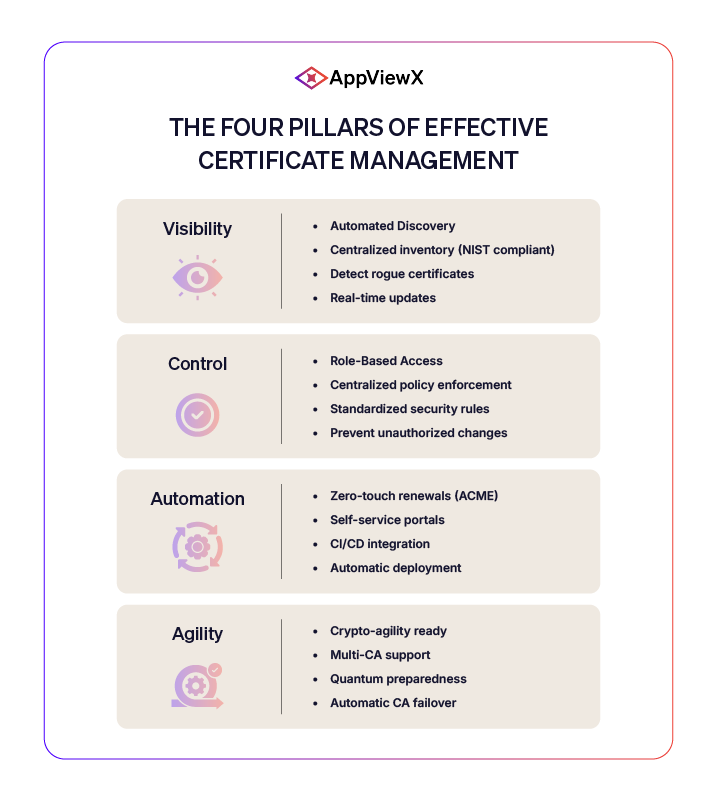
1. Establish continuous visibility
Start with discovery. You can’t manage what you can’t see. Automated discovery finds every certificate across cloud, on-premises, endpoints, and connected devices.
- Eliminate blind spots with continuous discovery: Deploy automated discovery to continuously identify newly issued certificates and flag non-compliant ones, such as self-signed certificates or shadow IT-issued certs, before they become security gaps.
- Build your centralized inventory following NIST guidelines: NIST SP 1800-16 recommends that every organization maintains a centralized certificate inventory that communicates directly with Certificate Authorities. When certificates are added or changed, your inventory updates automatically, no manual tracking required.
2.Enforce policy-based control
Centralized control ensures that your security standards remain consistent, regardless of which team is requesting a certificate.
- Restrict certificate access with RBAC: Deploy Role-Based Access Control (RBAC) to limit who can request or change certificates. Like a master key system for a building, RBAC ensures only authorized personnel handle sensitive security tasks, eliminating accidental changes and unauthorized access.
- Mandate security standards organization-wide: Establish centralized rules to enforce specific encryption strengths and naming conventions across every department. This prevents teams from using outdated or weak security settings and ensures your entire organization follows a single, high-security standard.
3.Implement end-to-end automation
Manual renewals create opportunities for errors, oversights, and missed deadlines. As validity periods shrink, these delays go from being operational setbacks to critical system-wide outages.
- Deploy zero-touch automation: Implement advanced workflows that automate the entire certificate lifecycle from issuance through renewal and last-mile installation. Modern platforms support both ACME-based and API-based automation, ensuring certificates are correctly bound to endpoints without manual intervention.
- Integrate certificate management into DevOps workflows: Build certificate management directly into your development pipelines so security is handled as “code.” This enables technical teams to move fast while ensuring every new service is protected the moment it goes live.
4.Enable operational agility
True resilience means having the flexibility to change your security methods or providers at a moment’s notice without breaking your services.
- Achieve crypto-agility for future threats: Crypto-agility enables you to seamlessly update encryption methods across thousands of certificates, adapt to changing validity periods, and switch between CAs without any disruption.. This capability is critical for adapting to 47-day certificate mandates, becoming “Quantum Ready” with NIST-approved PQC standards, and rapidly replacing certificates during CA distrust events.
- Enable multi-CA support to avoid vendor lock-in: Support multiple Certificate Authorities (CAs) so you’re not dependent on a single provider. If your primary CA provider experiences an outage or business disruption, your system automatically switches to a backup issuer to keep your sites running without interruption.
What to look for when evaluating certificate management solutions
Finding the right platform is no longer just about avoiding expired certificates; it is about building a scalable framework that can keep up with a rapidly changing security landscape. To be effective, a solution must move beyond simple “alerting” to become a central command center for your digital identity.
When evaluating a CLM platform, you should measure its effectiveness based on these factors:
| Capability | Key Features | Why it Matters |
| Multi-CA Support |
|
Prevents vendor lock-in and ensures continuity during CA outages |
| Automated Discovery |
|
Complete visibility across all environments including shadow IT |
| Deployment Automation |
|
Prevents downtime and production incidents from certificate changes |
| Workflow Integration |
|
Aligns with existing change management processes |
| Reporting & Compliance |
|
Demonstrates compliance and drives proactive management |
How AppViewX implements the 4 pillars
AppViewX transforms certificate lifecycle management by delivering all four pillars as a unified platform built specifically to eliminate manual certificate management at scale. Our platform automates discovery across every environment, integrates with multiple CAs, and handles renewals and deployments through zero-touch workflows.
Rather than piecing together separate tools, organizations get visibility, policy enforcement, automation, and flexibility working together from day one.
Continuous Visibility: AppViewX automates discovery across every environment. Cloud, on-premises, containers, endpoints, IoT devices. Discovery runs continuously without manual work. You see every certificate, including the ones your team forgot about.
Policy-Based Control: AppViewX enforces standards at scale. Define policies once. The platform enforces them across thousands of certificates automatically.. No manual deployments. Consistency happens without effort.
End-to-End Automation: Certificates request, validate, and install themselves on schedule through zero-touch workflows. No one remembers dates. No approval chains delay things. No manual steps create errors. Renewal happens automatically every time.
Operational Agility: AppViewX gives you flexibility to change. Switch encryption standards seamlessly. Replace Certificate Authorities without rebuilding anything. Adopt new security requirements when mandated. Update thousands of certificates in hours.
To eliminate the risks of manual management, request a
personalized demo with AppViewX today.
Tags
About the Author

Krupa Patil
Product Marketing Manager
A content creator focused on providing readers and prospective buyers with accurate, useful, and latest product information to help them make better informed decisions.