

Key Takeaways
- AI agents are zero-trust blindspots because they authenticate once but execute actions hours later outside that initial security check, operating autonomously beyond traditional verification controls.
- Most organizations cannot identify how many certificates their agents use or when those credentials expire.
- Traditional zero-trust verifies human users at login, but AI agents execute actions hours or days later outside that initial security check.
- When certificates expire, AI agents fail silently with no alerts, causing cascading business disruptions before operations teams discover the root cause.
- Organizations face regulatory compliance gaps, shadow AI risks, operational disruptions, data exfiltration, and reputational damage due to insufficient governance.
- Machine identity management requires automated discovery to locate credentials, lifecycle management to renew before expiration, and policy enforcement to govern access.
- Manual certificate tracking fails at AI agent scale. Automated discovery platforms prevent outages by continuously scanning infrastructure.
What is zero-trust architecture?
Zero-trust architecture is a security model based on the principle “never trust, always verify.” Unlike traditional perimeter-based security that assumes everything inside the network is safe, zero-trust treats every access request as potentially hostile, regardless of where it originates.
The table below outlines the core components of zero-trust architecture:
| Component | What It Does |
| Continuous verification | Authentication required for every access request |
| Least privilege access | Users receive only the minimum permissions needed |
| Microsegmentation | Networks are divided into small zones to contain breaches |
| Multi-factor authentication (MFA) | Multiple verification forms confirm user identity |
This framework has proven highly effective for protecting against credential theft, insider threats, and unauthorized access. However, zero-trust was designed with human users in mind, and AI agents present fundamentally different security challenges.
AI agent security gaps in a zero-trust architecture
Zero-trust architecture has become the gold standard for enterprise security, built on a foundational principle: never trust, always verify. Organizations have invested heavily in identity governance controls for human users through authentication, access, and behavioral controls. But zero-trust frameworks were created with only human identities in mind.
Traditional zero-trust verifies that authenticated users are the ones accessing data and executing commands. AI agents fundamentally break this assumption because they are invoked by users, but execute actions independently and adapt behavior dynamically.
Security platforms check risk when users interact with applications, but AI agents execute actions later, outside that initial security check. Traditional compliance frameworks cannot monitor or control this trust gap.
For CEOs and founders, this is a modernization priority. Extending zero-trust to AI agents enables secure automation at scale while maintaining the governance controls your organization requires.
What are AI agents, and why do they need different security?
AI agents are autonomous software systems that make decisions and take actions without human intervention. Unlike traditional applications that wait for user commands, AI agents:
- Analyze data and decide what actions to take
- Execute tasks across multiple systems independently
- Operate 24/7 without human oversight
- Adapt their behavior based on outcomes
An AI agent might monitor inventory levels, automatically reorder stock when supplies run low, negotiate pricing with vendors, and update financial systems, all without a human clicking a button. Another agent might analyze customer support tickets, route them to appropriate teams, draft responses, and escalate urgent issues.
Every action an AI agent takes requires authentication. To reorder stock, the agent needs credentials to access the inventory database, the vendor’s API, and the purchasing system. To update customer records, it needs certificates to connect to the CRM. These credentials are digital certificates and API keys that prove the agent is authorized to act.
The certificate visibility crisis
Most organizations cannot answer a simple question: how many certificates are securing your AI agents right now?
Security teams track employee credentials through centralized identity systems. But certificates proliferate invisibly. Development teams provision them. Cloud platforms auto-generate them. Legacy systems accumulate them over the years. Acquired companies bring entire certificate inventories that never get cataloged.
When a certificate expires, there’s no alert in your SIEM. No ticket in your help desk. The AI agent simply stops working. Revenue processing halts. Customer data stops syncing. Automated workflows freeze. Operations teams scramble to diagnose why systems failed, often spending hours before someone realizes a certificate expired three days ago.
The problem compounds with scale. A single AI agent might use a dozen certificates. An organization running hundreds of agents manages thousands of credentials spread across cloud platforms, on-premises infrastructure, and containerized environments. Traditional certificate tracking through spreadsheets or manual audits cannot keep pace.
You need automated discovery that continuously scans your environment and identifies every machine identity before it becomes an outage.
Why manual certificate tracking fails at AI agent scale
Organizations initially manage certificates through spreadsheets, calendar reminders, and manual audits. This approach breaks down completely when AI agents proliferate:
- Spreadsheets become incomplete immediately. Developers provision credentials in cloud environments without logging them. Acquired companies bring certificate inventories that never get cataloged. Auto-scaling creates container instances with fresh credentials automatically. No single source of truth exists across teams.
- Calendar reminders cannot handle distributed renewals. Certificates across multiple platforms have different expiration schedules. Email alerts get ignored or lost in overwhelming volumes. Individual team members cannot track thousands of renewal dates across the infrastructure.
- Manual audits discover problems too late. Scans identify expired certificates only after AI agents fail. Business processes stop before anyone realizes the root cause. Detection gaps last hours or days while teams scramble to diagnose outages.
- Organizational boundaries create blind spots. Security teams set policies, operations teams deploy infrastructure, and development teams build agents. Each group maintains separate inventories. Credentials fall between teams and go untracked as cross-functional coordination fails at scale.
AI agent security risks bypass zero-trust controls
Agents that make autonomous decisions without reliable logging create blind spots. Attackers exploit poor observability to hide data theft or unauthorized actions. According to Gartner research, 40% of enterprise applications will integrate AI agents by 2026, up from less than 5% in 2025.
A single compromised AI agent can steal terabytes of data, manipulate business processes, or poison decision-making systems before security controls detect the breach. Traditional compliance frameworks assume human decision makers. AI agents blur accountability lines.
Zero-trust evolution for the AI agent era
Traditional zero-trust controls weren’t designed for this scale or behavior pattern. The gap between human-focused security and machine identity reality is clear:
| Aspect | Traditional Zero-Trust | Machine Identity-Aware Zero-Trust |
| Focus | Human users | Humans + machines (including AI agents) |
| Authentication | MFA, SSO | Automated certificate management |
| Monitoring | User behavior analytics | Machine behavior + certificate lifecycle visibility |
| Scale | Thousands of users | Millions of API calls from agents |
| Credential Lifecycle | Days to weeks | Hours to minutes (automated) |
Your AI agents need the same rigorous identity verification as your workforce.
Credential management breaks down at scale
Every AI agent needs credentials to authenticate. The explosive growth in AI deployment has created unprecedented certificate sprawl:
- 84% of organizations experienced at least one API security incident in 2024
- Over half of organizations say their most recent significant outage cost more than $100,000
- 20% of outages exceed a cost of over $1 million
Most organizations don’t know how many machine identities they have or where they are. Without central visibility, certificates expire silently, and keys remain unrotated. When an AI agent’s certificate expires, the agent fails silently, taking down critical business processes.
Organizations deploying AI agents at scale need automated discovery for every certificate and API key.
How insufficient AI agent governance impacts businesses
AI agent security failures create measurable business damage across multiple dimensions. The costs extend beyond immediate remediation to include regulatory penalties, operational disruption, and long-term customer trust erosion.
Regulatory compliance gaps
Without a compliant AI agent audit trail, organizations cannot demonstrate to regulators what agents accessed or detected unauthorized campaigns. In financial services, missing traces of autonomous decisions are treated as books-and-records violations.
Without clear decision paths, auditors cannot assess compliance, detect bias, or ensure regulatory obligations are met. This creates legal exposure and reputational damage.
Shadow AI deployment risks
Gartner predicts that by 2030, over 40% of enterprises will experience security incidents from unauthorized shadow AI. GenAI traffic surged 890% in 2024, and Menlo Security reported a 68% surge in shadow AI usage in 2025.
44% of organizations struggle with business units deploying AI without IT involvement. 38% of employees share sensitive work information with AI tools without permission.
The exposure chain includes data pasted into chat interfaces, file uploads to AI platforms, API integrations between SaaS and AI services, and OAuth tokens granting persistent access.
Operational disruption from credential failures
When AI agent credentials expire or become misconfigured, agents fail silently. Organizations discover the failure only after critical processes stop functioning. These disruptions cascade across dependent systems, multiplying downtime costs.
Data exfiltration through compromised agents
Attackers who compromise AI agent credentials gain persistent access to enterprise data. Because agents operate continuously across multiple systems, a single compromised credential enables large-scale data theft that evades traditional detection.
Reputational damage from AI agent incidents
Public AI agent failures erode customer trust immediately. When agents leak customer data, make unauthorized decisions, or cause service outages, the organization appears unable to control its own systems. Competitors exploit these incidents in sales conversations, and customers question whether to continue the relationship.
Without automated certificate management, every new AI agent increases your risk of silent failures and security breaches.

Machine identity management for AI agent security
Forward-thinking organizations are extending zero-trust principles to include machine identity management. This means every AI agent needs a verified, managed identity with automated certificate lifecycle management to prevent credential sprawl and continuous monitoring adapted for machine behavior patterns.
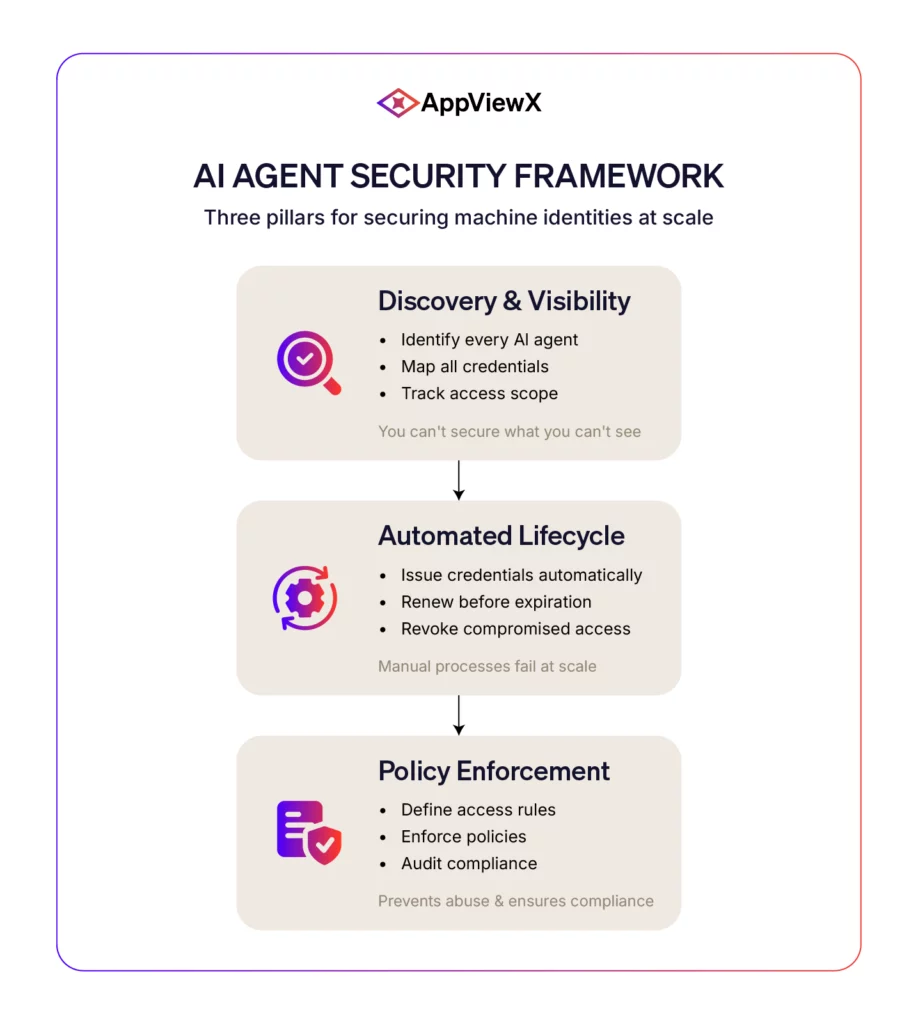
AI agent security framework: discovery, automation, policy enforcement
| Pillar | What It Means | Why It Matters |
| Discovery & Visibility | • Identify every AI agent • Map all credentials • Track access scope |
You can’t secure what you can’t see |
| Automated Lifecycle Management | • Issue credentials automatically • Renew before expiration • Revoke compromised access instantly |
Manual processes fail at AI agent scale |
| Policy Enforcement & Governance | • Define least-privilege rules • Enforce access policies • Audit compliance continuously |
Prevents credential abuse and ensures compliance |
These three pillars work together. Organizations must discover every certificate and API key in their environment, then use automated workflows to manage credentials throughout their lifecycle while enforcing policies that prevent misuse.
How to implement AI agent security controls
Five questions to assess your security posture:
- How many AI agents operate across our infrastructure?
- How are AI agent credentials managed and monitored?
- Do we have visibility into certificate lifecycles for non-human identities?
- What happens when an AI agent’s certificate expires?
- Can we audit every action an AI agent takes?
If your team can’t answer confidently, you have a critical gap in your zero-trust architecture.
Building a machine identity governance framework
Start with inventory through automated discovery. Designate clear ownership. Implement automated certificate management for scale. Establish policy enforcement to govern agent access.
Organizations that implement automated certificate lifecycle management, comprehensive discovery, and policy enforcement gain a competitive advantage through secure AI deployment. Those that don’t will respond to breaches they never saw coming.
Secure AI agents with AppViewX
AppViewX delivers automated discovery, lifecycle management, and policy enforcement for machine identities at AI agent scale. Eliminate manual tracking, prevent certificate-related outages, and maintain complete visibility across your infrastructure.

Tags
About the Author

Ganesh Mallaya
Global Field CTO
Enabling businesses to design, engineer and deploy automation and Digital trust management solutions.