




Key takeaways
- TLS renewals are dropping from yearly to every six weeks, pushing enterprises toward automation that keeps operations stable and, in turn, makes SOC 2 Type II compliance easier to demonstrate.
- SOC 2 Type II requires proof that your security controls worked consistently over an extended observation period, not just that they existed.
- Without automation, missed renewals, inconsistent key rotation, and unmanaged certificates become the gaps that SOC 2 Type II audits expose
- Full environment discovery, automated renewals, policy enforcement, and audit-ready reporting are the baseline capabilities any certificate automation platform needs.
By 2029, TLS certificates will have a maximum validity of 47 days. Renewals that once happened annually now need to happen every few weeks. Sustaining that frequency manually would be a monumental task and may result in security failures that a company seeking a SOC 2 Type II certification cannot afford.
The Shrinking TLS Certificate Lifespan Problem
The CA/Browser Forum reduced maximum TLS certificate validity from 825 days to 398 days in 2020. Now, with Ballot SC-81, validity drops to 47 days starting in 2027 for Apple platforms and 2028 industry-wide. The math is unforgiving.
Behind the shrinking lifespans is a bigger shift: certificate management has crossed from periodic IT work into a continuous operational discipline.
An enterprise managing 1,000 certificates today performs roughly 920 annual renewals. At 47-day validity, that number jumps to 7,766 renewals per year, more than 21 renewals every single day. At this volume, manual processes will miss renewals. Missed renewals mean outages, and during a SOC 2 observation period, they mean control failures too.
- 398-day validity (current standard): 920 annual renewals per 1,000 certificates, averaging 2.5 renewals per day
- 47-day validity (2027-2028): 7,766 annual renewals per 1,000 certificates, averaging 21.3 renewals per day
Organizations that continue relying on spreadsheets, email reminders, and manual provisioning will face a breaking point. The only sustainable path forward is through automated certificate lifecycle management.
Why certificate management is now a continuous operation
Machine identities are proliferating rapidly
According to the KuppingerCole Leadership Compass for Non-Human Identity Management, machine identities now outnumber human identities by 25 to 50 times in enterprise environments. Every API endpoint, service account, and automated process requires a certificate. Non-human identities grew 44% year-over-year, transforming what used to be occasional infrastructure updates into a continuous operational requirement.
Crypto-agility requirements are increasing
The 47-day mandate isn’t happening in isolation. NIST finalized the first post-quantum cryptographic standards (FIPS 203, 204, and 205) in August 2024. The European Commission’s roadmap calls for PQC transition to begin by end of 2026, with critical-infrastructure protection complete by 2030. UK NCSC guidance targets full migration by 2035.
Replacing every quantum-vulnerable certificate across an enterprise within those windows requires the same operational capability that 47-day renewals demand: discover what you have, replace at scale, validate the change, and prove it happened. The infrastructure you build for one prepares you for the other. That’s why crypto-agility, the ability to swap algorithms, CAs, and key types quickly across a distributed estate, has moved from a nice-to-have to the baseline assumption for modern PKI programs.
Where SOC 2 Fits in a Continuous Compliance World
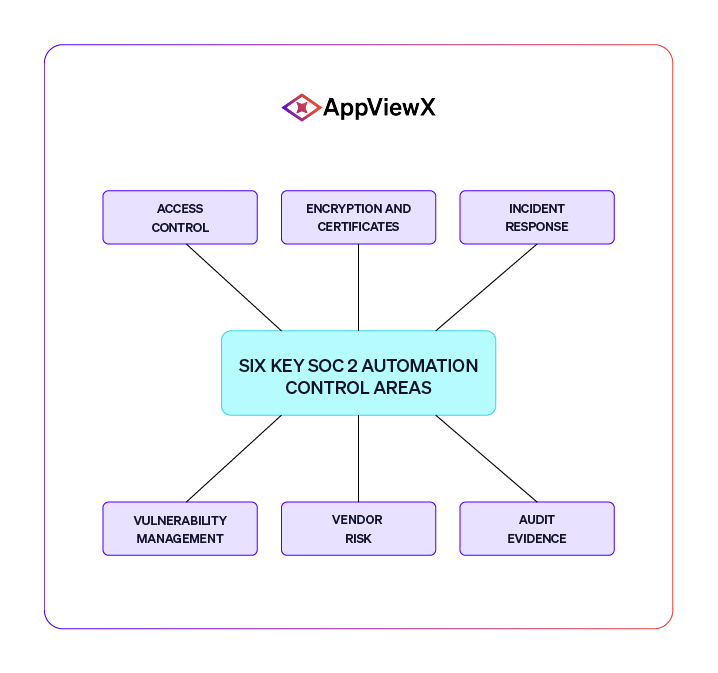
SOC 2 doesn’t require certificate automation or prescribe a specific tool. It’s a principles-based framework built on the AICPA’s Trust Services Criteria, and what it asks for is proof that your controls held up across the entire observation period.
That expectation isn’t unique to SOC 2. ISO 27001, PCI DSS v4.0, DORA, and the NIS2 Directive have all moved toward continuous evidence over point-in-time snapshots. For certificate operations, auditors are looking for a consistent set of artifacts:
- A complete inventory across hybrid and multi-cloud environments
- Timestamped evidence of renewals — when, by whom, against what policy
- Key rotation history that can be traced end-to-end
- Policy enforcement that’s verifiable in practice
These artifacts don’t get assembled before an audit. They’re produced when certificate operations are running well. A program built for operational resilience generates SOC 2 evidence as a byproduct, turning the audit into a confirmation rather than a separate project.
The risks of managing certificates manually
For early-stage teams, manual certificate management usually starts as a spreadsheet, a calendar reminder, or someone on the engineering team keeping track. It works until it doesn’t. And when it breaks, it tends to break at the worst possible time, right when an auditor is asking for evidence.
-
Expired certificates
With renewals now happening far more frequently across a growing number of cloud services, the window for human error is wide open. A missed renewal means service disruption, broken integrations, and customer-facing outages. During a SOC 2 observation period, it also becomes a documented control failure that auditors will flag, regardless of how well everything else was managed.
-
Inconsistent key rotation
Every certificate has an encryption key behind it, and stale keys are a security exposure. When rotations are tracked manually, it’s easy for them to happen late, get skipped entirely, or simply go unlogged, leaving weak key hygiene across your environment. The same gaps also give SOC 2 auditors a reason to flag your controls as unreliable.
-
No audit trail
Without comprehensive logs, you can’t trace incidents, investigate misconfigurations, or prove who did what across your certificate estate. That operational opacity becomes a compliance problem too: SOC 2 Type II requires evidence of who renewed each certificate, when, how, and whether it met your defined security policies. Manual processes rarely produce that level of documentation consistently.
-
Gaps in coverage
In a multi-cloud environment, certificates live across dozens of services, load balancers, APIs, and internal systems. Manual tracking almost always misses something, and every unmanaged certificate is a security blind spot in your infrastructure. Unmanaged certificates are also one of the most common reasons companies fail SOC 2 reviews.
What operationally resilient certificate management looks like
If continuous operations are the new baseline, the question shifts from “how do we avoid mistakes” to “what does a certificate program actually need to do.” A few capabilities are now table stakes.
| Capability | What it covers |
| Discovery across the whole estate |
|
| Closed-loop, zero-touch renewal |
|
| Policy enforcement as code |
|
| Audit-ready reporting |
|
When evaluating platforms, a useful test is to ask how the system handles renewal failure modes, not just the happy path. Closed-loop automation should validate deployment, roll back on failure, and surface anomalies before they become outages. The same logs and policy enforcement that keep operations running also produce the audit evidence SOC 2 Type II requires, generated as a byproduct rather than assembled before each audit.
Getting started with certificate automation
Automation doesn’t have to start as an all-or-nothing implementation. Most organizations begin by automating discovery and monitoring, then progressively add renewals, policy enforcement, and audit reporting as confidence builds. Here’s a practical roadmap to get started:
Step 1: Audit your current certificate inventory: Run a discovery scan across your infrastructure to identify every certificate in use. Check cloud environments, on-premises servers, load balancers, and APIs. Document what you find and where gaps exist.
Step 2: Set up automated monitoring: Configure alerts for certificates expiring within 30, 15, and 7 days. This creates your safety net before implementing full automation.
Step 3: Integrate with your Certificate Authority: Connect your automation platform to your CA with API access. Test the integration with a non-critical certificate first.
Step 4: Automate renewal workflows: Start with low-risk environments like dev or staging. Configure automatic renewal triggers at 30 days before expiration. Validate that renewals are completed successfully before expanding to production.
Step 5: Enable policy enforcement: Define your certificate standards (key length, algorithm, validity period). Configure your platform to reject or flag any certificate that doesn’t meet these requirements.
Step 6: Implement audit logging: Enable comprehensive logging for every certificate action: issuance, renewal, revocation, and key rotation. Ensure logs are immutable and timestamped for audit evidence.
How certificate automation supports SOC 2 compliance
As certificate lifespans shorten, the only practical way to stay on top of renewals, documentation, and audit evidence is through automation. Here’s what that covers:
Certificate automation checklist
| What to Automate | Why It Matters |
| Certificate discovery | Eliminates blind spots across your infrastructure and gives auditors complete environment coverage |
| Automated renewals | Prevents outages from missed renewals and closes the evidence gaps that fail SOC 2 Type II audits |
| Policy enforcement | Keeps every certificate to the same security standard and reduces compliance drift |
| Key rotation | Maintains strong key hygiene with a traceable, timestamped history |
| Audit-ready reporting | Produces operational and compliance evidence without manual effort |
| Anomaly alerts | Catches misconfigurations before they become outages or audit findings |
How to choose the right certificate automation platform
Not all certificate management platforms are built for operational resilience at modern renewal volumes. For founders evaluating options, the difference between a tool that helps you pass an audit and one that just manages renewals comes down to a few specific capabilities.
| Must-Have | Nice-to-Have |
| Full environment discovery across multi-cloud and hybrid infrastructure | Crypto resilience scoring |
| Automated renewals with zero manual intervention | Pre-built integrations with DevOps toolchains |
| Audit-ready reporting with timestamped logs | Self-service workflows for developer teams |
| Policy enforcement across all certificate types | Post-quantum cryptography readiness |
| Key management with documented rotation history | Kubernetes and container security support |
| Alerts for expiring or misconfigured certificates | Multi-CA support and CA-agility |
The must-haves are non-negotiable for SOC 2 Type II. Without full discovery, you have blind spots. Without automated renewals, you have evidence gaps. Without audit-ready reporting, you’re building your compliance case manually every single cycle. The nice-to-haves matter as your security program matures, but they shouldn’t drive your initial buying decision.
Automation isn’t just a productivity win, it’s how certificate management stays operationally viable as cycles compress. And because SOC 2 Type II requires proof that your controls are held up every day of the observation period, the same automation that keeps operations running also generates the audit evidence you need.
How AppViewX simplifies SOC 2 certificate automation
AppViewX gives enterprises complete visibility across every certificate in their environment, automates renewals and key rotation before expiry, and enforces consistent policies across all infrastructure. As certificate volumes grow with the 47-day mandate, crypto resilience scorecards give you a live view of your operational posture and PQC readiness. The same platform also generates the timestamped audit evidence SOC 2 Type II requires, so compliance becomes a natural output of running certificate operations well.
Tags
About the Author

Ganesh Mallaya
Global Field CTO
Enabling businesses to design, engineer and deploy automation and Digital trust management solutions.