



Key takeaways
- Three changes were shipped on May 13, 2026, and one deadline is non-negotiable. The tlsclient profile shuts down July 8, 2026. If you have client-auth certificates from Let’s Encrypt in your environment, the inventory and migration work starts now.
- The tlsserver profile moved to 45-day certificates. Renewal frequency doubles. Manual workflows that survived at 90 days will fail at 45.
- The classic ACME profile now chains through Generation Y intermediates. Chain verification has to live in your renewal logging, not in a deployment runbook from three years ago.
- This is an industry pattern, not a Let’s Encrypt problem. CA/Browser Forum’s SC-081v3 ballot takes public TLS validity to 47 days by 2029. The next CA’s root migration is already moving.
Three things changed on Let’s Encrypt’s production endpoints on May 13:
- The tlsserver profile dropped to 45-day certificates.
- The tlsclient profile is closing, with a hard cutoff on July 8, 2026.
- The classic ACME profile now chains through Generation Y intermediates.
This blog covers a 90-second recap of the May 8 incident, an operational breakdown of each of the three changes, and where this fits in the broader industry shift toward shorter validity periods.
The May 8 incident, in 90 seconds
Five days before the May 13 changes, Let’s Encrypt halted certificate issuance. At 18:37 UTC on May 8, the acme-v02 endpoint started returning HTTP 503 after engineers spotted a problem with the cross-signed intermediate bridging Generation Y back to Generation X.
Two hours and twenty-eight minutes later, issuance resumed at 21:03 UTC. The fix was a rollback: the tlsserver and short-lived ACME profiles, which had been issued from Generation Y, switched back to Generation X. No end-entity certificates were revoked. Staging endpoints kept running.
The postmortem closed on May 13 at 20:32 UTC. Root cause: the cross-signs were issued without their Extended Key Usage fields. Let’s Encrypt revoked and reissued the affected intermediates, and ACME Renewal Information (ARI) staggered the resulting client renewals across a controlled window.
May 8 left one operational takeaway worth carrying forward: chain verification is no longer a one-time setup check. Roots change. Cross-signs get repaired. Trust stores update on their own schedules. The verification needs to live in your renewal logging, not in a deployment runbook from three years ago.
What changed on May 13?
Three changes shipped together. Let’s Encrypt’s official API announcement covers all three. Here is the operational summary, then the details that matter for your workflows:
| Change | What’s different | When |
| tlsserver profile | Now issues 45-day certificates (down from 90) | May 13, 2026 |
| tlsclient profile | Closed to new ACME accounts | May 13, 2026 (hard cutoff July 8, 2026) |
| Classic ACME profile | Now chains through Generation Y intermediates | May 13, 2026 |
tlsserver profile now issues 45-day certificates
The tlsserver profile is opt-in. Subscribers who want to pressure-test their automation against the 45-day cadence ahead of the industry shift enroll here. Everyone else stays on the classic profile until the broader transition.
The broader transition runs in two scheduled drops. The classic profile moves from 90 days to 64 days on February 10, 2027, then from 64 days to 45 days on February 16, 2028. The 64-day stop in between is the one that breaks things. Processes that auto-renew at the standard one-third-of-validity mark adapt fine. Anything with hardcoded renewal thresholds or calendar-based scheduling hits the new cadence and fails.
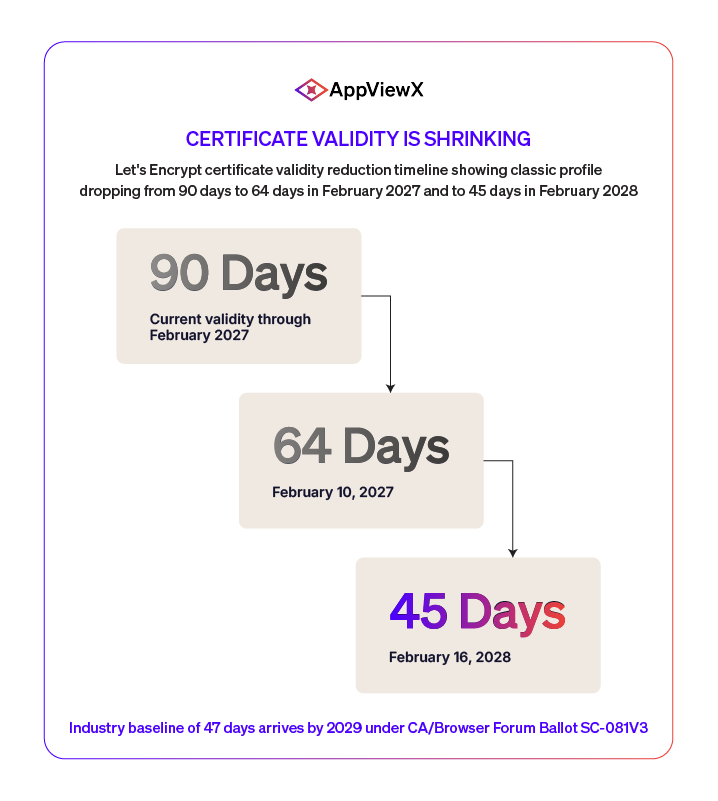
Renewal frequency roughly doubles at 45 days, and the math becomes mechanical: 1,000 certificates at 90-day validity produce 11 renewals per day on average, which doubles to 22 renewals per day at 45 days. The cadence has predictable casualties:
- Quarterly checks stop working at this volume
- Ticket-based renewal workflows stop working
- Runbook steps that someone executes by hand stop working
Automating 47-day certificate lifecycles covers the workflow patterns that survive at this cadence.
tlsclient profile restricted, full removal July 8, 2026
Two cutoffs apply. New ACME accounts can no longer enroll in the tlsclient profile as of May 13, 2026. Accounts already enrolled have until July 8, 2026, after which the profile shuts down entirely, and no further certificates will carry the TLS Client Authentication EKU.
The driver behind the change is structural: Generation Y intermediates do not include the clientAuth EKU, in line with the Google Chrome root program requirement separating TLS server and client authentication into distinct PKIs from June 2026 forward. The tlsclient profile was a temporary migration window for the use cases that depend on the EKU, including mutual TLS, server-to-server authentication in XMPP and similar protocols, and internal applications that gate access on the clientAuth EKU. None of those continue working through Let’s Encrypt after July 8.
That leaves roughly seven weeks of runway, and the inventory and migration work splits into three pieces:
- Inventory. Find every certificate in the environment that carries the TLS Client Authentication EKU. Most enterprises do not know whether they have tlsclient certificates at all because these certs typically live with application teams that deployed them for specific integrations, not with central PKI.
- Identify owners. Internal mTLS, XMPP services, and clientAuth-gated applications rarely surface in standard certificate inventories, which means the owners are not always known. The application team that deployed the certificate is the only source of truth for whether the clientAuth EKU is actually required.
- Migrate. Move the certificates to an alternative CA. For internal mTLS, that typically means a private PKI. For external use cases that require the clientAuth EKU, a commercial public CA.
The fastest path through the inventory step is EKU-filtered certificate discovery across cloud, on-prem, and Kubernetes, surfacing certificates by their EKU configuration rather than hostname or subject alone.
Classic ACME profile now chains through Generation Y intermediates
The default classic profile, which most Let’s Encrypt subscribers use, now issues from the Generation Y intermediate CAs. Generation Y is cross-signed by Generation X, so the chain still terminates at the existing X1 and X2 roots that current trust stores already carry.
Most subscribers will not see anything change because browsers, current operating systems, and recent server software validate the new chain without intervention. The exception is anything running an older or hardcoded trust store, including Cisco Expressway deployments, embedded IoT devices, legacy mobile platforms, and internal services that have not had a trust-store update since the last Let’s Encrypt root rotation. Those environments should be tested against the new chain before the next renewal cycle to confirm that the new intermediates validate cleanly.
The operational shift is that chain verification cannot be a one-time deployment check anymore. Every renewal should log the chain it produced through closed-loop automation, so root migrations stop being surprises and become queryable events in your audit trail.
What this means for your renewal workflows
The May 13 changes are not a Let’s Encrypt problem. They are an early signal of where the industry is going across all CAs. The operational implications cluster into four areas:
- Visibility matters more at 45 days because twice the renewal surface area means twice the failure modes, and what used to be a quarterly problem at 90-day cadence becomes a monthly one at 45. The certificate estate has to be visible by EKU, by CA, by validity period, and by chain rather than only by hostname.
- The July 8 tlsclient cutoff needs an owner today, because this is operational rather than strategic. Someone in your organization has to own the inventory work and the migration plan before the deadline arrives, and the work is not complex so much as unowned in most enterprises.
- Chain verification belongs in renewal logging, with every renewal logging the chain it produced. Once that data exists, root migrations stop being surprises, and the next CA transition becomes a query against your logs rather than a forensic exercise after an outage.
- This is an industry pattern. CA/Browser Forum’s SC-081v3 ballot takes public TLS validity to 47 days by 2029, and the enterprise implications extend across every CA, which means the renewal-workflow disciplines you build now apply to every CA in your estate.
Why certificate operations are becoming infrastructure
The operational bar for certificate management is rising across the industry, and what was acceptable at 90 days is operational debt at 45. Validity periods will keep shrinking, root migrations will keep arriving, and EKU policies will keep tightening, so the pattern is set, whether or not any individual team is ready for it.
Teams that treat certificate operations as infrastructure absorb each change as a configuration update, because their renewals are automated end-to-end, their inventory is real-time and CA-agnostic, and their crypto-agility is a property of the platform rather than a project being run on the side. Teams that treat certificate operations as paperwork live in spreadsheets, ticket queues, and runbooks, which means each CA change becomes a multi-week scramble that no amount of weekend work can shorten.
The 47-day mandate is where the gap compounds, because workflows designed for 90 days do not survive a 45-day cadence, and the time to redesign them is shorter than the deadline allows. The technical changes from May 13 are individually manageable. The deeper question is whether your certificate operations are built as infrastructure or whether they will keep being treated as paperwork through the next round of changes.
How AppViewX helps you stay ahead of CA changes
The renewal workflow disciplines that absorb the May 13 changes are the same ones that handle every CA transition still ahead, which is what makes certificate operations infrastructure rather than paperwork. The AppViewX 47-day mandate solution covers the workflow patterns for shortening validity periods, root migrations, and EKU policy changes across every CA in your estate, with CA-agility at the architecture layer so the platform stays vendor-neutral regardless of which CA you start with or move to next.
The next CA change should arrive as a configuration update rather than a project. To see how AppViewX delivers that posture across your certificate estate, book a demo with an AppViewX expert.
Tags
About the Author

Ganesh Mallaya
Global Field CTO
Enabling businesses to design, engineer and deploy automation and Digital trust management solutions.