

Key Takeaways
- To operate at 47-day certificate validity, replace manual, per-certificate work with centralized, policy-driven automation that applies reusable lifecycle rules across entire certificate groups.
- Split ownership across PKI, infrastructure, and application teams scales poorly once every certificate becomes a recurring operational event.
- Policy inheritance lets one rule set govern renewal timing, validation, deployment, and notifications across thousands of certificates at once.
- Continuous metadata synchronization with supported CAs keeps inventories accurate and closes the visibility gaps that lead to outages.
Digital certificates have quietly become one of the fastest-moving operational dependencies in enterprise infrastructure. As maximum certificate lifespans continue to shrink from 398 days to 47 days, many organizations are discovering that the real challenge is keeping pace with them.
Practices that worked when certificates lasted a year begin to fail when renewals, validations, deployments, and monitoring must happen every few weeks. In a 47-day world, certificate lifecycle management is no longer an occasional operational task. It runs continuously.
Much of the industry discussion centers on shorter validity periods themselves, but the deeper shift is operational. You can’t prepare for 47-day maximum validity periods simply by renewing faster. You need a different operating model, one built on centralized, policy-driven automation rather than manual, certificate-by-certificate work.
Why manual certificate management no longer scales
For years, certificate management evolved around split ownership. PKI teams handled issuance and renewals. Infrastructure teams managed deployment, and application owners provisioned certificates into their services. While far from ideal, this fragmented model was workable when certificates were issued annually.
That model falls apart as validity periods shrink.
At 47-day lifecycles, enterprises effectively live in a permanent renewal state. Every certificate becomes a repeat operational event. Teams must constantly track expirations, coordinate renewals, validate configurations, distribute certificates, and confirm deployments again and again, at far higher frequency. And the difficulty isn’t only the volume, but also the complexity.
Each certificate carries its own lifecycle rules. Renewal windows vary by CA. Validity differs across environments. Some applications demand pre-deployment validation, others require immediate post-renewal distribution. Managing these nuances individually introduces operational sprawl, inconsistency, and eventually outages.
As certificate usage spreads across cloud platforms, load balancers, Kubernetes clusters, APIs, and internal services, stitching together lifecycle operations manually becomes impossible to sustain. The answer isn’t more scripts or bigger operations teams, it’s centralized, policy-driven lifecycle automation.
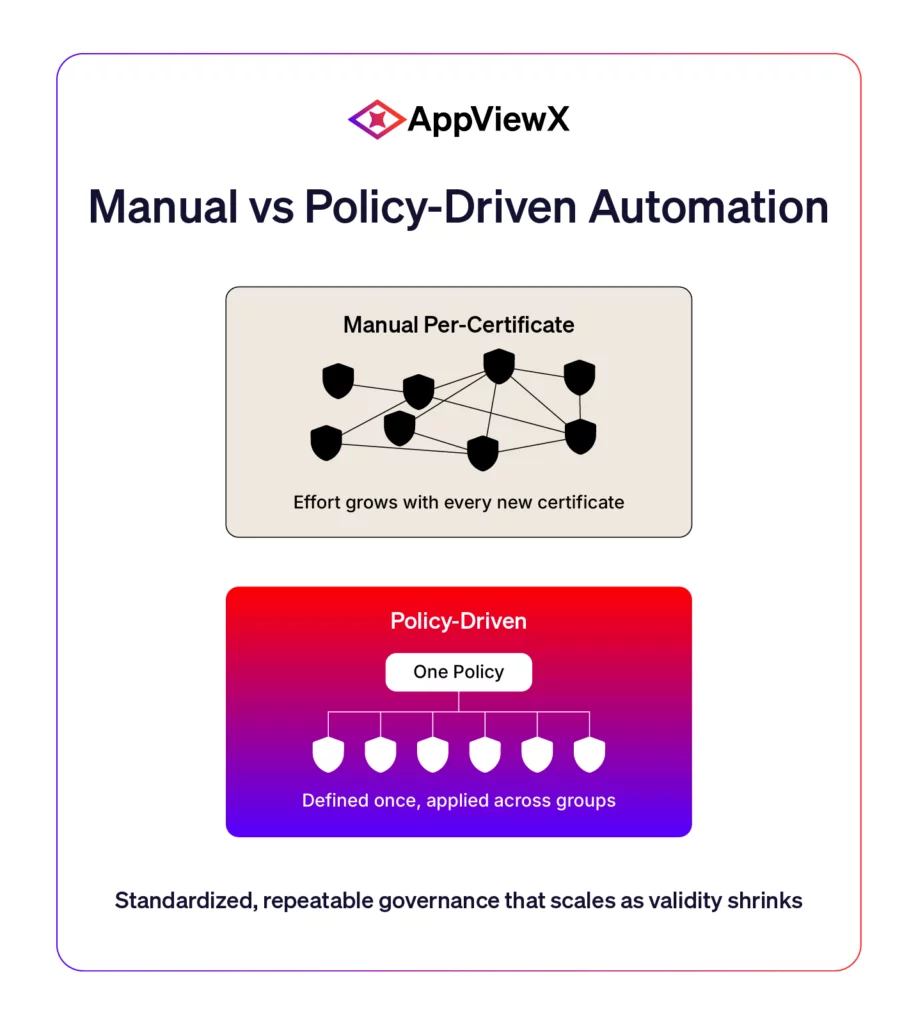
The table below contrasts the two operating models across the dimensions that matter most at a 47-day scale.
| Dimension | Manual, Per-Certificate | Policy-Driven Automation |
| Renewal effort | Grows with every new certificate | Defined once, applied across groups |
| Consistency | Varies by administrator and environment | Standardized through inherited policy |
| Visibility | Fragmented across teams and tools | Centralized inventory synced with CAs |
| Scalability | Breaks down as cadence increases | Scales naturally as validity shrinks |
| Risk of outage | Rises with volume and human error | Reduced through repeatable governance |
Introducing policy-driven lifecycle automation
AppViewX’s Summer 2026 product release introduces Policy-Driven Lifecycle Automation, designed to help organizations shift from certificate-centric work to policy-centric operations.
Instead of defining lifecycle behavior for every certificate, administrators define reusable lifecycle policies. These policies govern renewal timing, validity settings, approval workflows, deployment actions, failure handling, and notifications, all from a central control plane.
This fundamentally changes how certificate operations work.
Certificates stop being isolated objects to be managed one by one. Instead, organizations define standard lifecycle rules once and apply them broadly across environments, so a single policy can determine how renewals occur, how exceptions are handled, and who gets notified across hundreds or thousands of certificates.
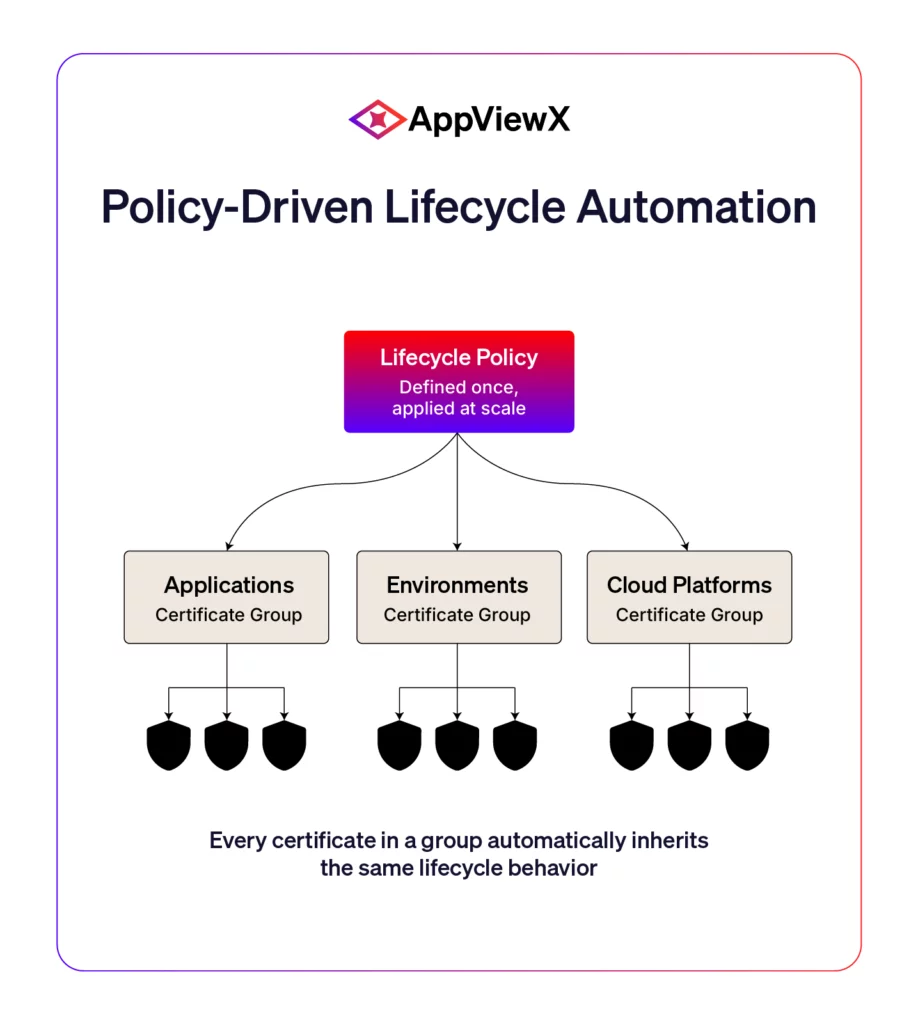
Policies can be assigned to certificate groups that mirror real operational structures: applications, environments, business units, cloud platforms, or ownership boundaries. Once applied, every certificate in that group automatically follows the same lifecycle behavior.
How policy-driven lifecycle automation works
The Policy Engine simplifies lifecycle management by turning operational intent into reusable automation.
Administrators define lifecycle policies that may include:
- Certificate validity settings
- Approval and governance workflows
- Change the windows that define when automation runs
- Automation triggers
- Notification and escalation rules
These policies are then associated with certificate groups rather than individual certificates, and those groups can represent applications, environments, platforms, or organizational boundaries.
Once assigned, certificates automatically inherit lifecycle policies, which keep behavior consistent across environments while dramatically reducing administrative effort.
In parallel, metadata synchronization continuously pulls updated information from supported CAs, so inventory views stay accurate, complete, and aligned with CA records, removing blind spots created by fragmented visibility.
Together, policy inheritance and CA synchronization create a scalable automation framework that centralizes governance without sacrificing operational accuracy.
The business outcome: Operational scalability
Policy-driven lifecycle automation delivers more than incremental efficiency gains. It creates a scalable operational foundation for modern certificate management.
By replacing per-certificate operation with centralized policies, organizations significantly reduce manual effort and coordination overhead. Lifecycle behavior becomes predictable and standardized, rather than dependent on individual administrator actions.
Metadata synchronization reinforces that reliability by keeping certificate inventories aligned across supported CAs, which eliminates reconciliation gaps and outdated records.
Most importantly, this model scales naturally as validity periods keep shrinking.
Organizations preparing for 47-day certificates can’t rely on processes designed for yearly renewals, and policy-driven lifecycle automation provides the governance, repeatability, and visibility needed to operate at modern renewal frequencies.
This is how enterprises achieve sustainable 47-day readiness, not by working faster, but by letting policy drive automation.
Getting started
Policy-Driven Lifecycle Automation is available as part of the Summer 2026 AppViewX release. Organizations can get started by engaging their AppViewX Customer Success team or exploring implementation guidance and best practices through the 47-Day Readiness Hub.

Tags
About the Author

Jeevan Krishna Murthy
Product Solutions Architect
A product solutions Architect responsible for designing and executing customer and technology solutions with CERT+.