

Key takeaways
- Encryption key management is the set of controls that govern cryptographic keys throughout their lifecycle. It establishes who can access each key, where it resides, and how long it remains in use.
- Keys pass through six lifecycle stages: generation, distribution, storage, usage, rotation, and destruction.
- Strong key management rests on five principles: least privilege, separation of duties, centralized visibility, audit logging, and keeping keys out of code.
- Quantum computing is expected to break today’s widely used public-key encryption algorithms like RSA and ECC, and data harvested now can be decrypted once the capability exists. Crypto-agility keeps your encryption ahead of that threat.
- Layering keys so that each one is protected by another above it (DEK, KEK, MEK) ensures a single exposed key never unlocks everything.
- Where keys live shapes how well they are protected: HSMs offer the highest assurance, vaults scale flexibly for everyday workloads, and escrow preserves recoverability if a key is lost.
- A CLM platform replaces manual key handling with automation that scales as your environment grows.
Every piece of data you encrypt is only as safe as the key that locks it. Encryption key management is how you govern those keys across their entire life, from creation to retirement.
The best approach is to establish centralized visibility, governance, and lifecycle control over all keys, regardless of where they reside.
Understanding encryption key management
An encryption key is a string of characters used to scramble data so only someone with the matching key can read it. Lose control of that key and the protection it provides disappears, which is why the key itself needs as much care as the data it secures.
Key management covers the entire lifecycle of a cryptographic key, not just generating it. Think of it as inventory control for your most sensitive assets, where knowing exactly what you have keeps your data protected and your services running.
The goal: the right key, in the right place, available to the right system, for exactly as long as it is needed and no longer.
The six stages of the key management lifecycle
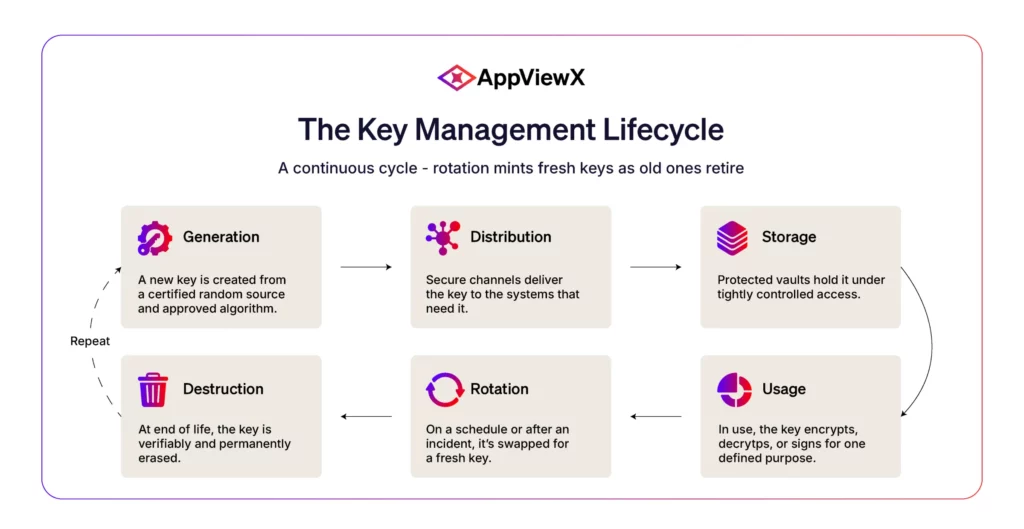
Every key moves through six stages. Handling each one deliberately, with clear ownership and automation where possible, is what keeps keys secure across their lifecycle.
- Generation: Keys are created from a certified random source using approved algorithms. This is the foundation, since weak or predictable generation undermines everything that follows.
- Distribution: Keys are delivered securely to the systems that need them. Keys in transit are a prime interception target, so the handoff has to be protected end to end.
- Storage: Keys are held in protected locations with strict access controls. Most key compromises trace back to poor storage, which makes this stage one of the highest priorities.
- Usage: Keys encrypt, decrypt, or sign, each scoped to a single purpose. Reusing one key across many functions widens the impact if it is ever exposed.
- Rotation: Keys are replaced on a set schedule or after a security event. Regular rotation limits how much data any single key ever protects.
- Destruction: Retired keys are securely and verifiably erased. A forgotten old key is a quiet liability, so removing it cleanly closes the loop.
The thread running through all six is control: always knowing which keys exist, where they are, who can use them, and when they change.
The DEK, KEK, and MEK key hierarchy
Mature programs almost never protect data with a single key. They use a layered hierarchy, where each layer protects the one below it:
- Data Encryption Key (DEK): encrypts your actual data. Numerous and rotated often.
- Key Encryption Key (KEK): encrypts and protects your DEKs so they can be stored safely.
- Master Encryption Key (MEK): the top of the chain. Usually held in hardware, it protects the KEKs.
This pattern is called envelope encryption, and the payoff is containment. If a DEK is compromised, you replace only that key rather than re-encrypting everything, while the MEK rarely changes and stays protected.
The five principles of strong key management
While specifics will vary by organization, effective key management consistently rests on five core principles:
- Least privilege: Grant each person and system access only to the keys required for their role. Limiting the number of people and services with access to any given key reduces the opportunities for it to be exposed or misused, and contains the impact if a single account is ever compromised.
- Separation of duties: No individual should be able to create, approve, and use a key on their own. Dividing those responsibilities across different people or systems ensures no one person holds complete control, which guards against both unintentional errors and deliberate misuse.
- Centralized visibility: Maintain a single, complete inventory of every key in use rather than relying on guesswork. A key that has been overlooked cannot be protected or rotated, and overlooked keys are a frequent source of risk. A unified view across all environments is what allows you to remain in control as the number of keys increases.
- Audit logging: Maintain a clear record of which keys were used, by whom, and when. Should an issue arise, these records allow you to establish exactly what occurred, and they provide the evidence needed to demonstrate effective controls to auditors and customers.
- No keys in code: Keys should never be stored directly within applications, scripts, or configuration files, where they are easily exposed. Keeping them in a secure, dedicated store removes that exposure and allows you to rotate or retire them independently of your code.
Together, these keep access tight, accountability clear, and your keys under control as you grow.
HSM vs vault vs escrow: where should your keys live?
Where you store keys sets the ceiling on your security assurance. Three models dominate, and most teams use a mix:
HSMs
A Hardware Security Module is a tamper-resistant device that generates and uses keys without ever exposing them in plaintext. It offers the highest assurance and is often required for regulated workloads and top-tier keys like your MEK. The trade-off is cost and overhead.
Vaults
A vault is a software-based secrets manager with access policies, encryption at rest, and audit trails. Cloud vaults scale easily, which makes them a natural fit for DEKs and high-volume keys. Many teams pair a vault with an HSM that protects the vault’s own master key.
Key escrow
Key escrow stores a secure backup copy of a key so it can be recovered if the original is lost. It solves a real problem, but a backup key is still a working key, so the recovery path must be tightly governed.
| Model | Best for | Assurance | Trade-off |
| HSM | Master keys, regulated workloads | Highest | Higher cost and overhead |
| Vault | DEKs, high-volume cloud keys | High | Depends on the config discipline |
| Escrow | Recoverability and continuity | Varies | Adds a recovery path to govern |
Most teams do not pick just one model. They use HSMs for their most sensitive keys, vaults for everyday workloads, and escrow where recoverability matters, then manage all of it from one place so nothing slips through the cracks.
PQC and the future of key management
Key management is undergoing its most significant shift in decades, driven by two developments at once: shorter certificate lifespans and the arrival of post-quantum cryptography.
In August 2024, NIST finalized the first post-quantum standards, FIPS 203, 204, and 205. FIPS 203 (ML-KEM) is built to replace today’s vulnerable key exchange and key transport methods like RSA and ECDH with quantum-resistant versions.
The public-key encryption securing most data today is expected to become vulnerable once quantum computing matures. The risk is not only future data. Sensitive information captured today can be stored and decrypted later once quantum hardware is powerful enough to break the encryption. In practice, that means the keys and algorithms you choose now have a shelf life, and organizations need a clear plan to move to quantum-safe options before the threat becomes real.
That is why crypto-agility, the ability to discover, rotate, and replace keys and algorithms on demand, is becoming a competitive advantage rather than a compliance exercise. The organizations that can identify each one in use and swap them without disruption will absorb this transition far more smoothly than those managing it by hand.
How keys relate to certificates and machine identities
Keys do not live in isolation. Every TLS certificate is bound to a key pair, and every machine identity (a server, container, device, or workload) uses those keys to prove it is what it claims to be.
Managing them together makes it easier to stay in control:
- When a certificate renews, its key may rotate
- If a key is compromised, the certificate tied to it has to be revoked and reissued
- Managing both in one workflow gives you a single, accurate view of every key and certificate you have
How CLM simplifies key management
Keys and certificates are closely linked, so managing them on the same platform makes practical sense. A certificate lifecycle management (CLM) platform brings both under one roof, which turns the principles and stages covered above from manual effort into a managed, repeatable process.
Concerns like visibility, access control, rotation, and audit are all easily addressed through a CLM platform:
| Concern | What a CLM does | Impact |
| Visibility | Discovers all certificates and associated keys | Nothing goes unseen |
| Rotation | Automates rotation at scale | No manual effort |
| Access control | Enforces role-based policies | Only the right access |
| Storage | Integrates with HSMs and vaults | Keys stay where they belong |
| Audit | Logs every action | Records ready on demand |
| Crypto-agility | Swaps keys and algorithms fast | Smooth PQC transition |
Consolidating onto one platform reduces outages, cuts manual work, and gives you the crypto-agility to adapt as requirements change.
How AppViewX delivers key management at scale
AppViewX brings key management together on a single platform, covering the full lifecycle, storage, governance, and crypto-agility:
- Certificate and key lifecycle automation: discovery, provisioning, rotation, and renewal across cloud, on-premises, and hybrid environments
- SSH key lifecycle management: the same control extended to SSH keys, eliminating sprawl and enforcing policy at scale
- HSM and vault integration: support for the DEK, KEK, and MEK hierarchy so your most sensitive keys stay protected in hardware
- Secure key escrow: private keys encrypted at rest with the master key held separately
- Built-in governance: role-based access control, automated audit logging, and centralized visibility that put strong key management principles into practice by default
- Crypto-agility and PQC readiness: the inventory and automation to adopt new standards as they arrive rather than scrambling to catch up
See how AppViewX delivers the visibility, automation, and crypto-agility your key management strategy demands.

Tags
About the Author

Krupa Patil
Product Marketing Manager
A content creator focused on providing readers and prospective buyers with accurate, useful, and latest product information to help them make better informed decisions.