



Key takeaways
- Agent Identity Security manages AI agents as their own identity class, with dedicated discovery, ownership, and access controls.
- AI agents act autonomously, run briefly, and often share credentials, so their access follows machine logic.
- Agent risk concentrates in three places: the permissions an agent holds, the inputs that reach it, and the authority chain behind its actions.
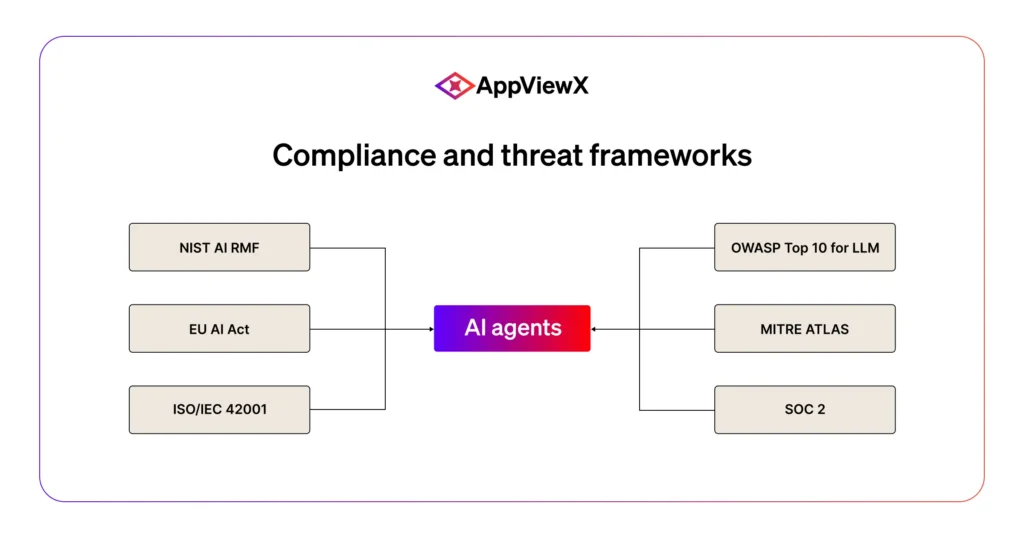
- Established frameworks now apply to AI agents, including the NIST AI Risk Management Framework, ISO/IEC 42001, the EU AI Act, the OWASP Top 10 for Large Language Model Applications, and MITRE ATLAS.
- Managing agents builds on the identity discipline teams already use for people and machines.
Artificial intelligence (AI) agents now operate as a distinct identity type inside the enterprise. This glossary defines the terms security and identity teams use when dealing with AI agents.
What Agent Identity Security means
Agent Identity Security is the discipline of managing AI agents as identities in their own right, so each one is visible to the security team, assigned an owner, and governed by policy.
Four areas define the discipline:
- Risk insights surface how agents behave and what they can reach.
- Policy-based governance sets the rules an agent follows.
- Adaptive agent access adjusts what an agent can do based on its task and behavior.
- Threat detection identifies anomalous activity as it happens.
Agents behave differently from earlier software in ways that shape how they are secured. They start and stop quickly, they authenticate with keys and tokens, they act without a person in the loop, and they reach the systems they use through protocols built for machines.
Why these terms matter now
Individuals can stand up their own agents and Model Context Protocol (MCP) servers with little awareness from the security team, and company information can move outside its expected boundaries as a result. Precise terms give security, identity, and platform teams a common reference for the same agents, the same risks, and the same controls.
Foundational identity terms
These foundational terms place the AI agent among the identities an enterprise already manages:
AI agent
An AI agent is a software actor that plans and carries out tasks using large language models (LLMs) and connected tools, and it can initiate actions on its own. Its reach extends across the systems its tools connect to.
Agentic AI
Agentic AI describes systems in which one or more agents pursue a goal across multiple steps, calling tools and other agents to complete a task. Subagents handle parts of a task under an orchestrating agent.
Non-human identity
A non-human identity (NHI) is any identity that authenticates software in place of a person. The category covers service accounts, application programming interface (API) keys, tokens, workloads, and AI agents.
Machine identity
A machine identity authenticates a machine or workload, commonly through certificates and keys. Managing these identities is part of enterprise identity governance.
Agent identity
Agent identity is the specific, verifiable identity of an individual agent. It ties an agent’s actions to a named owner and a defined scope of access, making attribution possible.
Human identity and AI agent identity
The table below compares human identity and AI agent identity across the attributes that shape how each is governed:
| Attribute | Human Identity | AI Agent Identity |
| Lifespan | Persistent and session-bound | Short-lived and ephemeral |
| Behavior | Bounded and predictable | Autonomous and variable |
| Credentials | Held per user | Often shared across agents |
| Access pattern | Follows human workflows | Runs at machine speed across systems |
| Governance model | Established identity and access management | Emerging and lifecycle-based |
Related identity types
Teams often group the following under one label, and each carries a different credential model and risk.
Service account
A service account is an identity principal used for machine-to-machine authentication. It holds credentials and permissions, and it does not plan or act on its own.
API key
An API key is a static credential string that grants access to a service. It carries no lifecycle of its own, and stays valid until someone rotates or revokes it.
Bot
A bot runs scripted, rule-based automation along predefined steps. Its behavior is fixed by the script it follows.
Workload identity
A workload identity is the attested identity of a running process, issued at runtime as a short-lived cryptographic credential. SPIFFE, the Secure Production Identity Framework For Everyone, defines one widely used standard for workload identity.
Discovery and visibility terms
The following terms cover how agents, their components, and their tool connections are discovered and inventoried:
Shadow AI
Shadow AI refers to agents, models, and MCP servers that run in an environment without the security team’s knowledge or approval. Discovery brings them into a single inventory.
AI Bill of Materials (AIBOM)
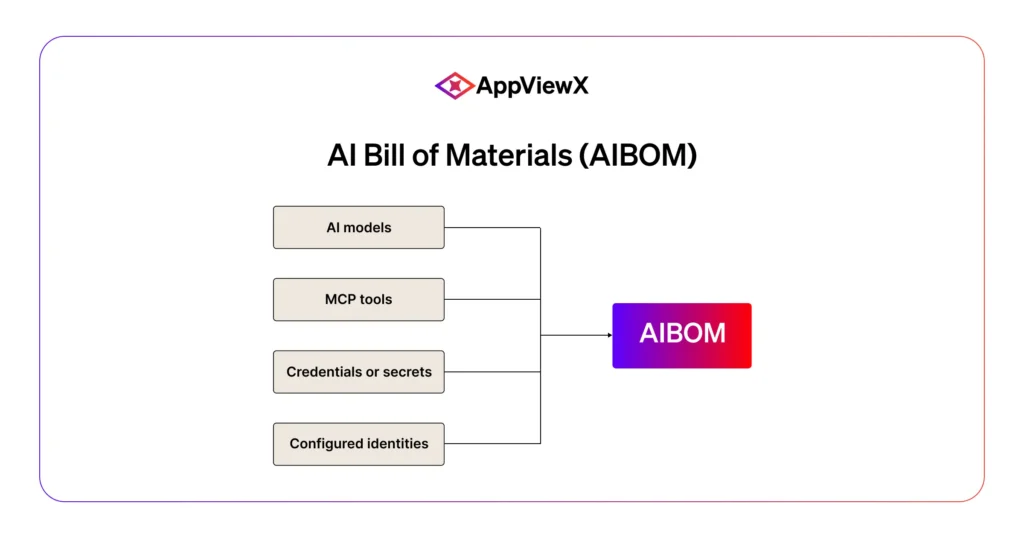
An AI Bill of Materials (AIBOM) is a complete record of every component tied to an agent, covering AI models, Model Context Protocol tools, credentials or secrets, and configured identities. It gives teams a per-agent view of the supply chain behind each agent’s actions.
Model Context Protocol (MCP)
The Model Context Protocol (MCP) is an open protocol that connects AI applications to external tools and data.
MCP server
An MCP server exposes tools, the AI application or client invokes them, and a workload executes the call under a machine identity. The set of servers an agent uses defines much of its reach, so their sanction status is tracked as part of agent posture.
MCP gateway
An MCP gateway is a control point in the path of MCP traffic. It provides visibility into which tools agents connect to and supports policy on those connections.
Access and governance terms
These terms set what an agent can do, gate its path to production, and track it at runtime:
Least-privilege access
Least-privilege access restricts an agent to only the tools and data its task requires.
Just-in-time access
Just-in-time access grants an agent permissions only for the moment a task needs them, then removes them, so no standing access builds up between tasks.
Task-based access
Task-based access ties an agent’s permissions to the specific task it performs, so its access shifts as its work does.
Task-based access
Task-based access ties an agent’s permissions to the specific task it performs, so its access shifts as its work does.
Guardrails
Guardrails are controls applied automatically to an agent that touches sensitive systems, giving it defined, auditable boundaries. They take effect once an agent is approved for production.
Human-in-the-loop approval
Human-in-the-loop approval routes an agent action to a person for review before it proceeds. Approvals and alerts reach reviewers through tools such as ServiceNow, Slack, and Microsoft Teams.
Agent kill switch
An agent kill switch stops a running agent immediately, on demand or by policy. Teams use it to halt an agent whose behavior calls for intervention.
Agent lifecycle management
Agent lifecycle management governs an agent from registration through decommission. Before an agent reaches production, it passes through an approval workflow for security review.
Agent posture
Agent posture is a continuous assessment of each agent against a configurable set of posture detectors, including ownership, credential hygiene, MCP server sanction status, model drift, and system prompt changes. Posture assessment produces evidence that maps to compliance controls.
Continuous monitoring
Continuous monitoring assesses agents at runtime. Because LLMs are nondeterministic, an agent that looks compliant during evaluation can behave differently in production, so assessment continues while it runs.
Risk and attack vocabulary
The terms below name the failure modes teams design against in agent systems:
Excessive agency
Excessive agency is the risk that an agent holds more functionality, permissions, or autonomy than its task requires, letting it take damaging actions. It appears as LLM06 in the OWASP Top 10 for Large Language Model Applications.
Prompt injection
Prompt injection is an attack in which untrusted input redirects an agent to take an action its operator did not intend. It holds the top position, LLM01, in the OWASP Top 10 for LLM, because models process instructions and data in the same channel.
Jailbreaking
Jailbreaking coaxes a model into producing output that its safety guidelines disallow. It targets the model’s built-in content restrictions.
Confused deputy
The confused deputy problem occurs when an agent uses its own legitimate authority to carry out an unintended action. The agent holds the permission, and the request takes advantage of it.
Authority laundering
Authority laundering describes delegated authority passing through enough agent-to-agent hops that its origin and accountable owner become hard to reconstruct. It erodes attribution across a chain of agents.
Lethal trifecta
The lethal trifecta describes the combination of access to private data, exposure to untrusted content, and the ability to communicate externally. When one agent holds all three, the risk of data exfiltration rises.
Secrets sprawl
Secrets sprawl is the spread of credentials such as keys and tokens across code, systems, and agents faster than teams can track or rotate them. Unrotated and shared credentials add to the attack surface.
Trust and credential terms
Agents authenticate with credentials, and trust signals let identity and security systems respond when a credential or its access changes.
Credential
A credential is the secret an identity uses to authenticate, such as a password, key, token, or certificate. Agents carry credentials to reach the resources they act on.
OAuth token
An OAuth token is an access credential issued under the OAuth 2.0 authorization framework that agents commonly use to access APIs and SaaS data. A stolen token grants an attacker the access the token represents.
PKI
PKI, or public key infrastructure, issues and manages the certificates and keys that let machines and workloads authenticate. Agents that present certificates depend on it for trust.
Post-quantum cryptography
Post-quantum cryptography refers to algorithms built to resist attacks from quantum computers, which matters for credentials that must stay trustworthy for years.
Shared Signals Framework
The Shared Signals Framework (SSF), finalized on August 29, 2025, defines how cooperating systems exchange security signals and events. Identity providers and security tools use it to share status changes in a common format.
Continuous Access Evaluation Profile (CAEP)
The Continuous Access Evaluation Profile (CAEP), a profile of SSF finalized the same day, lets identity events trigger real-time changes to access. When an employee leaves, their agents can transfer to a manager, and when an account is compromised, the risk posture of that user’s agents can rise.
Open Cybersecurity Schema Framework (OCSF)
The Open Cybersecurity Schema Framework (OCSF) normalizes event data into a common schema. Agent events emitted in OCSF format flow into existing security information and event management (SIEM) tools such as Splunk, Microsoft Sentinel, and Datadog without custom parsers.
Compliance and threat terms
Agent governance aligns with named external frameworks.
NIST AI RMF
The NIST AI Risk Management Framework (AI RMF) is a voluntary framework built around four functions: govern, map, measure, and manage. Teams use it to structure how they identify and manage AI risk.
EU AI Act
The EU AI Act sets legal obligations for providers and deployers of AI systems in the European Union. Obligations for general-purpose AI models became applicable on August 2, 2025.
ISO/IEC 42001
ISO/IEC 42001, published in 2023, is the first management system standard for governing AI. It defines how an organization sets up, runs, and improves an AI management system.
SOC 2
SOC 2 is an examination against the AICPA Trust Services Criteria. Its controls are often extended to cover how agents access data, which produces evidence relevant to SOC 2 examinations.
OWASP Top 10 for Large Language Model Applications
The OWASP Top 10 for Large Language Model Applications ranks the top risks in LLM and agent systems, including prompt injection and excessive agency. Security teams use its rankings as a reference point for AI risk.
MITRE ATLAS
MITRE ATLAS is a knowledge base of real-world adversary tactics and techniques used against AI and machine learning systems.
Frameworks for governing AI agents
The table below maps each framework to its focus for agents:
| Framework | Body | Focus for AI Agents |
| NIST AI RMF | NIST | Govern, map, measure, and manage AI risk |
| EU AI Act | European Union | Legal obligations for AI providers and deployers |
| ISO/IEC 42001 | ISO and IEC | Management system for governing AI |
| OWASP Top 10 for LLM | OWASP | Ranked risks, including excessive agency and prompt injection |
| MITRE ATLAS | MITRE | Adversary techniques against AI systems |
| SOC 2 | AICPA | Trust services controls often extended to agent access |
How AppViewX secures agent identity
AppViewX Agent Identity Security discovers agents across connected platforms, builds an AIBOM for each, monitors posture against compliance controls, governs which agents reach production, and detects threats as agents act. Every agent runs with a known identity, an owner, and controlled access.

Tags
About the Author